The difference between OEM, ODM, private label, and white label comes down to one question: who owns the design. With OEM you hand the factory your own design and it builds to spec. With ODM you pick from the factory’s existing designs and modify them. Private label puts your brand exclusively on a product built for you. White label puts your brand on a product dozens of other sellers also carry. Everything downstream — minimum order quantity, unit cost, lead time, tooling fees, IP ownership, and whether a competitor can sell the identical item — follows from that single distinction.
Buyers rarely get this explained cleanly. Suppliers use the four terms loosely, often interchangeably, and the result is that brands sign up for a model that does not match what they actually need. A first-time Amazon seller pays for custom tooling they did not need. An established brand accidentally buys a white-label item already saturating the marketplace. Both outcomes are avoidable once the four models are separated properly.
This guide to OEM vs ODM pet products defines each model precisely, compares them across the eight variables that actually change your P&L, and gives you a decision tree you can run in twenty minutes. Where we quote numbers that reflect our own terms at CuteEye, we say so explicitly. Where we quote typical industry ranges, we label them as such — those figures are what sourcing teams commonly encounter across Chinese pet-product suppliers, and they vary widely by factory, material, and season.
Key takeaways
- The four sourcing models form a spectrum of design ownership, not four unrelated products. White label → private label → ODM → OEM moves control from the factory toward you.
- White label and ODM get you to market fastest because the tooling and engineering already exist. OEM takes longest but is the only path to genuine exclusivity.
- Minimum order quantity scales with how much of the production line has to change for you. Standard item with your logo: lowest. New mold: highest.
- Tooling fees are usually the largest single upfront cost in a custom program, and who owns the mold is a contract clause, not an assumption.
- Most successful brands run a hybrid: white label to test demand, ODM to improve the product, OEM to lock in exclusivity once volume justifies it.
The four models, defined
Before comparing, each model needs a clean definition — because in day-to-day sourcing conversations these words get blended together, and the blending is where cost surprises come from.

OEM — Original Equipment Manufacturing
You design it. The factory builds it.
Under OEM, you bring the complete design intent: drawings, materials, dimensions, tolerances, and functional requirements. The factory’s engineering team reviews it for manufacturability, suggests adjustments that reduce cost or defect rate, then runs production to your specification.
What you control: everything. Geometry, materials, colorway, hardware, packaging, branded elements. You can also hold the IP on the finished design, provided the contract says so.
What it costs you: development time (you are now doing product engineering), tooling, and typically the highest minimum order quantity in the range.
Typical industry ranges: development cycles for a custom-designed pet accessory commonly run several months from concept to first article; our own custom programs run 7–30 days for production once the design and sample are approved — a considerably shorter window that reflects having our own silicone production line in-house rather than subcontracting that step.
Who it suits: brands with defined product vision, in-house or contracted design capability, and volume that justifies the upfront spend. Also anyone whose differentiation cannot be achieved by changing a color — i.e. anything where the function is the selling point.
ODM — Original Design Manufacturing
The factory designs it. You choose and modify it.
Under ODM, you select from products the factory has already engineered, tooled, and produced. You then modify within available levers: material, color, dimensions within tooling limits, hardware, packaging, branding.
What you control: surface and specification choices, but not the fundamental shape or mechanism — unless you pay to change the tooling, at which point you are partway toward OEM.
What it costs you: far less than OEM. No concept development, usually no new tooling, and a much shorter lead time because the line already knows how to make it.
Key nuance most guides miss: ODM exclusivity is negotiable and usually conditional. If you modify several parameters, ask directly whether the modified configuration will be sold to other buyers. Get the answer in writing, because “customized for you” and “exclusive to you” are different promises.
Who it suits: brands with clear positioning but no engineering team; anyone needing catalog breadth quickly; buyers improving on an existing category rather than inventing one.
Private label
A product made for your brand, sold only under your brand.
This is the one term people use most loosely. Strictly, private label means the product carries your brand and is not resold to your competitors. In practice, whether exclusivity actually holds depends on which manufacturing model sits underneath:
- Private label over ODM = factory’s design, your branding, exclusivity by agreement.
- Private label over OEM = your design, your branding, exclusivity by construction — nobody else can make it without your drawings.
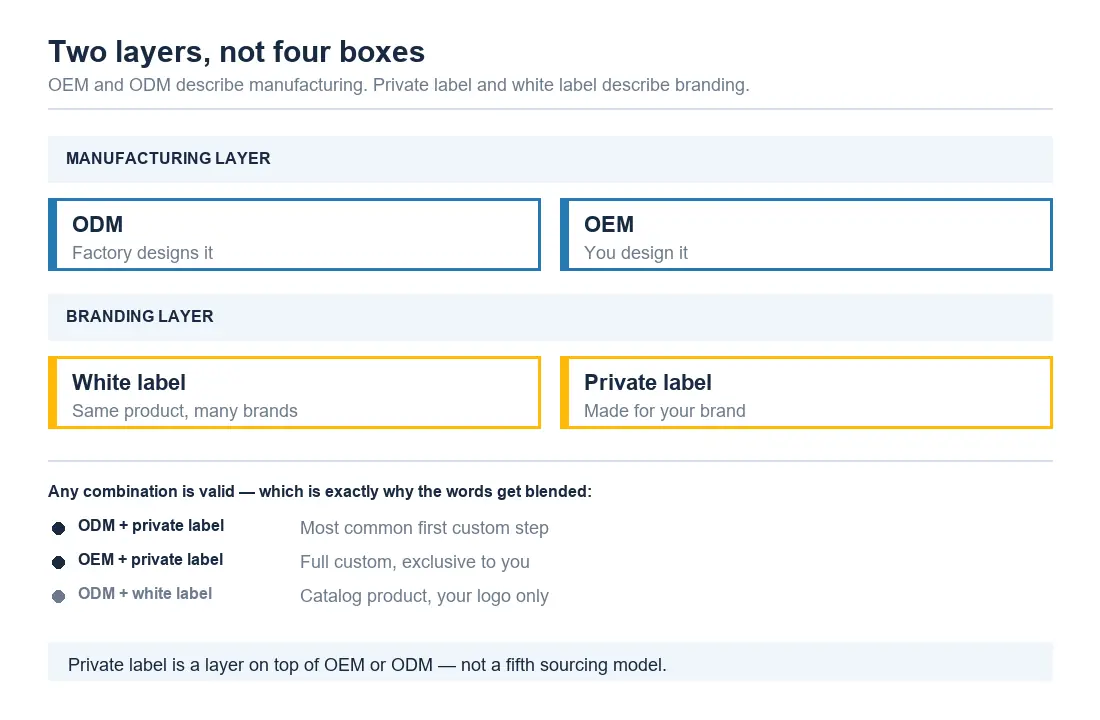
This is exactly why many suppliers’ websites say “OEM/ODM and private label” as if they were three separate services. They are layers, not alternatives. The manufacturing layer determines cost and lead time; the labeling layer determines who gets to sell it.
Typical industry ranges: MOQ for private-label runs frequently lands in the low thousands per SKU. At CuteEye we run low and flexible MOQs with mixed-batch ordering supported, because our core buyers — pet shops, Amazon sellers, distributors, and emerging private-label brands — mostly cannot justify a single-SKU container order during validation.
Who it suits: retailers and brands building own-brand margin who need some degree of exclusivity but must manage cash carefully.
White label
A finished product. Your logo goes on it. So does everyone else’s.
White label is the fastest and cheapest route. The product already exists, is already in production, already has whatever certification is required. You choose branding and packaging, and you launch.
What you control: brand presentation only. Logo, hangtag, retail carton, barcode, sometimes color if the factory offers it from stock.
What it costs you: the least, by a wide margin. Stock-based items also ship fastest — our in-stock items ship in 3–7 days, which is what makes demand testing viable without a three-month commitment.
The strategic risk: there is no moat. The identical item is available to your competitors from the same catalog, so competition reverts to price and to whoever has better listing execution. White label is a launch mechanism and a demand test, rarely a durable position.
Who it suits: new brands validating demand, resellers expanding catalog quickly, retailers filling gaps ahead of a season.
OEM vs ODM pet products: side-by-side comparison
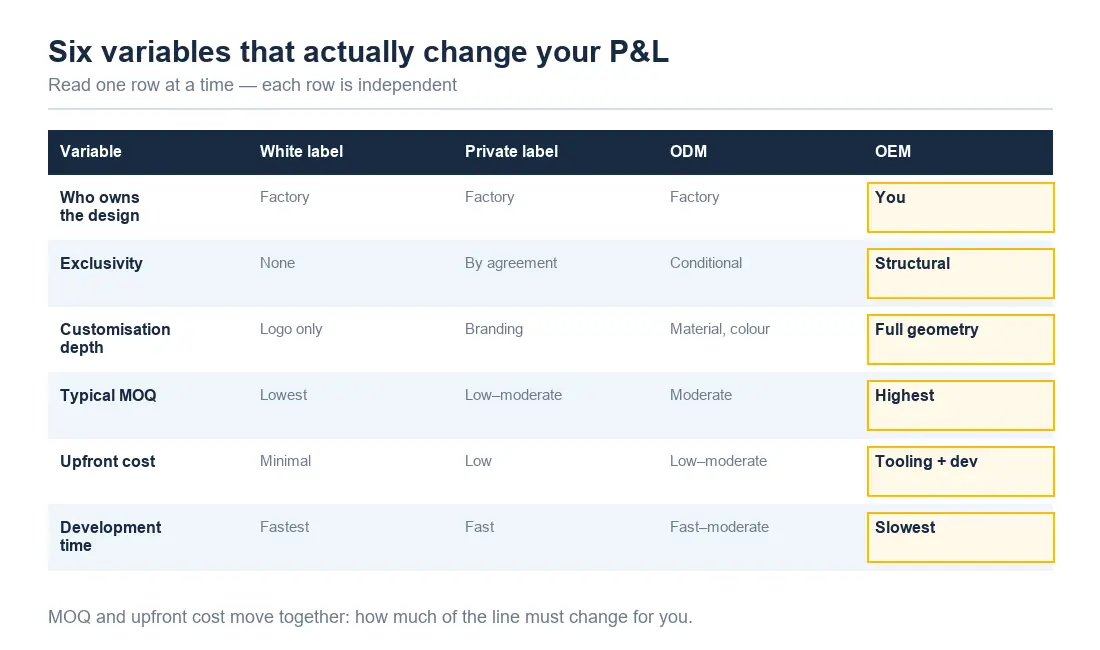
Eight variables decide which model fits your situation. This table is built to be read one row at a time — each row is independent.
| Variable | White label | Private label | ODM | OEM |
|---|---|---|---|---|
| Who owns the design | Factory | Factory | Factory | You |
| Exclusivity | None — sold to many | By agreement | Conditional, negotiable | Structural |
| Customization depth | Logo & packaging only | Branding + selected options | Materials, colors, specs within tooling | Full: geometry, material, tooling |
| Typical MOQ | Lowest | Low–moderate | Moderate | Highest |
| Upfront cost | Minimal | Low | Low–moderate | Highest (tooling + development) |
| Development time | Fastest | Fast | Fast–moderate | Slowest |
| Unit cost | Lowest | Low | Low–moderate | Highest at first, falls with volume |
| Best for | Demand testing | Own-brand margin | Fast differentiation | Defensible differentiation |
Read the “MOQ” and “Upfront cost” rows together. They move in the same direction for one reason: how much of the production line has to change to make your product. A hangtag swap changes nothing. A new silicone geometry changes a mold, a cycle time, and a QC procedure — and somebody has to pay for that.
Where the confusion actually comes from
Most sourcing confusion has three specific sources. Recognizing them makes supplier conversations dramatically shorter.
1. The terms are used as marketing adjectives, not contract definitions. A supplier listing “OEM supported” may mean anything from “we can print your logo” to “send us your 3D files.” Until a quote specifies tooling, MOQ, and who owns what, the label tells you very little. Ask for the concrete parameters instead of arguing about the word.
2. Private label is treated as a fifth thing rather than a layer. As above, private label describes branding; OEM and ODM describe manufacturing. Any combination is possible, and mixing them up is how buyers end up paying OEM prices for ODM exclusivity — or expecting OEM exclusivity from an ODM quote.
3. Nobody asks about exclusivity until after the PO. This is the expensive one. Exclusivity is easiest to negotiate while the order is still hypothetical and hardest to obtain once you have already paid for tooling and samples. Raise it in the first RFQ.
Decision tree: pick your model in five questions
Answer these in order. Stop at the first question that resolves your situation.
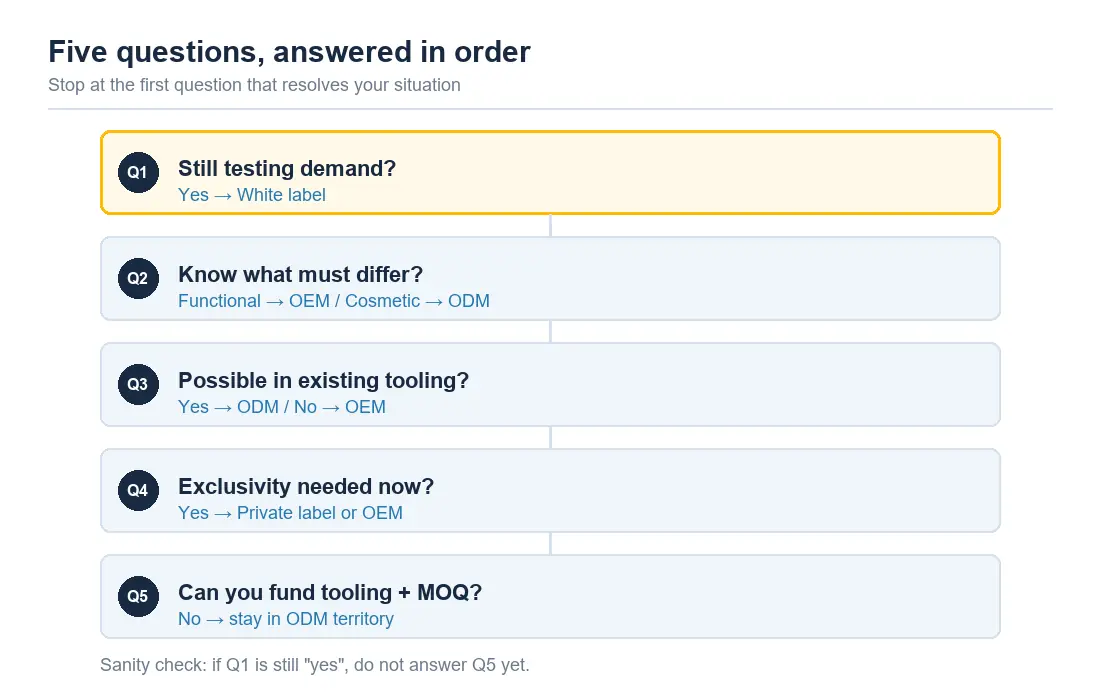
Q1. Are you still testing whether people want this product at all?
→ If yes, choose white label. Your goal in validation is speed and low cash exposure, not differentiation. Once you have sell-through data, you have earned the right to invest further.
Q2. Do you already know what the product should do differently from what exists?
→ If yes, and the difference is functional or structural, go to OEM. If the difference is cosmetic — color, fabric, trim, branding — ODM is enough and costs far less.
Q3. Can the differentiation be achieved within existing tooling?
→ If yes, ODM. If it requires new geometry, new mechanism, or new material behavior, OEM.
Q4. Is exclusivity contractually important to you right now?
→ If yes, private label over ODM with written exclusivity, or OEM. If no — you are optimizing for margin, not defensibility — private label is sufficient.
Q5. Can you fund tooling plus a higher MOQ before you sell a single unit?
→ If no, you are firmly in ODM territory regardless of how attractive OEM looks. Running OEM before you can fund it is the single most common way new pet brands burn their launch budget.
A useful sanity check: if your answer to Q1 is still “yes,” do not answer Q5 at all. Validation first, optimization second.
What each buyer type should actually do
The four buyer profiles below account for most inquiries we field. Each has a genuinely different correct answer.
Amazon / marketplace sellers. Start white label to validate the listing, then move to ODM as soon as you know the SKU works. Your competitive pressure is review velocity and price, so unit cost matters more than exclusivity early. Do not commission custom tooling before you have consistent sales — prospective tooling costs are unrecoverable if the listing stalls. Add product changes only after you understand which feature reviews actually mention.
Pet shop chains and specialty retailers. Private label is usually right. You need your own brand on shelf, you need consistent supply across seasons, and you need packaging that meets retail requirements. Tooling investment is rarely justified unless you are doing significant volume on a signature item. Factor packaging compliance into your timeline — retail carton requirements frequently affect lead time more than the product itself.
Distributors and wholesalers. Your margin comes from breadth and availability, not from owning designs. White label and private label both fit; pick based on whether your customers expect brand consistency from you. Prioritize suppliers who can hold stock so you are not waiting on production for every reorder.
Brands with in-house R&D. OEM — you already have the engineering capability, and paying for it twice makes no sense. Your leverage is in clear documentation: tolerances, material specs, test requirements, and acceptance criteria. The quality of your technical package largely determines how good your first sample is.
The hybrid path most growing brands miss
The most common mistake we see is treating this as a one-time choice. It isn’t — it’s a sequence, and following the sequence saves money at every step.

Phase 1 — Validate (weeks, not months). White label, small quantities, stock-based items. Purpose: prove demand and learn what customers actually say about the product. Keep cash exposure low. Our in-stock items ship in 3–7 days precisely to compress this phase.
Phase 2 — Improve (as review data accumulates). Move the validated SKU to ODM. Use real customer feedback to pick which two or three parameters to change: a material upgrade, a hardware swap, a packaging rethink. You now have evidence for what to improve, and evidence is much cheaper than opinion.
Phase 3 — Defend (once volume justifies it). Commission OEM work on your hero SKU: new tooling, new geometry, whatever makes the product genuinely yours. At this point you already know the market wants it, which is exactly when tooling investment stops being speculative.
The reverse order is what drains budgets: tooling first, demand second. Every successful own-brand program we have watched run Phase 1 before Phase 3.
Cost drivers you can actually negotiate
Unit price is rarely one number — it’s a stack of decisions, and several of them are adjustable. Understanding the stack is what separates buyers who negotiate effectively from buyers who just ask for a discount.
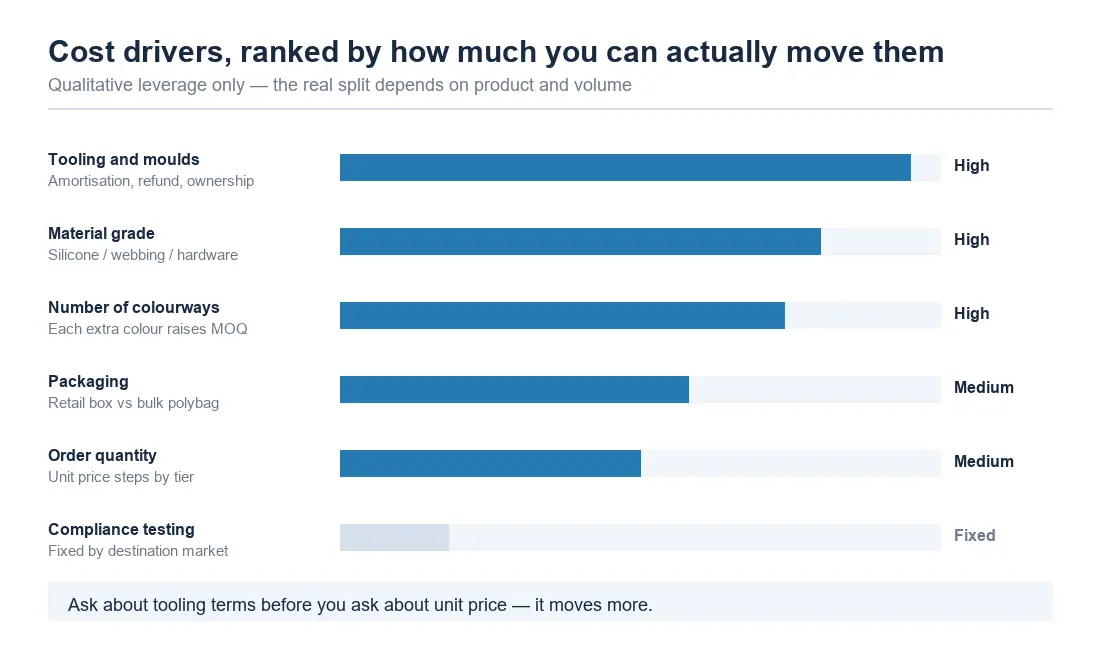
| Cost driver | What moves it | Negotiable? |
|---|---|---|
| Material grade | Base polymer, fabric denier, metal alloy, coating | Yes — often the biggest single lever |
| Colorway | Standard stock color vs. custom Pantone match | Partly — custom color usually carries a minimum |
| Tooling | New molds, dies, jigs; complexity and cavity count | Partly — amortization terms and ownership are the real question |
| Packaging | Retail carton, hangtag, polybag, printed insert | Yes — and often overlooked as a saving source |
| Testing & certification | REACH, CPSIA, EN71, EN standards depending on market | No — but scope it precisely so you don’t pay for unnecessary tests |
| Order quantity | Price breaks are usually tiered, not linear | Yes — ask for the actual tier table, don’t guess |
| Mixed-batch eligibility | Whether multiple SKUs can combine to hit a tier | Yes — and it disproportionately helps growing brands |
| Incoterm & freight | EXW / FOB / DDP, consolidation, mode | Yes — sometimes more than the unit price itself |
Two practical notes. First, always ask for the tier table, not just a single quote — knowing that 1,000 units costs X and 2,500 costs Y reframes the entire decision. Second, mixed-batch ordering is the most under-used lever available to small brands: combining several SKUs to reach a price tier can cut unit cost without increasing total inventory meaningfully. We support mixed batches for exactly this reason.
Timelines and what actually delays them
Lead time is where launches go wrong, because buyers plan for production time and forget everything attached to it.
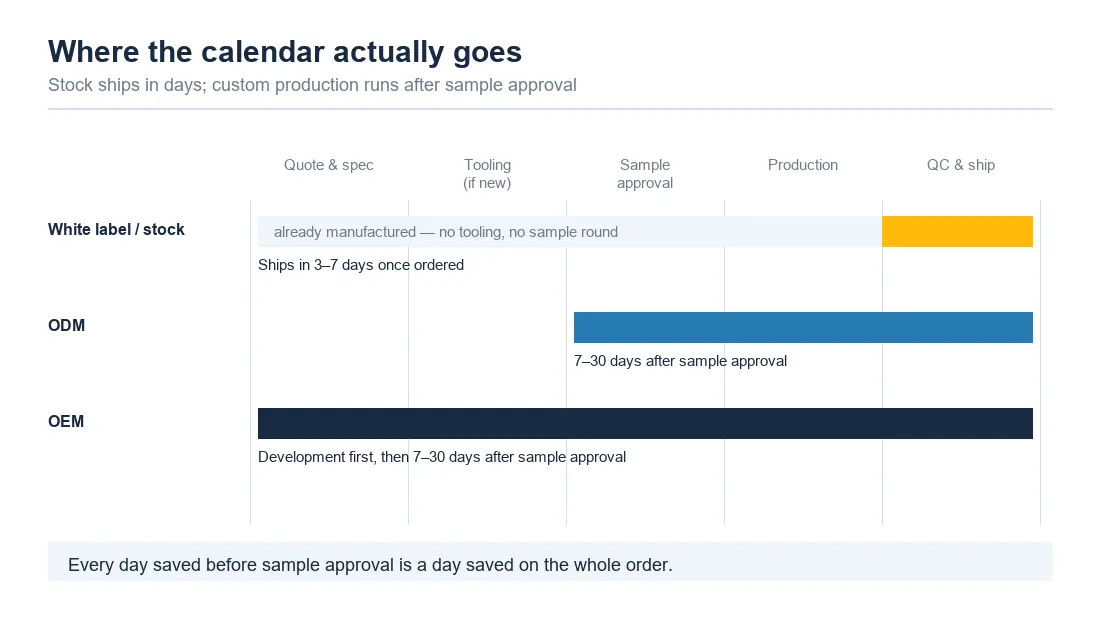
Our own figures, stated plainly: in-stock items ship in 3–7 days. Custom production runs 7–30 days after design and sample approval. Those are our commitments, and they reflect having our own silicone production line rather than subcontracting that step.
Everything else that eats schedule lives outside those numbers:
- Sample approval loops. Each round trips adds days to weeks. Approve decisively and specify corrections in writing the first time.
- Packaging artwork and proofs. Retail carton printing frequently gates shipment even when the product is finished. Start packaging design in parallel with product development, not after.
- Testing slots and laboratory queues. Third-party lab scheduling is seasonal and can add weeks in peak periods. Book early if you are launching against a date.
- Component lead times. Specialty hardware, custom webbing colors, or electronic modules can have supplier-side lead times that exceed assembly time.
- Peak-season congestion. Q3 for Q4 delivery compresses everyone’s schedule. Place earlier than feels necessary.
Practical rule: take your production estimate and add your slowest single dependency, not the sum of small ones. In most delayed projects, one item dominated the delay.
IP, exclusivity, and tooling ownership
This is the clause set that matters most and gets read least.

Tooling ownership. If you paid for the mold, who owns it? Default practice varies; assume nothing. Ownership determines whether you can take the program to another factory later, and that optionality has real value. Make it explicit in writing.
Design IP. For OEM, your drawings and specifications should be protected by an NDA before you send them. For ODM, understand that factory-developed designs are typically the factory’s IP — you’re licensing access to them, not buying them.
Exclusivity terms. If exclusivity matters, define it precisely: which product, which territories, which sales channels, for how long, and what minimum annual volume keeps it in force. “We’ll make it just for you” is not enforceable in any useful sense. “Exclusive to you in the EU and UK for 24 months contingent on minimum annual volume of X units” is.
Marketplace and channel restrictions. If you need Amazon-only exclusivity, or conversely need the right to sell across channels, state it. This changes what the factory can promise to other buyers.
Ask these four questions in the first RFQ, before samples. Doing so costs nothing and preserves leverage you lose permanently once money moves.
Questions to send your supplier before you commit
Copy this into your RFQ. Clear questions get clear quotes; vague requests get optimistic estimates.
- Is this product white label, private label, ODM, or OEM — specifically?
- What is the MOQ per SKU, and what are your quantity price tiers?
- Can multiple SKUs be combined to reach a tier (mixed batch)?
- Is there tooling involved, how much, and who owns it after payment?
- Will this configuration be sold to other buyers? If no, can you put that in writing?
- What is the sample cost, sample lead time, and how many correction rounds are included?
- What is production lead time after sample approval?
- Which certifications do you hold, and are they product-specific and current?
- What are the available customization levers, and which cost extra?
- What happens if my first production run fails inspection?
- Can you hold safety stock for reorders?
- What are your payment terms, and do they change for first orders?
A supplier who answers all twelve precisely is usually a supplier worth working with. Some of these questions have uncomfortable answers; those are exactly the ones you want before committing.
FAQ
Is private label the same as OEM?
No. Private label describes branding — the product carries your brand. OEM describes manufacturing — the factory builds to your design. You can have private label over OEM, or private label over ODM. They answer different questions, and conflating them is the most common sourcing mistake in this category.
Which model has the lowest MOQ?
White label, because the product is already in production and nothing changes for your order. Each step toward OEM raises the effective MOQ, since more of the line has to be set up specifically for you. Flexible MOQ and mixed-batch ordering can close much of that gap — ask about both explicitly.
Can I start with ODM and move to OEM later?
Yes, and it is usually the smarter sequence. Validate demand with existing tooling, then invest in custom tooling when the SKU has proven itself. Moving from ODM to OEM is a natural upgrade path; moving from OEM back to ODM usually means abandoning sunk tooling cost.
Who owns the product design under ODM?
Typically the factory, since they developed it. What you typically get is the right to sell it under your brand, sometimes with exclusivity if negotiated. If owning the design matters commercially, OEM is the correct route.
How long does it take to get a custom product made?
It depends where in the process you start. Our custom production runs 7–30 days after design and sample approval. Sample development, packaging artwork, testing, and shipping all sit outside that window and frequently dominate the real timeline.
Is white label worth it if competitors can sell the same item?
For testing, yes — its purpose is learning whether demand exists at minimum cost. As a durable position, generally not, because competition reverts to price. Most brands use white label to earn the data that justifies moving up the spectrum.
Do I need my own certifications to sell pet products?
Requirements depend purely on destination market and product category. The EU, UK, and US each have distinct frameworks — see the EU REACH framework and US CPSC business guidance — and the specifics change. Always confirm current requirements for your exact product and market rather than relying on a general checklist — and clarify with your supplier whether their certificates are product-specific and in date.
What’s the single biggest hidden cost in custom programs?
Tooling ownership misunderstandings. Buyers assume they own molds they paid for; contracts sometimes say otherwise. The second most common is underestimating packaging lead time, which can delay shipment even when the product itself is finished.
Ready to compare models against your actual product?
If you tell us the category, target market, target quantity, and whether you already have a design, we can tell you which of the four models fits — and what it would cost. We operate from Huizhou, Guangdong, with our own silicone production line alongside a vetted partner factory network covering 15 major pet product categories, working with pet shops, Amazon sellers, distributors, and private-label brands. Customization covers logo, color, material, packaging, and barcode; samples are available on request.
Tell us your category, target market and quantity — get a model recommendation and a quote
Related reading
Planning a private label programme end to end? Start with our 12-week private label launch guide. Comparing suppliers across categories begins at the wholesale pet supplies hub, where you can also review the wholesale dog collars and dog harness ranges.