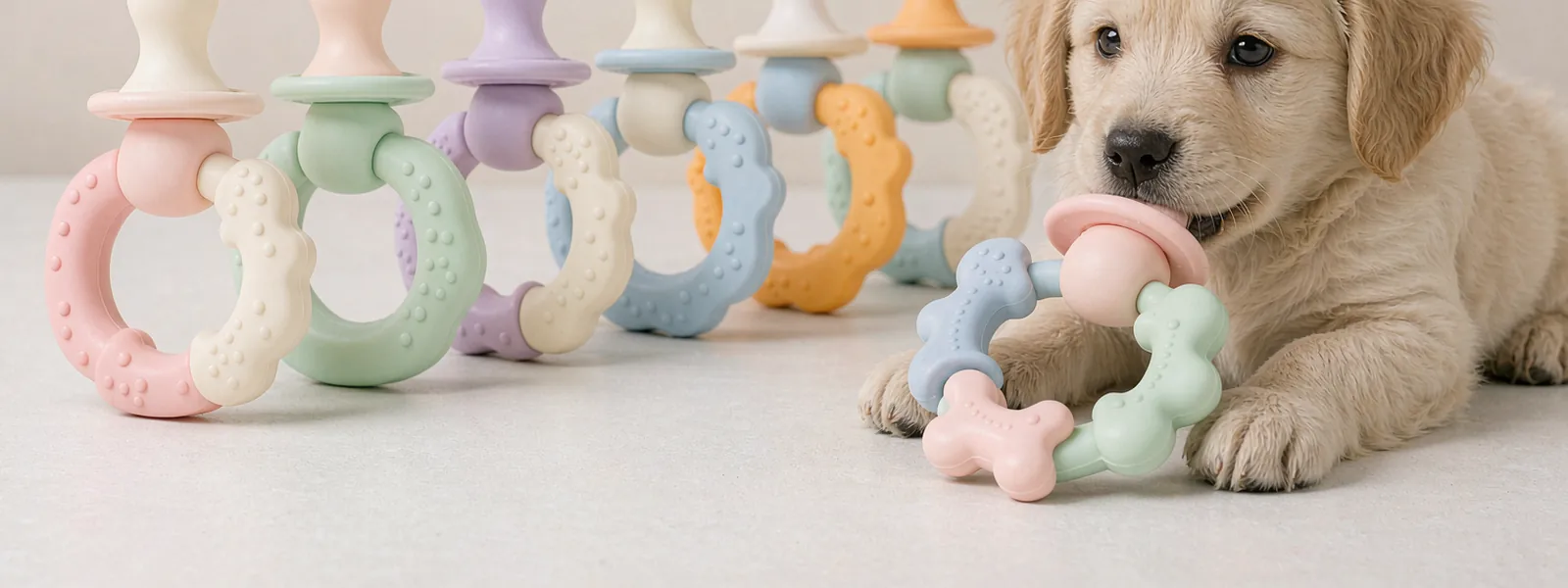
Chew-Grade Classification: The Specification That Prevents Most Problems

The single most useful thing a buyer can do with bulk dog toys is stop treating "dog toy" as one product. Chew strength is a spectrum, and matching the toy to the dog is the whole job. We grade bulk dog toys across five levels, and so should your range:
- Grade 1 — Soft and plush. Light chewers, seniors, and comfort-oriented dogs. Squeakers, rope and fabric construction. Will be destroyed by a determined chewer, and should never be sold as durable.
- Grade 2 — Light rubber and TPR. Puppies and gentle adults. Good for fetch and treat-dispensing. Moderate durability.
- Grade 3 — Standard durable rubber. The volume core of most ranges. Handles regular chewing from medium breeds; appropriate for most retail positioning.
- Grade 4 — Heavy-duty rubber and reinforced construction. Large breeds and committed chewers. Thicker walls, heavier material, higher unit cost.
- Grade 5 — Extreme / power-chewer. Nylon and composite constructions designed to abrade rather than fracture. Highest durability; requires honest marketing because no toy is genuinely indestructible.
The commercial value of grading bulk dog toys is in the returns data. Ranges that label chew grade clearly and honestly see materially fewer "it broke immediately" complaints than ranges that imply everything is tough. The claim you make on the packaging is a specification decision.
One honesty point worth making explicitly about bulk dog toys: no toy is indestructible. Any supplier — including us — who tells you otherwise is describing a marketing position, not a product. Grade 5 means it takes far longer, not that it cannot be destroyed.
Materials: What Each One Is Good For
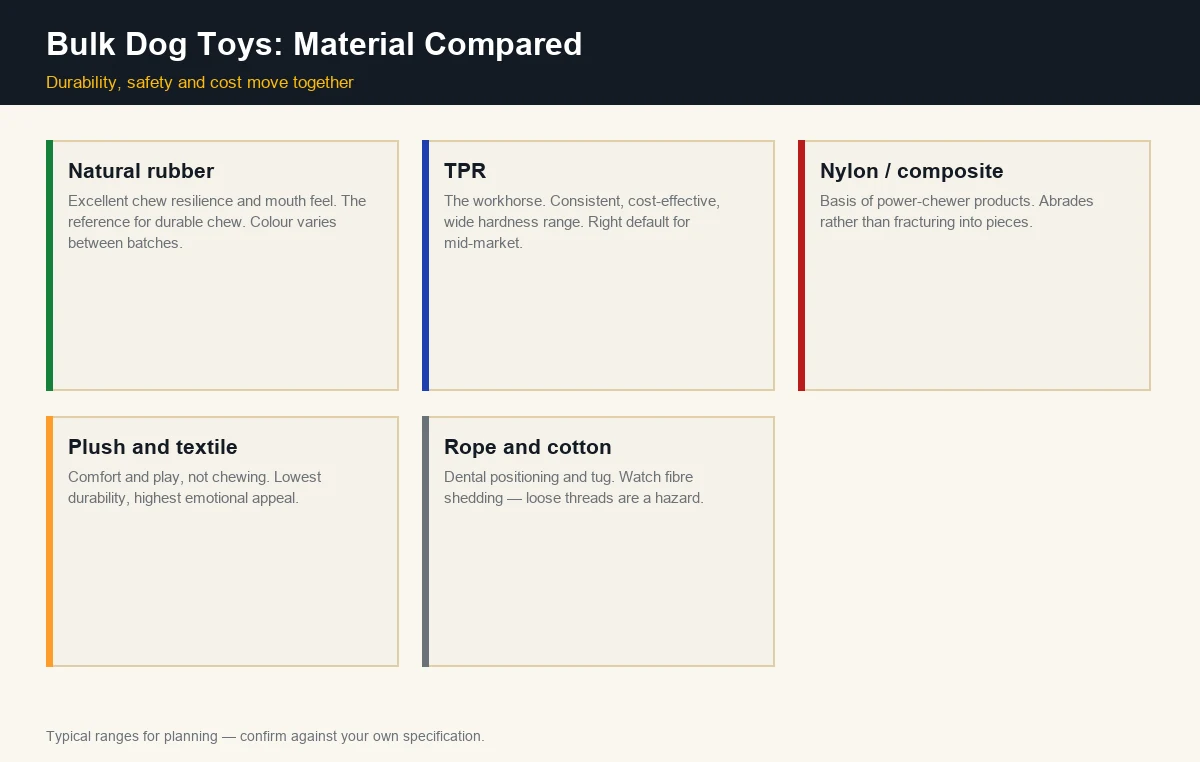
Material choice in bulk dog toys drives durability, safety and cost simultaneously, and the trade-offs are real:
- Natural rubber. Excellent chew resilience and a satisfying mouth feel; the reference material for durable chew products. Costs more and varies in colour consistency between batches.
- TPR (thermoplastic rubber). The workhorse of bulk dog toys. Processable, consistent, cost-effective, and available across a wide hardness range. The right default for most mid-market ranges.
- Nylon and composite. The basis of power-chewer products. Abrades under chewing rather than fracturing into pieces. Requires careful design so abraded material is not ingestible in volume.
- Plush and textile. Comfort and play rather than chewing. Squeakers, crinkle and rope. Lowest durability, highest emotional appeal, strong basket addition.
- Rope and cotton blends. Dental-positioned products and tug toys. Watch the fibre shedding — loose threads are a known hazard if construction is poor.
Where your market requires it, ask for material documentation on your bulk dog toys rather than a material name. Composition statements and third-party testing such as OEKO-TEX standards for textile components, or REACH-related documentation for plastics, are what your retail partners will ask for. Get them in writing before you commit rather than after.
Toy Categories by Function
Function is the second axis for bulk dog toys, and it is how most retail ranges are merchandised:
- Chew toys — the durability core of any range of bulk dog toys, and the segment where grading matters most. See the classification above.
- Fetch and throw toys — balls, launchers and flying discs. Abrasion and buoyancy are the specifications that matter.
- Treat-dispensing and puzzle toys — the fastest-growing segment. Design complexity drives tooling cost; the difficulty calibration determines whether customers repurchase.
- Tug and rope toys — interaction-led, low cost, strong basket addition.
- Plush and comfort toys — seasonal gifting and impulse; highest visual merchandising value.
- Training and agility aids — a smaller but loyal segment.
Our bulk dog toys range covers all six, and most successful first orders draw from three or four rather than going deep in one. Breadth tells you what your customers actually want; depth is cheap to add once you know.
Where Bulk Dog Toys Fail: The Four That Matter

After enough production runs of bulk dog toys, four failure modes account for nearly everything that goes wrong in this category. All four are specification decisions:
- Fracture into ingestible pieces. The serious one. Hard materials that shatter rather than abrade, or wall thickness too low for the intended chew grade. Prevented by specifying wall thickness and requiring impact testing at the intended grade.
- Small parts detaching. Squeakers, eyes and decorative elements pulled free. Prevented by specifying enclosure method and pull-testing the attachment.
- Seam and bond failure. Multi-material toys separating at the join. Common in rubber-and-rope and plush-and-rubber constructions. Prevented by specifying the bond method and testing it.
- Squeaker failure within days. The most common complaint and the least serious, but it drives reviews. Prevented by specifying a rated squeaker and its enclosure.
The first two are worth contractual language in your bulk dog toys agreement. If you are supplying a retailer with a compliance process, expect them to ask what testing you have, and ask your supplier before they ask you.
Compliance and Documentation by Market
Requirements for bulk dog toys differ by destination and change over time, so treat this as a checklist of what to ask about rather than a statement of what applies to you:
- Composition and material declarations — what the product is actually made of.
- Third-party testing — including standards such as OEKO-TEX for textiles and REACH-related documentation for plastic and coated components, where your market requires them.
- Small-parts and mechanical testing — relevant to the fracture and detachment failure modes above.
- Labelling and origin — country of origin, material content and any required warnings.
- Traceability — the ability to identify which production batch a unit came from. This is the one buyers forget until they need it.
Worth noting for bulk dog toys: recall readiness is a supply-chain property, not a product property. Ask any supplier how they would identify and isolate a batch. The answer tells you more about them than any certificate does.
Assortment Strategy for Retail
Because bulk dog toys are low-unit-cost and visually driven, assortment, assortment does more work here than in almost any other category. Three principles hold up in practice:
- Grade across the range, not within it. Stock all five chew grades rather than five versions of grade 3. A power-chewer owner who finds only soft toys in your range does not come back.
- Price-ladder deliberately. Impulse items at the counter, mid-tier on the shelf, premium durable products at eye level. The durable end carries the margin; the impulse end carries the volume.
- Bundle for basket value. Toy multipacks and themed sets consistently outperform the equivalent value in single units, and they solve the merchandising problem of small items on a large shelf.
Seasonality is real for bulk dog toys: gifting periods lift plush and multipack dramatically, while durable chew products sell steadily year-round. Plan the mix accordingly rather than reordering reactively.
OEM, Private Label and Packaging
Bulk dog toys take branding well and offer more customisation surface than most categories:
- Colour matching to your brand palette, including multi-colour mouldings
- Moulded or printed logos on rubber and TPR
- Custom shapes and tooling for exclusive designs
- Retail packaging: header cards, window boxes, printed polybags, multipack sets
- Barcode and origin labelling for retail readiness
Custom tooling is the one cost that behaves differently with bulk dog toys: a new mould is a real investment with a real minimum behind it, and it is worth modelling against your expected volume before committing. It is also the strongest defensive position available in a category this easy to copy. Standard configurations dispatch in roughly 3–7 days; custom colours or existing-shape branding run 7–30 days from artwork approval; new tooling takes longer and is quoted separately.
MOQ, Lead Time and Consolidation
Minimums are low and mixed cartons are allowed, which matters for bulk dog toys more than in most categories because a toy range is inherently broad. You can combine styles, grades and colours toward the order minimum, and consolidate bulk dog toys with other categories in the same shipment.
Toys pack efficiently and are relatively light, which makes them a good consolidation partner against bulky categories such as bedding. Buyers building a full range commonly combine them with wholesale dog collars and dog harnesses, which share retail space and buying cycles.
Puppies, Adults and Seniors: Three Different Products
Chew behaviour changes across a dog's life, and bulk dog toys ranges built for one stage, and ranges built for one stage underserve the other two. Three segments behave distinctly:
- Puppies. Teething drives chewing intensity far above adult levels, and puppy products need softer materials, smaller dimensions and closer attention to small-part security. This is the segment where a safety failure is most likely and most damaging.
- Adults. The volume core. Behaviour varies by breed and individual, which is precisely why the chew-grade classification above matters more than any single product decision.
- Seniors. Softer materials, gentler squeakers, and often larger formats that are easier to hold. An underserved segment with strong loyalty, and one where thoughtful product selection is noticed.
For bulk dog toys the practical implication is that a range covering all three stages sells better than three times as many adult products, because it lets a customer find something for the dog they actually have rather than the average dog.
How Pricing Behaves in This Category
Toy pricing is stepped, and knowing where the steps are helps you plan order sizes rather than guessing at them. Four variables move the unit price in bulk dog toys:
- Quantity per SKU — the largest lever. Tooling and set-up costs are fixed, so they amortise across the run.
- Material and grade — natural rubber and nylon composites cost more than TPR, and grade 4 and 5 constructions use more material.
- Colour count — each additional colour adds changeover time. Consolidating colours is one of the cheaper ways to reduce unit cost.
- Packaging complexity — a single polybag is dramatically cheaper than a printed window box or a multipack set.
Worth being clear about trade-offs: consolidating colours reduces your unit cost and also reduces your range breadth. In a category this visual, breadth usually earns more than the saving, at least until you know which colours actually sell.
Building a Range Ladder

A toy range works hardest when it is deliberately laddered rather than assembled from whichever products looked good in a catalogue. Three tiers is the structure that tends to hold up:
- Good — the impulse tier. A low price point, high visual appeal, and honest positioning as a light-duty product. This tier drives volume and basket size. Balls, small plush and rope toys sit here.
- Better — the volume core. Mid-priced, grade 2 to 3 durability, and the tier most customers actually buy. TPR chew products and standard treat dispensers sit here.
- Best — the margin tier. Grade 4 and 5 constructions, natural rubber, and premium packaging. Lower volume, materially higher margin, and the tier that generates the reviews the rest of the range benefits from.
The discipline is to keep the tiers visually distinct so a customer can self-select without assistance. When all three tiers look similar, everyone buys the cheapest one, and the range stops doing its job. Packaging is usually the cheapest way to make the difference legible.
One caution specific to bulk dog toys: resist the temptation to let the impulse tier dominate the order. It moves fastest and earns least, and a range weighted toward it produces strong turnover and weak profit.
The questions below come up in almost every bulk dog toys conversation, and they are answered here the way we answer them in writing rather than the way a buyer might hope: with the caveats included.