
Engraving Methods Compared
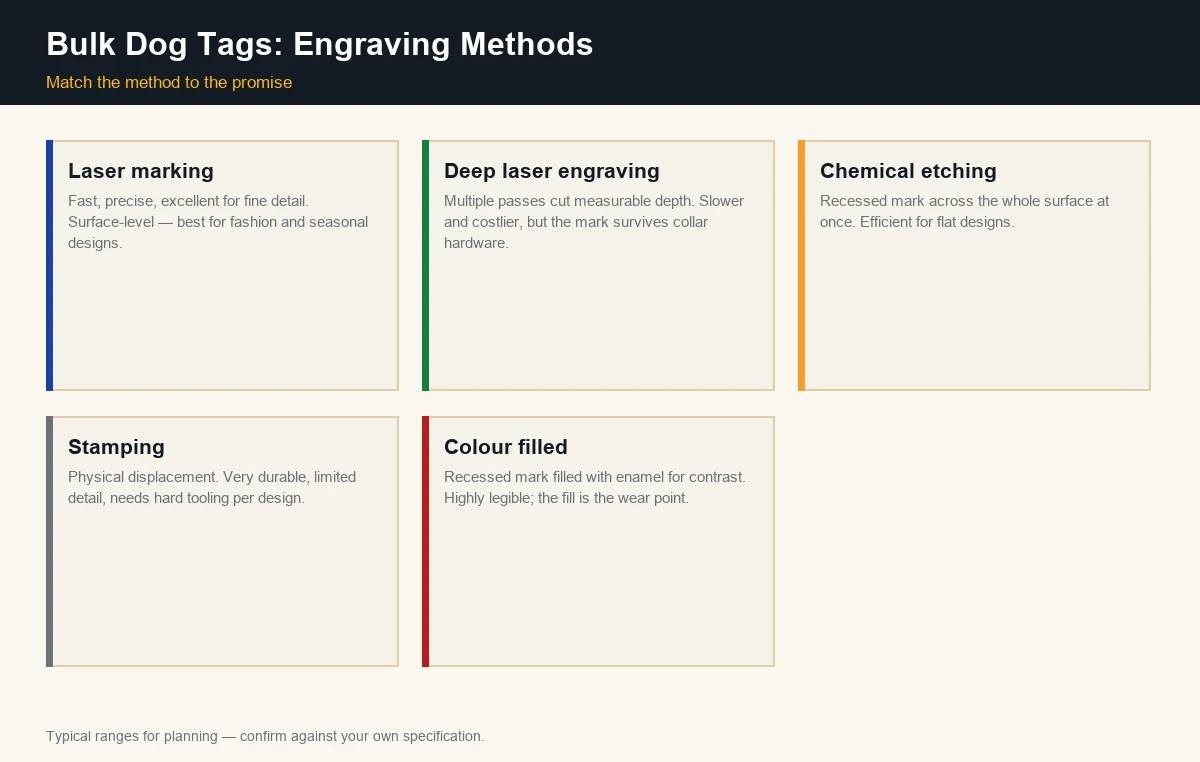
For bulk dog tags, "engraved" covers at least four different processes with very different durability and cost profiles. Knowing which one you are buying is the first specification decision in bulk dog tags:
- Laser marking. Fast, precise, and excellent for fine detail and complex artwork. On metal it produces a surface mark or a shallow ablation depending on power and material. The most flexible option and the default for variable data — every tag different, no tooling.
- Laser engraving (deep). Higher power and multiple passes to cut a measurable depth into the metal. Slower, more expensive per unit, and dramatically more durable because the mark is below the surface rather than on it.
- Chemical etching. Produces a recessed mark across the whole surface at once. Efficient for flat designs, less suited to fine variable text.
- Stamping and mechanical engraving. Physical displacement of metal. Very durable, limited in detail, and requires hard tooling per design — so it suits a fixed design at volume rather than per-tag customisation.
- Colour-filled and enamel options. A recessed mark filled with enamel for contrast and legibility. Attractive and highly legible; the fill is the wear point and should be specified with a hardness rating.
The practical rule for bulk dog tags: match the method to the promise. If you are selling a lifetime ID tag, surface marking will not hold up to years of collar hardware rubbing against it, and the returns will tell you so. If you are selling a fashion tag with a seasonal design, surface marking is entirely appropriate and much cheaper.
Readability: What Makes an Engraving Last
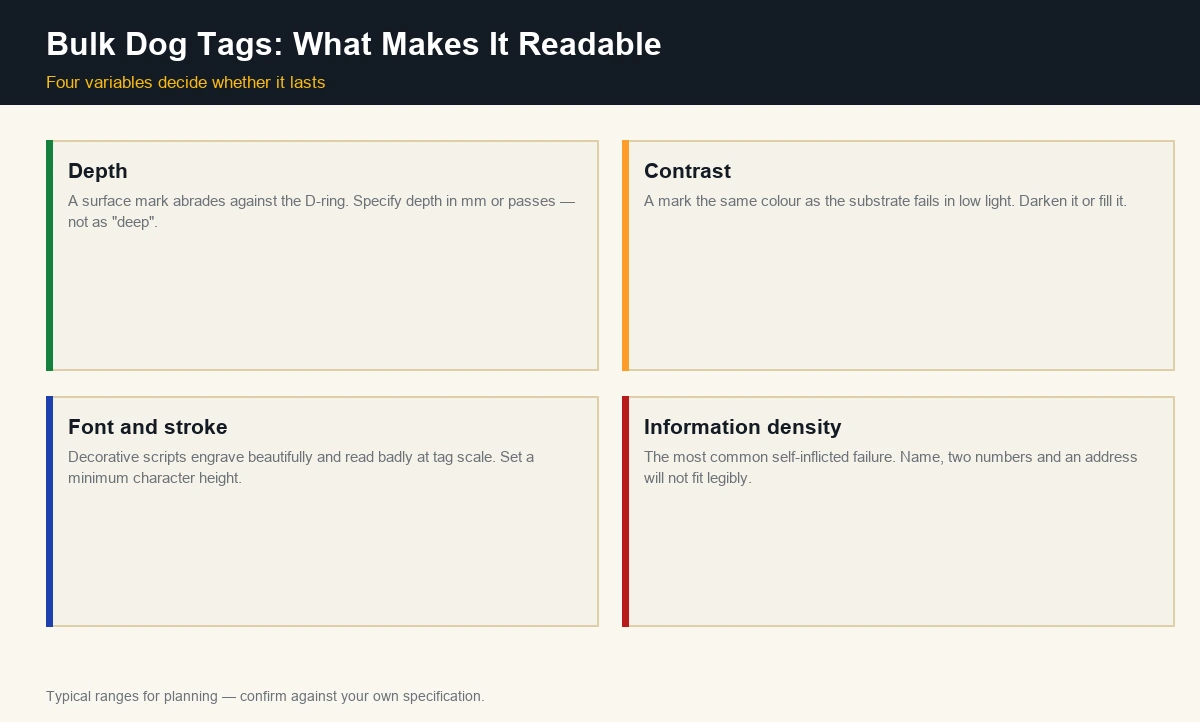
Legibility failures are the most common complaint about bulk dog tags in bulk dog tags, and they are almost always specification decisions. Four variables decide whether a tag is still readable after a year:
- Depth. A surface mark abrades against the D-ring and the collar hardware. Depth is what survives. Specify it in millimetres or as a pass count, not as "deep".
- Contrast. A mark the same colour as the substrate is hard to read in low light. Darkened marks or colour fill solve this; bare metal on bare metal does not.
- Font and stroke weight. Decorative scripts engrave beautifully and read badly at tag scale. Sans-serif, adequate stroke weight, and a minimum character height are worth specifying.
- Information density. The most common self-inflicted failure. Putting a name, two phone numbers, an address and a medical note on a 25 mm tag produces text too small to read. Decide the priority order and let the rest go.
Worth knowing what actually belongs on bulk dog tags: a phone number is the highest-value item, because it is what a finder will act on. A name helps a finder speak to the dog. An address is useful but consumes space that a second contact number would use better.
Material Choices: Cost, Durability and Positioning
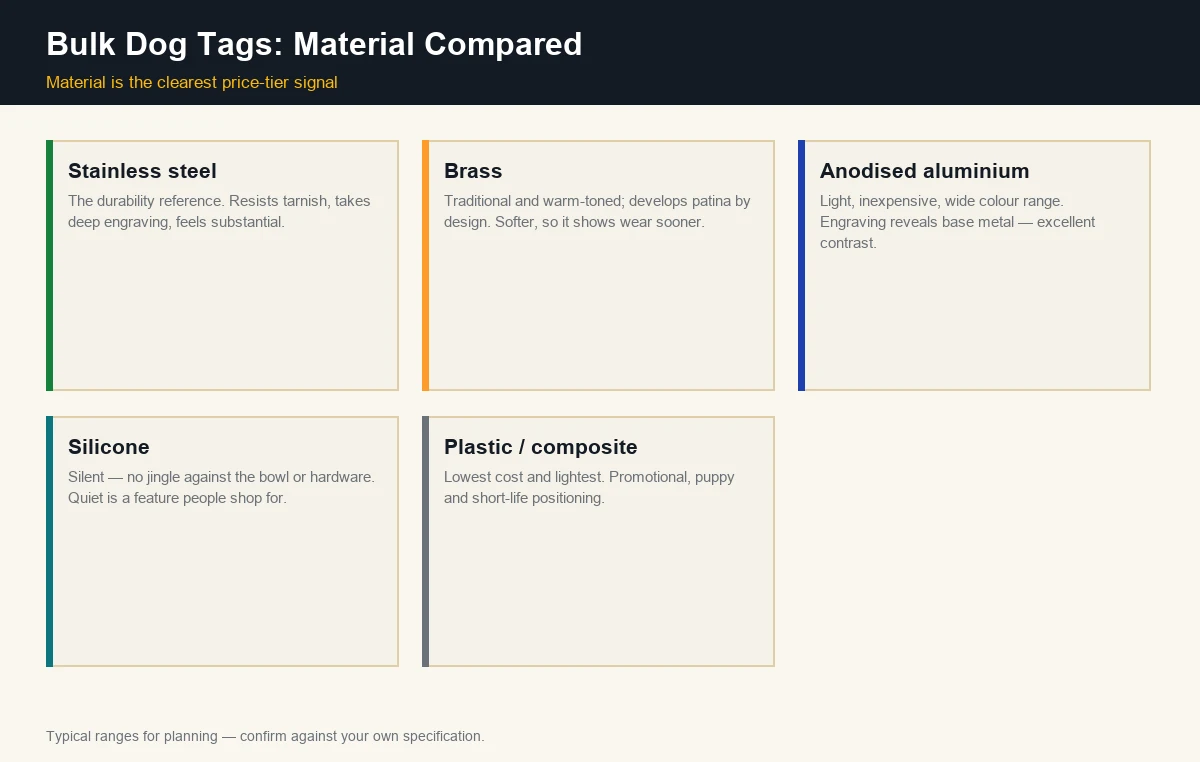
Material sets both the price point and the wear characteristics of bulk dog tags of bulk dog tags, and the trade-offs are genuine rather than hierarchical:
- Stainless steel. The durability reference. Resists tarnish and corrosion, takes deep engraving well, and carries a solid weight that customers read as quality. Higher unit cost.
- Brass. Traditional, warm-toned, develops patina. Popular in heritage and premium positioning. Softer than steel, so deep engraving is easier and the tag shows wear sooner.
- Aluminium (anodised). Light, inexpensive, and available in a wide colour range through anodising. The volume choice for fashion and colour-led ranges. Engraving reveals the base metal, which produces excellent contrast on coloured tags.
- Silicone. Silent — the tag does not jingle against the bowl or the collar hardware — and quiet is a feature people actively shop for. Takes moulded or printed marking; durability of the mark is the specification to watch.
- Plastic and composite. Lowest cost, lightest weight, widest colour range. Appropriate for promotional, puppy and short-life positioning rather than lifetime ID.
Positioning note for bulk dog tags: the material is the clearest signal of price tier in this category, because customers can feel it. A range that sells stainless and aluminium side by side will naturally ladder, and the aluminium will move more units while the steel generates the reviews.
Silent, Glow and Functional Variants
Beyond material, three functional variants of bulk dog tags are worth planning into a range of bulk dog tags because they are searched for specifically:
- Silent tags. Silicone sleeves or moulded constructions that stop the jingle. Genuinely shopped for by name, and a straightforward upsell once you have explained the feature.
- Glow and reflective tags. Photoluminescent or retroreflective finishes for night visibility. Inexpensive to specify, and strongly associated with positive reviews.
- QR and smart tags. A tag carrying a scannable code that resolves to an online profile with multiple contacts and medical notes. Solves the information-density problem described above completely. Requires a service element alongside the product, so ask how the profile is hosted and for how long before you commit.
The QR variant of bulk dog tags deserves a specific caution: the tag is hardware, but the profile is a service. If the hosting lapses, the product stops working. Establish who hosts it and what happens at renewal before you sell it.
SKU Economics: Why This Category Outperforms Its Size
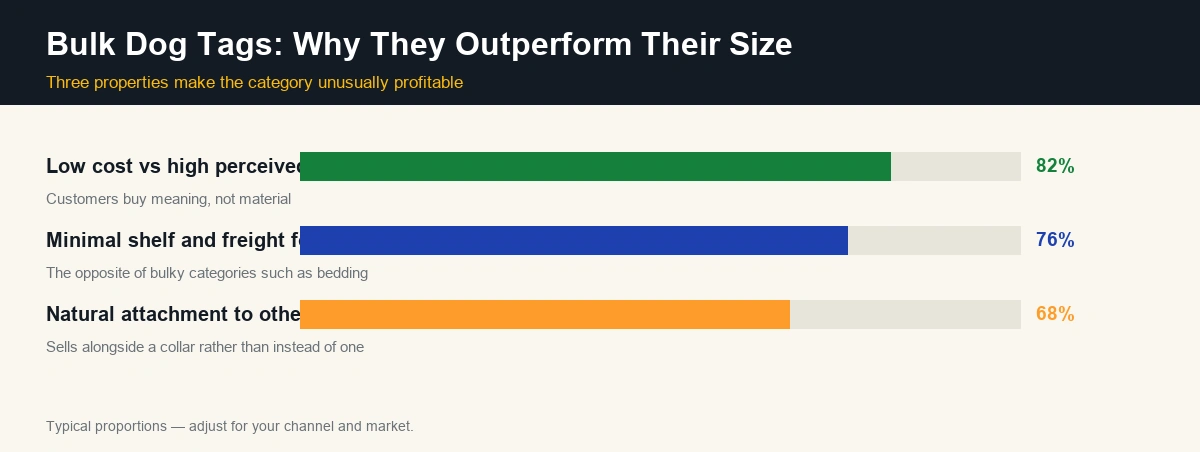
This is the part of bulk dog tags that most buyers underrate: the category's unit economics. Three properties make the category unusually profitable per unit of shelf space:
- Low unit cost against high perceived value. Personalisation raises what customers will pay far more than it raises what the product costs. A tag is one of the few pet products where the customer is buying meaning rather than material.
- Minimal shelf and freight footprint. Tags ship cheaply, store in a drawer, and can be displayed on a small counter unit. Freight per unit of revenue is among the lowest in any pet range — the opposite situation from bulky categories such as bedding.
- Natural attachment to other purchases. A tag sells alongside a collar or harness rather than instead of one. It is the classic basket item, and it attaches to wholesale dog collars more naturally than almost anything else in the range.
The operational consequence for bulk dog tags is worth planning for: personalised tags require an artwork and proof workflow, which is a different kind of work from shipping cartons. Budget the approval cycle into your lead time rather than discovering it after the goods are packed.
Category spending data from bodies such as the American Pet Products Association is worth reading before deciding how much of the range to put behind identification products.
Artwork and Proof Workflow
A predictable workflow prevents most bulk dog tags custom-order disappointment. Ours runs in four steps, and any competent supplier should be able to describe theirs just as concretely:
- 1. Brief. You send the artwork, the font preference, and the information to be engraved, plus the material and finish.
- 2. Digital proof. We return a mockup showing placement, scale and legibility — typically within 1–2 business days.
- 3. Approval. You approve or request revision. Nothing enters production before this.
- 4. Production and QC. Units are produced and checked against the approved proof.
The proof stage for bulk dog tags is where the readability problems above get caught. It is worth using properly rather than approving quickly — a digital proof reviewed carefully costs minutes and prevents an entire production run of illegible tags.
Retail Packaging and Display
Small items need presentation help, and bulk dog tags reward attention here in a way that larger categories do not more than most categories:
- Header cards and blister packs — the standard for peg display, and the format that lets a customer read the personalisation options without assistance.
- Counter display units — a small footprint, high-margin placement that works particularly well next to the till.
- Gift boxes and pouches — suit premium and gifting positioning, especially for brass and stainless.
- Barcoded retail-ready packaging — we can apply your barcode and origin labelling.
If you are selling bulk dog tags into a channel where staff will not explain the product, packaging has to do the selling. Show the font options, show the information that can be engraved, and show the material.
MOQ, Lead Time and Ordering
Minimums are low and mixed cartons are allowed. For bulk dog tags this matters in a specific way: because personalisation effectively multiplies your SKU count, the ability to mix designs, materials and finishes toward one minimum is what makes a broad range testable.
Stock blank and standard designs dispatch in roughly 3–7 days. Custom engraving runs 7–30 days from proof approval. Because tags are small and dense, they consolidate exceptionally well with other categories — you can add meaningful revenue to a shipment of bulky goods at almost no freight cost.
Matching Tags to the Rest of the Range
Bulk dog tags perform best when they are specified as part of a range rather than bought standalone, because the tag is the item that makes the rest feel finished. Two attachment points do most of the work:
- Collars. A tag is the natural companion purchase to a collar, and offering both in a matched finish is the simplest basket-value decision in the category. Wholesale dog collars and tags share a buyer, a shelf and a selling moment.
- Harnesses. Increasingly the attachment point, particularly for small breeds where the harness carries the identification.
Finishing consistency matters more here than buyers expect. A stainless tag on a brass-accented collar looks like an accident, and customers notice. Decide the finish family for the range and hold to it across categories.
Sizing is the other specification worth aligning: a tag proportionate to a small-breed collar is genuinely different from one for a large breed, and a single tag size across a whole range will look wrong at one end or the other.
How Pricing Works for Custom Tags
The pricing structure for bulk dog tags differs from most categories because personalisation introduces per-unit variable work rather than a fixed set-up. Four factors set the unit cost:
- Engraving method — surface marking is the cheapest; deep engraving and colour-filled work add materially.
- Material — stainless and brass cost more than aluminium; silicone sits between depending on construction.
- Variable data — every tag different costs more per unit than one design repeated, because each unit needs individual handling.
- Volume — as in every category, the largest single lever.
A useful planning note: because variable engraving carries a per-unit cost that does not fall as steeply as material costs do, the economics of this category reward a reasonable price point rather than the lowest one. Competing on price here tends to compress margin without much volume gain, because customers are buying personalisation rather than metal.
Four Mistakes Buyers Make in This Category
Having watched enough orders through production, four errors account for most disappointment with bulk dog tags, and all four are avoidable at the briefing stage:
- Ordering one size for the whole range. A tag proportionate to a large-breed collar looks wrong on a small-breed one. Specify at least two sizes.
- Approving a proof on a screen and skipping the legibility check. A font that reads clearly at proof resolution can fail at tag scale. Check the smallest character height specifically.
- Specifying a finish without seeing the hardware it will sit against. Clash between tag and collar hardware is the most common aesthetic complaint, and it is entirely predictable.
- Ordering personalised stock without a reorder plan. Variable engraving does not scale as cheaply as blank stock, so decide early whether you are selling custom or standard, because the two have different economics.
The questions below come up in most bulk dog tags conversations, and each is answered here as directly as we can manage, including where the honest answer is that it depends on your specification.