Wholesale cat toys: The Hunt Sequence: Why Most Toys Are Ignored
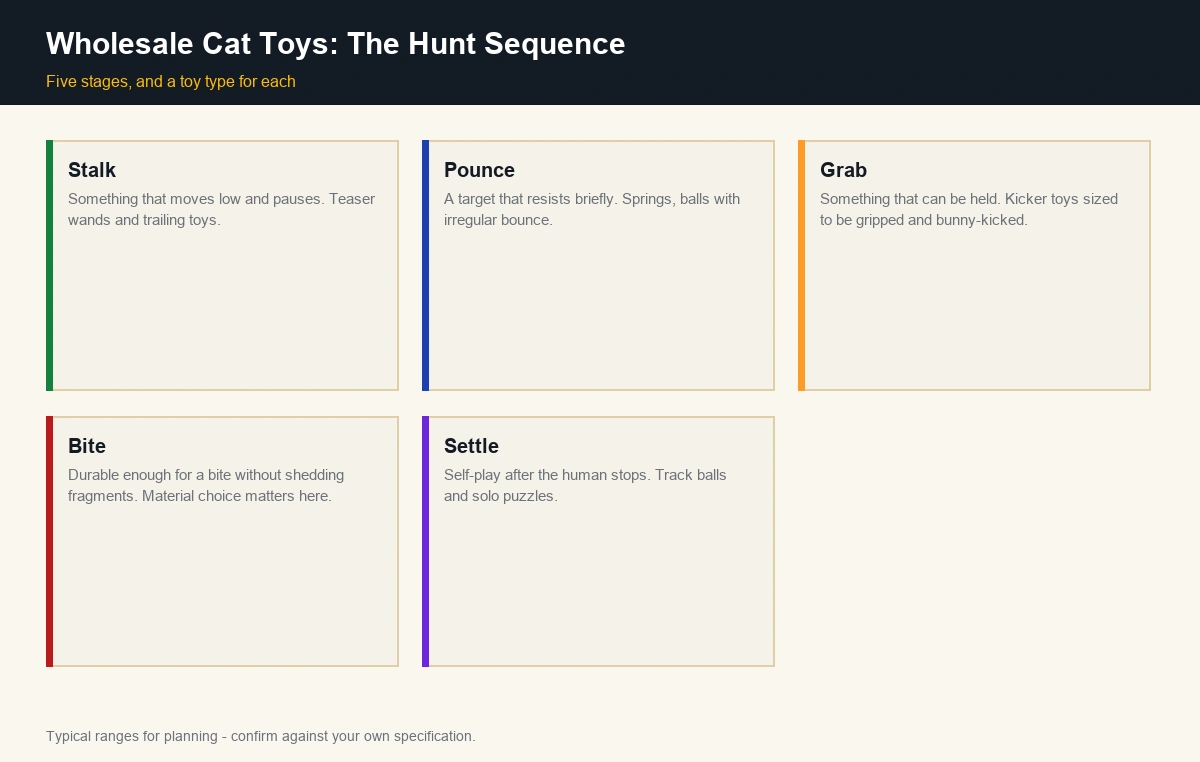
Cats engage with a toy through a sequence, not with a single action. The sequence runs stalk, pounce, grab, bite, settle. A toy that serves one stage and nothing else gets a week of attention and then is ignored, which is exactly what happens to most single-function toys.
Stalk needs something that moves low and pauses. Movement that never stops is not interesting, because prey stops. Teaser wands and trailing toys serve this stage.
Pounce needs a target that resists briefly and then moves unpredictably. Springs and balls with irregular bounce do this; a ball that rolls predictably does not.
Grab needs something that can be held. Kicker toys sized to be gripped and bunny-kicked serve this stage, and this is the stage most ranges omit entirely.
Bite needs a material that survives a bite without shedding fragments. This is a safety requirement as much as a durability one.
Settle is self-play after the human stops. Track balls and solo puzzles serve it, and it is the stage that determines whether a toy gets used when nobody is home.
A range of wholesale cat toys that covers three or more stages gets used repeatedly. A range that covers one stage, however well made, does not.
Wholesale cat toys: Six Families and What Each One Is For
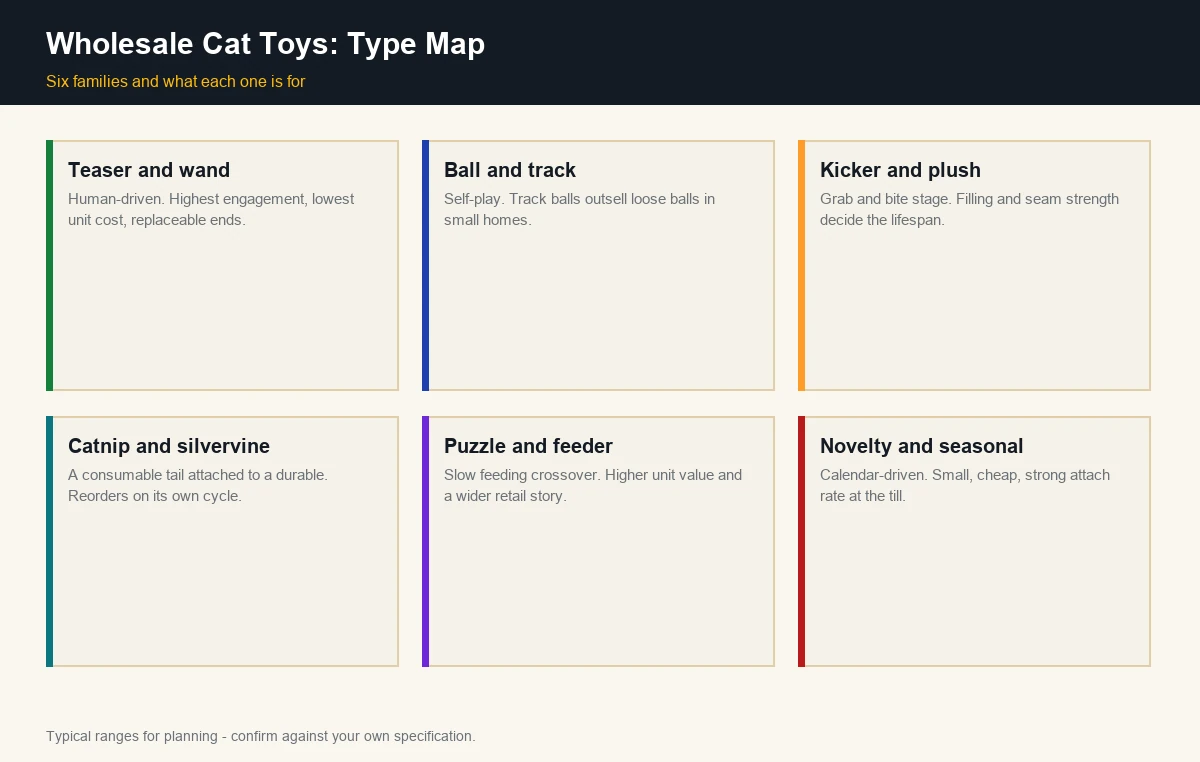
Six families cover the market, and each one carries a different margin, frequency and complaint profile.
Teaser and wand toys are human-driven and produce the highest engagement per unit of cost. The commercial weakness is that the wand sells once; the strength is that the ends are replaceable, which creates a refill line.
Ball and track toys serve self-play. Track balls outsell loose balls in smaller homes for a simple reason: a ball under a sofa is gone, and a ball in a track is not.
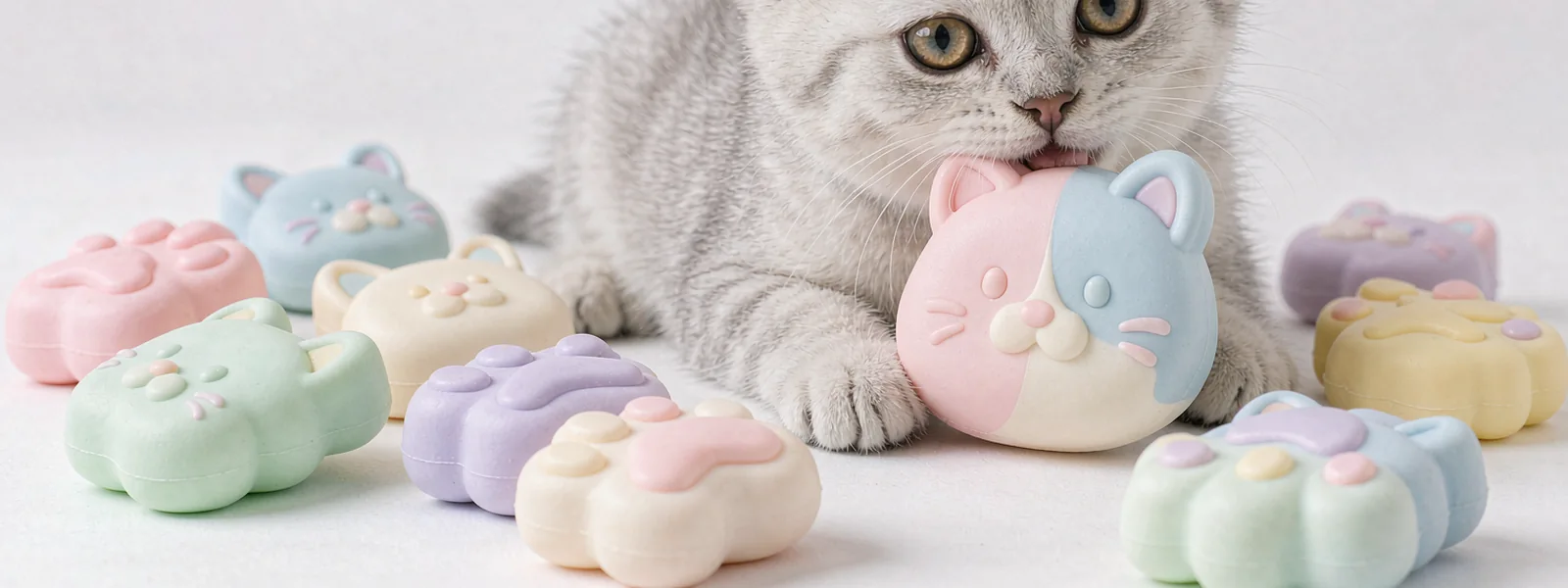
Kicker and plush toys serve the grab and bite stages. Filling density and seam strength decide lifespan, and this is where low-cost units fail first and most visibly.
Catnip and silvervine products are a consumable attached to a durable. They reorder on their own cycle, which is the most valuable property a toy line can have.
Puzzle and feeder toys cross into slow feeding. They carry a higher unit value and a wider retail story, and they are the natural premium line in a range.
Novelty and seasonal items are calendar-driven. They are small, cheap and carry a strong attach rate at the point of sale, which makes them disproportionately profitable relative to their unit price.
Wholesale cat toys: Where Safety Complaints Actually Come From
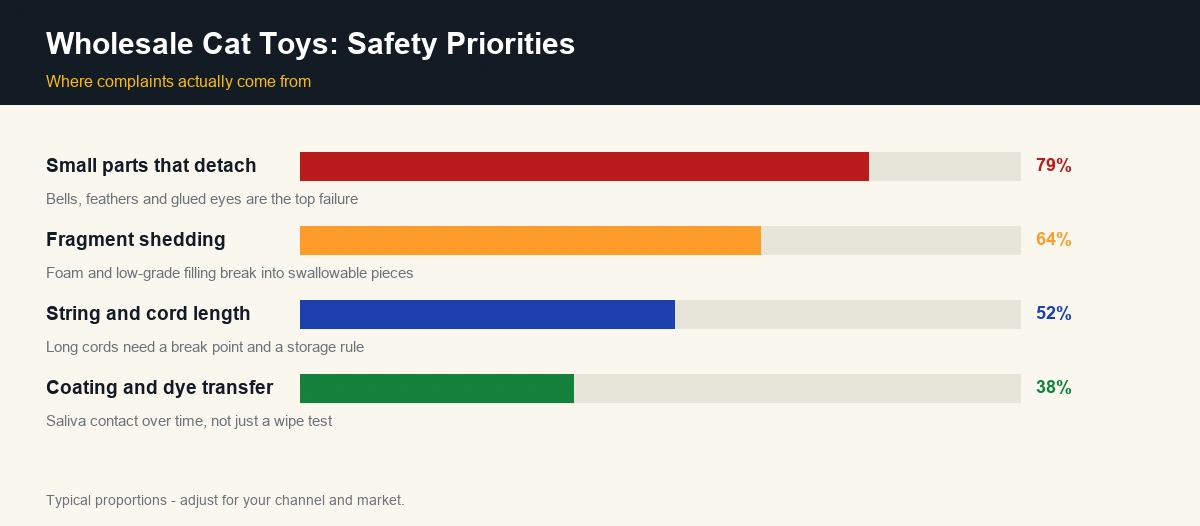
Four failure modes generate most safety complaints in wholesale cat toys. All four are specification problems rather than material mysteries.
| Failure | Component | Specification that prevents it |
|---|---|---|
| Small parts detaching | Bells, feathers, glued eyes | Pull-test value and mechanical fixing over adhesive |
| Fragment shedding | Foam and low-grade filling | Filling density and a specified bite test |
| Cord and string length | Wands, trailing toys | Maximum length and supervised-use labelling |
| Coating and dye transfer | Printed and dyed surfaces | Saliva-contact test, not a wipe test |
The first is the most common by a clear margin. A bell or a glued eye that detaches is a choking hazard and a review at the same time. Mechanical fixing and a stated pull-test value remove it.
The fourth is the one buyers forget. Cats mouth these products for extended periods, so a coating test based on a quick wipe is not representative. Ask for a saliva-contact test if the product has any printed or dyed surface.
Wholesale cat toys: A Range Ladder That Sells Through
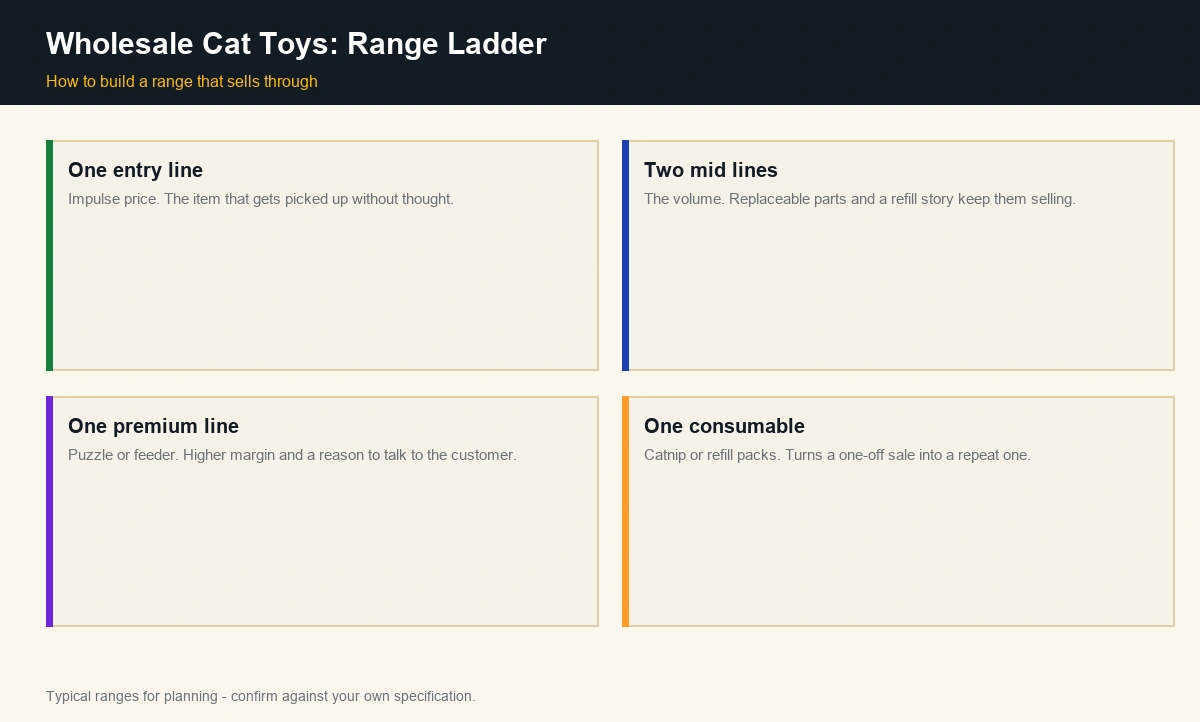
Four slots build a range that repeats rather than a collection that does not.
One entry line at impulse price. This is the item picked up without thought and it exists to start the relationship, not to carry margin.
Two mid lines carrying the volume. These should have replaceable parts or a refill story, because that is what brings the customer back rather than leaving them with a finished product.
One premium line, usually a puzzle or feeder. It carries higher margin and gives staff a reason to talk to the customer, which is worth more than its unit contribution.
One consumable. Catnip, silvervine or refill packs. This is the slot most ranges omit and the one that converts a one-off sale into a repeat one.
The mistake to avoid is four variations of the same toy at four price points. That is a price ladder, not a range ladder, and it produces cannibalisation rather than basket value.
Wholesale cat toys: Materials, Fillings and Coatings
Filling density is the specification that separates a kicker toy that lasts from one that goes flat in a fortnight. Too loose and it offers no resistance to a bite; too dense and it is rejected. This is worth sampling rather than specifying blind, because the acceptable band is narrow and differs by market.
Seam construction matters as much as filling. A seam that holds under a pull test but opens under repeated bunny-kicking fails in use rather than in test, which is why a bite-and-shake cycle is worth requesting in addition to a pull value.
Plush and fabric coverings shed. Short, densely woven coverings resist clawing better than long pile, and they also hold less of the cat's own hair, which customers notice.
Coatings and dyes need saliva-contact testing rather than wipe testing, as noted above. This is the least requested and most informative test in the category.
Wholesale cat toys: Replaceable Parts and the Refill Story
The most valuable structural feature a wholesale cat toy line can have is replaceable parts. A wand with replaceable ends sells a second time without the customer re-evaluating the brand. A track ball with replacement balls does the same.
This matters because toy categories are usually treated as one-off purchases, and the repeat purchase is what turns a listing into a line. It also changes the packaging: replaceable parts need to be sold separately, which means separate barcodes and a merchandising decision.
Consumables do the same job more directly. Catnip and silvervine refills are bought on a cycle determined by use rather than by season, which makes them the most predictable reorder in the category.
OEM and Private Label Options
Wholesale cat toys customise easily and quickly, which makes them the best category in the cat aisle for testing a private label before committing to a larger project. Typical options:
- Shape and dimensions — new shapes, sizes and configurations, including silicone and moulded parts.
- Materials and colour — fabric, filling density, rope, silicone grade and colour matching.
- Branding — woven labels, printed packaging, branded headers and hangtags.
- Packaging — retail-ready packs, multipacks, barcodes and inserts in your language.
Moulded silicone parts run on our own line, which is the shortest path from a drawing to a physical sample. Sewn and plush items run through partner factories we hold QC history with.
MOQ, Lead Time and Shipping
Minimums are kept low and can be met with mixed styles and colours in the same order, so a range can be tested across all four ladder slots without committing to depth in one. Minimums depend on whether tooling exists: an existing mould in a new colour carries a lower minimum than a new shape.
Stock items typically dispatch in 3–7 days. Custom production runs 7–30 days depending on specification, material availability and finishing. Toy units pack densely and ship cheaply, which is why this category tolerates a wider range than most: the freight penalty for carrying variety is low.
Shipping is arranged to your forwarder or ours, with carton dimensions and units per carton confirmed before booking.
Compliance and Documentation
Requirements differ by destination market, and naming the market at enquiry stage determines which testing applies. Recurring items for wholesale cat toys:
- Small-parts testing — pull-test values for attached components, per the relevant toy standard.
- Material declarations — filling, fabric and coating composition, particularly where chemical limits apply.
- Labelling — country of origin, material content, age or supervision warnings in the local language.
- Packaging and barcodes — retail-ready packing and valid barcodes, including separate barcodes for refill packs.
Behavioural guidance that helps when writing customer-facing copy for this category is published by International Cat Care.
Why a Toy Gets Ignored After a Week
The most common outcome for a cat toy is not breakage — it is indifference. Understanding why is the difference between a range that repeats and one that does not.
Novelty decays. A toy that does one thing is explored once and then ignored, because exploration is the reward and it has been exhausted. Toys that offer a variable response — irregular bounce, a refillable scent, a replaceable end — stay interesting because the response is not fully predictable.
Predictability is the enemy. Movement that repeats identically every time stops registering as prey. This is why a wand operated by a human outperforms most automated toys: the movement varies.
Scent is the cheapest way to renew interest in an existing toy. Catnip and silvervine refills re-open the exploration loop on a product the customer already owns, which is why the consumable slot in a range of wholesale cat toys does more for retention than adding another shape.
Channel Fit: Pet Stores, Marketplaces and Subscription Boxes
Three channels buy wholesale cat toys, and the range that works in one is often wrong for another.
Pet specialty retail wants a visible ladder: an entry item, two mid lines and something premium to talk about. Staff recommendation drives the mid lines, and the premium puzzle or feeder is what gives them something to say.
Marketplace and e-commerce want multipacks and clear safety statements. Reviews in this channel turn on durability and on whether attached parts stayed attached, so the pull-test value is worth stating.
Subscription boxes want small, high-variety, low-unit-cost items with strong novelty. This is the natural home for the seasonal and novelty family, and it is the channel where variety matters more than lifespan.
Packaging and Merchandising for Wholesale Cat Toys
Packaging does more work in this category than in most, because the buyer cannot see the product behave.
State the hunt stage the toy serves. "For stalking and pouncing" tells a customer more than a photograph does, and it sets expectations about what the toy will and will not do. This is the cheapest conversion copy available in wholesale cat toys.
Make replaceable parts visible on the pack. A refill line only works if the customer knows it exists at the point of the first purchase.
Group by stage rather than by price. A shelf organised by what the toy does converts better than one organised by cost, because the customer is solving a problem rather than comparing numbers. Adjacent placement with kitten toys works well because the same household buys both.
Five Questions Buyers Ask Before Ordering
Five questions come up in most enquiries about wholesale cat toys, and each has an answer worth putting in the listing.
What is the pull-test value on attached parts? Small parts detaching is the top safety complaint in the category. A value, not an assurance.
Is there a bite or shake test on the filling? Fragment shedding is the second complaint, and a pull test alone does not reveal it.
What is the maximum cord length? Relevant to any wand or trailing toy, and it drives the supervision labelling.
Are refills or replacement parts available? The consumable slot in the range is what turns one sale into a repeat one.
Can I mix styles in one order? Usually yes, and it matters because a range ladder needs four slots rather than four colours of one toy.
The Complaint Path: What Happens When a Batch Fails
In wholesale cat toys the most common batch issue is attachment strength drifting below the approved sample — a bell, feather or glued eye that pulls free more easily than the sample did. It is a safety issue and a review issue simultaneously.
Three things make it manageable. Pre-shipment inspection with a pull test on attached components rather than a visual check. A named contact who owns the complaint and can authorise a remedy. A defined outcome covering what happens to faulty stock, who pays freight, and how quickly a replacement ships.
Ask also how filling density is controlled between batches, because a filling that varies is a product that varies in both feel and durability, and customers notice the inconsistency even when they cannot name it.
Unit Economics of a Toy Range
Toy unit prices are low and freight-per-unit is lower still, which produces an unusual situation: the economics of wholesale cat toys are governed by range structure rather than by unit cost.
Variety costs little to ship and much to manage. Because units pack densely, carrying eight styles rather than four barely changes the freight bill. It does change the picking, barcode and storage overhead. The practical limit on range breadth in this category is operational, not logistical.
Margin sits in the premium slot. Puzzle and feeder toys carry the highest unit margin in the range and justify a conversation with the customer. They also sell in the lowest volume, which is why one premium line rather than three is the right structure.
The consumable slot carries the retention. Refills and catnip packs have the lowest unit value and the highest lifetime value, because they are what brings the customer back without a re-evaluation. A range without this slot has no designed-in repeat purchase.
Novelty tolerates a shorter lifespan. Seasonal and novelty items are expected to be disposable, which means they can be specified to a lower durability standard honestly, provided the listing does not imply otherwise.
Two further points matter when comparing wholesale cat toys across suppliers. First, ask whether the filling density is controlled by weight or by volume, because a filling specified by volume varies with how loosely it is packed, and that variation is what customers feel as inconsistency between units. Second, ask what happens to the attachment method if the component supplier changes, since a new bell or eye from a different source is a new pull-test result.
Range reviews are worth doing annually rather than never. Wholesale cat toys have a shorter product cycle than most categories, and a range that was correct two seasons ago is usually carrying at least one line that has stopped earning its shelf space.