
The Sizing Grid Behind a Wholesale Dog Bed Order
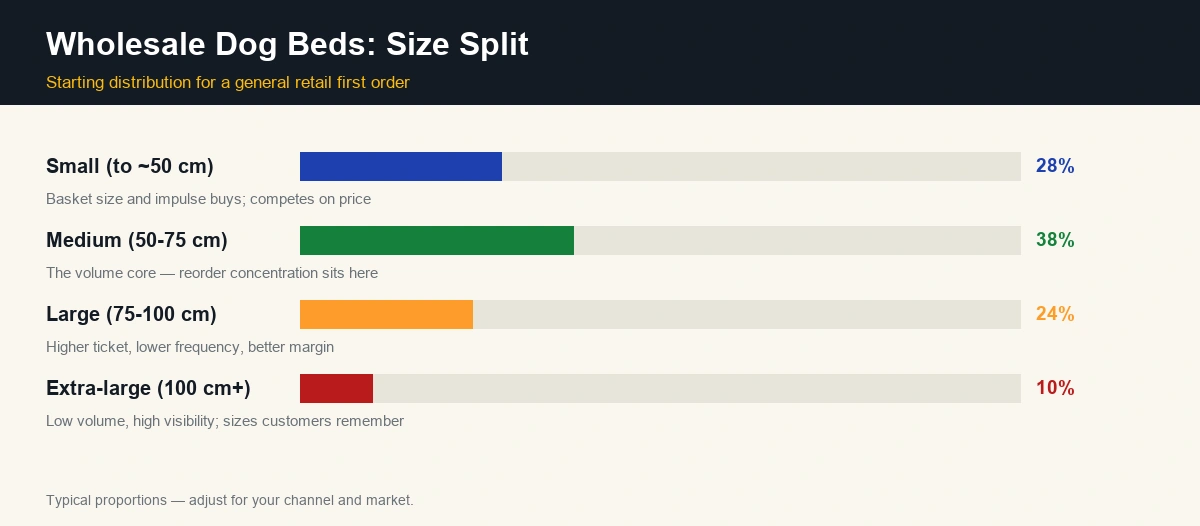
The first decision in wholesale dog beds is not which bed — it is which sizes, in what proportion. Get the split wrong and you will be sitting on small beds you cannot move while reordering large ones at air-freight urgency.
Most first orders are overweighted toward small. Buyers picture the product, not the distribution curve, and end up with a pyramid that does not match demand. A workable starting split for a general retail range looks more like this:
- Small (up to ~50 cm) — 25–30% of units. Drives basket size and impulse buys, but competes on price.
- Medium (50–75 cm) — 35–40% of units. The volume core; this is where most reorder volume sits.
- Large (75–100 cm) — 22–28% of units. Higher ticket, lower frequency, better margin.
- Extra-large (100 cm+) — 8–12% of units. Low volume, but the size customers remember a brand for.
These are typical proportions we see across general retail ranges, not a rule — working-dog and large-breed specialists skew dramatically larger, city-centre boutiques the opposite. The point is to decide the split deliberately and write it into the first order rather than discovering it after the goods land.
One structural note: because wholesale dog beds are sized by external dimension, a "large" from one factory is not a large from another. Always buy against measured centimetres, not against the label.
Fill Materials: What Each One Costs You Later

Fill is where the difference between a bed that lasts three years and one that flattens in three months is decided — and it is the least visible part of the product at the point of sale. Three families cover almost all wholesale dog beds:
- Polyester fibre (PP cotton) fill. The volume workhorse. Cheap, washable, quick to dry, and it compresses permanently under sustained load. Fine for light-duty and small-breed beds; a complaint generator in large sizes.
- Foam — including orthopaedic and memory foam. Holds shape, distributes pressure, and is the basis of every senior and joint-care claim. Costs more per unit and adds weight, which raises freight. Density is the specification that matters: ask for it in kg/m³, not as a marketing tier.
- Reconstructed and shredded foam. A middle path that recovers shape better than fibre at a lower cost than solid foam. Quality varies enormously with the binder and the source — this is where a sample earns its keep.
The honest trade-off: a cheap fill looks identical in a product photograph and behaves very differently by month four. If your channel is price-led retail, fibre fill is defensible. If you are selling to a customer who will remember the product, foam is usually the cheaper choice over the life of the SKU, because returns cost more than the fill does.
Cover Fabric, Zippers and Wash Cycles
For wholesale dog beds, the cover is the part the customer touches and the part that fails first. Three specifications decide whether wholesale dog beds survive a wash cycle:
- Removability. A zip-off cover is the single feature most associated with repeat purchase in this category. Beds without it get spot-cleaned, and spot-cleaned beds get replaced sooner — which is good for volume but bad for reviews.
- Fabric weight and weave. Measured in gsm for woven fabrics. Lightweight covers tear at the seam after a handful of washes; heavier Oxford and canvas weaves hold. Ask for the gsm, not the name.
- Zipper quality. The most common single failure point in the category. A zipper that separates after two washes turns a durable bed into a return. Specify a branded zipper with a tested pull count if your channel carries a warranty.
Water-resistant liners are worth specifying on wholesale dog beds for outdoor and crate use, and worth skipping for orthopaedic indoor beds where breathability matters more. For markets with textile requirements, covers are the component that needs documentation — ask what exists today rather than what could be arranged, and see the compliance section below.
Orthopaedic vs Standard: Matching Product to Channel
Orthopaedic is the most abused word in wholesale dog beds, and buyers should be precise about what they are claiming. A bed earns the description through foam density and thickness working together to reduce pressure points — not through a label on the packaging.
Channel matters more than product here:
- Veterinary and senior-pet channels — orthopaedic construction is the product. Customers arrive already looking for it and will compare density claims.
- General pet retail — a mid-density foam bed with a removable cover outsells a premium orthopaedic unit at most price points.
- E-commerce and marketplaces — the photograph sells, so the visible cover quality and the shape of the bolsters matter disproportionately. Freight-per-unit is also the tightest constraint here.
- Discount and promotional — fibre fill at a sharp price. Expect replacement rather than loyalty, and price accordingly.
A useful discipline when buying wholesale dog beds: decide which of these you are supplying before you brief a factory, because the specifications point in different directions and a compromise bed usually serves none of them well.
Where Bulk Dog Beds Fail: Five Modes
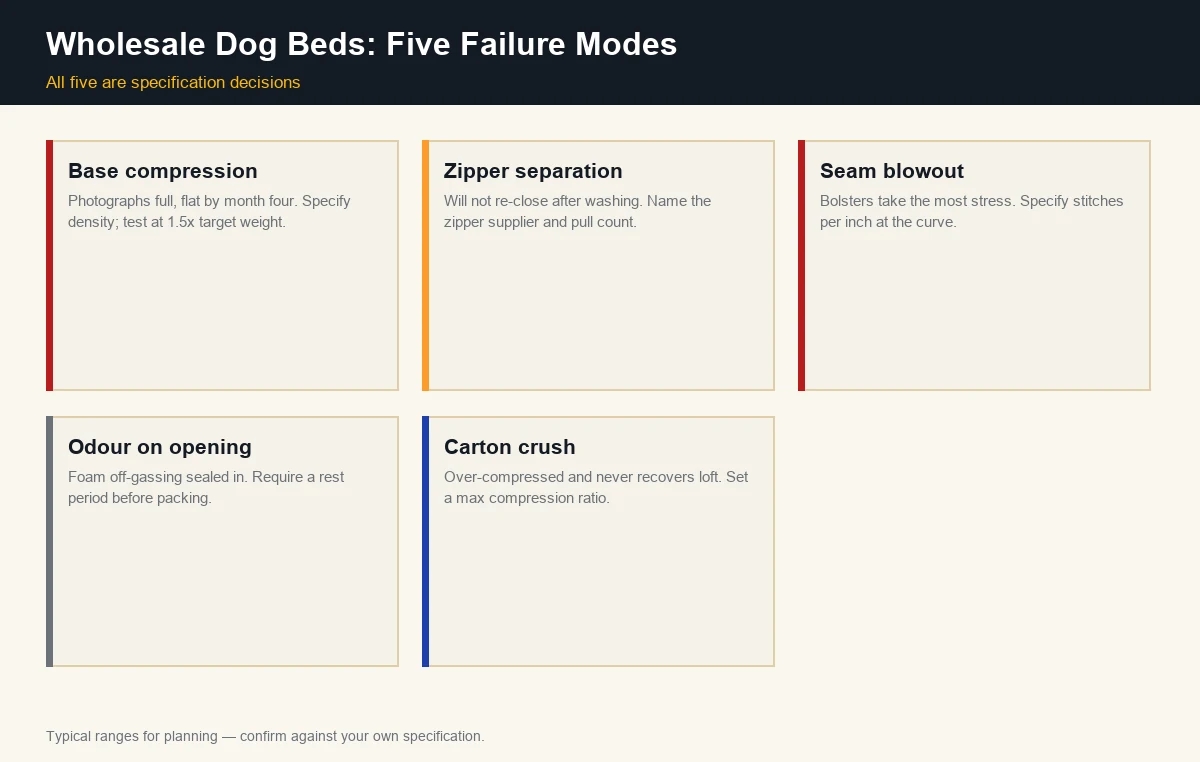
After enough production runs, the same five problems account for most complaints about wholesale dog beds. All five are specification decisions, not manufacturing luck:
- Base compression. The bed photographs full and arrives flat within weeks. Cause: fill density too low for the load it will carry. Fix: specify density, then test at 1.5× the target breed weight.
- Zipper separation. Cover unzips and will not re-close after washing. Cause: unbranded zipper, no pull-count test. Fix: name the zipper supplier in the spec.
- Seam blowout at the bolster. Bolsters take the most stress because dogs lean on them. Cause: stitch density too low at the curve. Fix: specify stitches per inch at stress points.
- Odour on opening. Foam and adhesive off-gassing sealed into packaging. Cause: packing too soon after production. Fix: require a rest period before packing and vented cartons.
- Carton crush on arrival. Compressed-for-shipment beds that never recover their loft. Cause: over-compression to save freight. Fix: set a maximum compression ratio and a recovery time in the spec.
Every one of these failure modes is cheap to prevent in wholesale dog beds at specification stage and expensive to absorb as returns. This is the practical argument for writing a real spec rather than buying from a photograph.
Volumetric Weight: The Cost Most Buyers Miss

This is the part of the wholesale dog beds category that surprises people. Wholesale dog beds are light and enormous, which means freight is charged on volume, not weight — and freight is frequently a larger share of landed cost than the product itself.
Two consequences follow, and both are decided before you order:
- Compression ratio is a commercial decision. Vacuum-packing or compressing a bed reduces carton volume substantially, which reduces freight. Push the ratio too far and the foam will not recover. The right ratio is a property of the fill, so it must be tested on the actual construction rather than assumed.
- Nesting and knockdown save more than negotiation. Beds with removable bolsters, or ranges designed to nest inside one another, ship dramatically better than fixed-shape units. A small design change here is often worth more than a meaningful price concession.
Practically, when sourcing wholesale dog beds: ask any supplier for a landed cost per unit including freight to your door, and compare that number across quotes rather than the ex-works price. A supplier charging more per unit who packs more efficiently very often lands cheaper. We say this because it is true of us and of our competitors — the number to compare is the one that arrives at your warehouse.
OEM and Private Label Options
Wholesale dog beds are one of the more customisable categories, because the cover is a textile surface that takes branding well:
- Logo application — woven label, printed patch, embroidery, or heat transfer, depending on the fabric and the wash rating you need.
- Colour and pattern — custom dye lots are viable at volume; printed patterns need higher minimums.
- Cover construction — zip configuration, piping, bolster shape, and whether the inner is removable.
- Packaging — retail box, printed polybag, or compressed roll-pack with a header card.
- Barcoding and labelling — we can apply your barcode and country-of-origin labelling for retail readiness.
Customisation adds lead time. Standard wholesale dog beds from stock ship in roughly 3–7 days; custom covers, fills or branding move into the 7–30 day production window. Plan the artwork approval as part of that window rather than after it.
MOQ, Lead Time and Shipping
We keep minimums low and allow mixed cartons, which matters in this category specifically: a bed range that forces you to buy 300 units of one size is a bed range you cannot test. You can combine sizes, colours and cover options toward the order minimum, and consolidate wholesale dog beds with other categories in the same shipment.
Consolidation is worth planning deliberately. Because beds are volumetric, pairing them with dense, heavy categories in the same container improves the overall freight profile of the shipment considerably. Buyers building a full range typically mix bedding with wholesale dog collars and dog harnesses, which pack efficiently against the bulky items.
Standard production runs 7–30 days depending on specification; stock items dispatch in 3–7 days. Typical freight options are sea for consolidated orders, air for urgent top-ups, and courier for samples and small parcels.
Compliance and Documentation
Documentation requirements for wholesale dog beds vary by destination market and change, so verify against your own obligations rather than relying on a supplier summary. Where your market requires textile documentation, ask which documents exist today: composition statements, and third-party testing such as OEKO-TEX standards for fabrics, or REACH-related documentation for coated and synthetic components. Category-level market data from bodies such as the American Pet Products Association is worth reading before deciding which segments of the bedding market to enter at all.
Get answers about wholesale dog beds in writing before releasing a deposit. A supplier who can produce a test report in a day is a different risk from one who promises to arrange one later.
Carton Planning: How Volume Decides Your Margin
Because wholesale dog beds are charged on volume rather than weight, carton planning is a margin decision rather than a logistics detail. Three levers are available, and they are best used together.
- Compression. Vacuum or mechanical compression reduces carton volume substantially. The limit is set by the fill: foam recovers well from moderate compression and poorly from aggressive compression, while fibre fill tolerates more. Test on the actual construction before committing to a ratio.
- Nesting. Ranges designed so that sizes nest inside one another ship considerably better than fixed-shape units. If you are developing an exclusive design, this is worth raising at the design stage because it cannot be added afterwards.
- Knockdown construction. Removable bolsters and separate cushions let a bed pack flat. This adds an assembly step for the customer, so it suits e-commerce and value channels better than premium retail.
The carton arithmetic is worth doing before you brief a supplier about wholesale dog beds: take the carton dimensions, divide by the number of units, and compare freight per unit rather than unit price. A bed that costs more ex-works but packs thirty percent tighter very often lands cheaper, and that is the comparison that determines what you actually earn on the SKU.
One further point specific to wholesale dog beds: because the product is bulky and the freight is volumetric, warehousing cost per unit of revenue is high. Depth in this category is expensive in a way that depth in collars or tags is not, which is an argument for testing breadth first and committing to depth only on the sizes that prove themselves.