
The Maine Coon is judged on shape, not mass. The CFA standard awards points for head, body, coat, colour and balance — and none for weight — while noting that a mature male commonly reaches or exceeds 20 pounds and that the breed may take three years to reach full growth. Those two facts, far more than the “large cat” label, are what break standard gear: a size ladder that stops at large, a growth curve that assumes maturity at twelve months, and a coat deep enough to corrupt every tape measurement. This guide covers the numbers, the geometry, and the stocking decisions that follow.
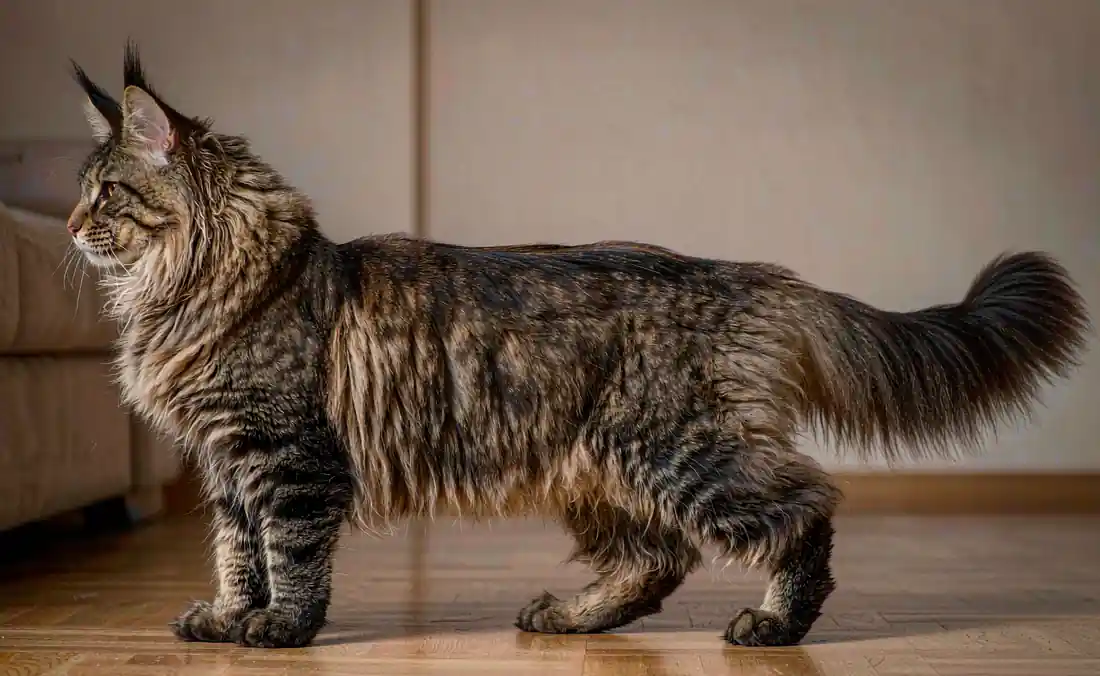
What the CFA standard actually specifies
The CFA Maine Coon standard describes a solid, rugged, rectangular cat with a square muzzle, a heavy shaggy coat and a plumed tail, and it does so without ever naming a weight. That omission is deliberate. The standard scores shape, it explicitly states that quality should never be sacrificed for size, and it asks judges to allow for slow maturation. For anyone building product, the practical consequence is that there is no registry figure to design against. The numbers in circulation — breeder reports, trade size tables, retailer weight brackets — are not derived from any standard, which is why they disagree with each other by several centimetres.
The point score shows what is actually graded
| Section | Points | Breakdown |
|---|---|---|
| Head | 30 | Shape 15, ears 10, eyes 5 |
| Body | 30 | Shape 15, neck 5, legs and feet 5, tail 5 |
| Coat | 20 | Texture, length, ruff |
| Colour | 15 | Body colour and pattern |
| Balance | 5 | Overall proportion |
Read the breakdown rather than the total. Ears carry ten of the head’s thirty points, more than eyes, and legs and feet carry five of the body’s thirty. Those two facts have direct product consequences: ear width and paw size are graded traits on the Maine Coon, not incidental features, so a pattern that pinches the ear base or assumes a narrow paw is failing on the traits the standard cares about most. The standard also lists delicate bone structure as a disqualification, which is the closest it comes to saying that this is a heavy-boned animal without ever putting a number on the weight.
The figures the standard does give
| Attribute | Standard figure | Note |
|---|---|---|
| Overall size | Largest of all pedigreed cats | CFA breed description |
| Mature male weight | Reaches or exceeds 20 lb (9.1 kg) | CFA; females are usually smaller |
| Growth period | Up to three years to full growth | Breed description; the body section also allows for slow maturation |
| Body shape | Long, muscular, broad-chested, rectangular | Body section, 15 points |
| Neck | Medium long | Body section |
| Ears | Large, well-tufted, wide at base | Head section, 10 points |
| Paws | Large, round, well-tufted | Five toes front, four back |
| Tail | Long, wide at base, plumed | Body section, 5 points |
| Coat | Heavy and shaggy; shorter at shoulders, longer on stomach and britches; frontal ruff desirable | Coat section, 20 points |
Three lines in that table do more work than the weight figure, and they are easy to skim past.
The first is “shorter at the shoulders.” This is the only place on a Maine Coon where the coat lies close to the body, and it is exactly where the front strap of a harness or the buckle of a collar sits. That is good news for fit accuracy and bad news for comfort: there is no fur cushion there, so a strap edge that is merely firm on a domestic longhair can abrade skin on this breed.
The second is the frontal ruff. A ruff is graded, desirable and deliberately full. It is also the reason collar sizing goes wrong on the Maine Coon in a specific way — the collar does not sit on the neck, it sits on the ruff, so an owner tightening it until it “feels snug” is tightening against fur and will usually end up one size too small.
The third is the toe count. The standard registers five toes in front and four behind, and lists incorrect numbers as a disqualification. A graded trait that is counted rather than measured tells you something useful about scale: paw width on the Maine Coon is not a rounding error to be absorbed by a generic pattern.
Why there is no weight figure to design against
Removing weight from a breed standard is not an oversight, and it is not unique to cats. Show standards describe the animal that should be bred; they are not population surveys. The Maine Coon standard goes further than most by naming the growth period twice and by instructing judges to allow for slow maturation, which is a formal acknowledgement that two animals of the same age can be legitimately different sizes.
The commercial effect is that “large cat” is an uncalibrated term. There is no registry that publishes a chest girth for the Maine Coon, no accepted conversion from weight to girth, and no tolerances. Every size chart for the Maine Coon, including ours, is a pattern decision rather than a standard. The honest way to publish one is to state the girth band it covers and let the buyer measure, which is the approach set out further down this page.
The three-year growth curve is the real sizing problem
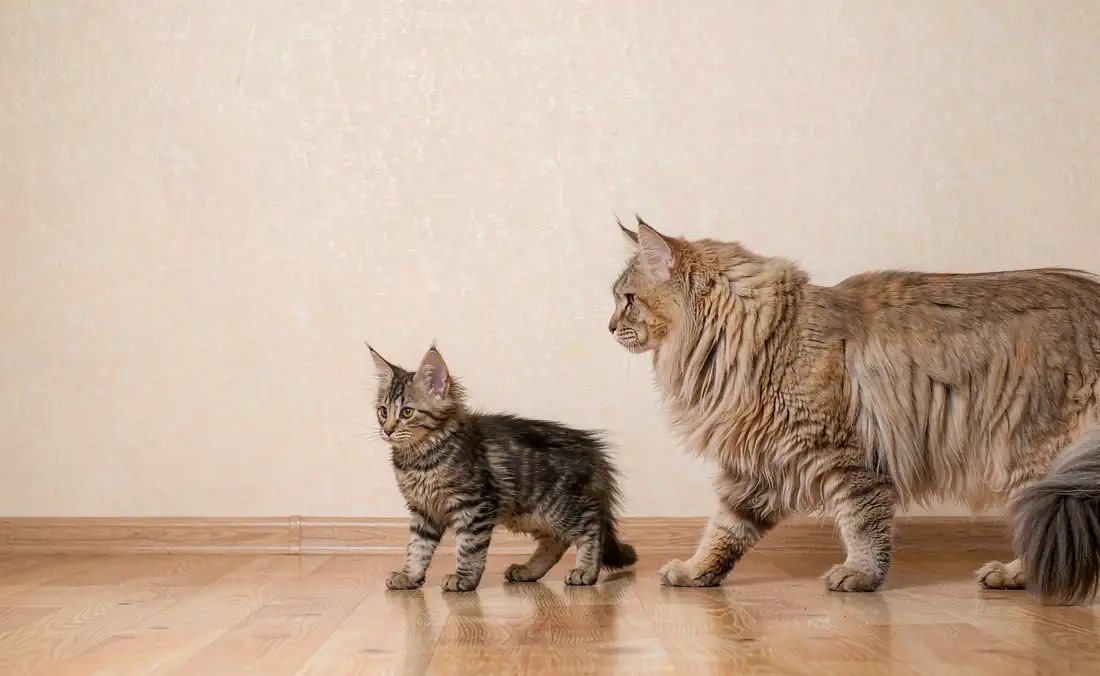
A Maine Coon kitten is not a small adult cat, and it does not become one on the schedule that retail size ladders assume. The standard allows up to three years to reach full growth, which means a harness bought at four months will be outgrown several times before the animal stops changing shape. For a retailer this is a repurchase pattern rather than a fitting inconvenience. For a manufacturer it decides how wide the ladder has to be, and whether a single-size sale is even the right unit to ship.
What the growth actually looks like
| Age | Share of adult weight (typical) | Size the animal needs | What usually goes wrong |
|---|---|---|---|
| 4 months | Around 30–35% | Smallest size in the range | Neck opening too wide, chest strap too long |
| 6 months | Around 50–60% | Small to medium | Range often has no true small |
| 12 months | Around 80–85% | Medium to large | Looks adult, is not; buyers stop sizing up |
| 18–24 months | Around 90–95% | Large to extra large | Chest deepens faster than length |
| 30–36 months | 100% | Extra large | Final size, often outside the range |
Two cautions on that table. No registry publishes a growth curve, and these shares are breeder-reported ranges rather than measurements from a controlled study; individual animals vary widely, and males diverge from females early. Use the table as a planning shape, not as a specification. The second caution is that the coat fills in on a different schedule from the skeleton. A twelve-month Maine Coon can look fully grown because the ruff has arrived, while the chest is still widening underneath it. Visual maturity runs ahead of structural maturity on the Maine Coon, and buyers size from what they see.
Why the retail ladder stops too early
The common cat harness range is extra small, small and medium, occasionally large. That ladder was built for a species that reaches adult weight within twelve months, and it is a reasonable ladder for that species. It fails on the Maine Coon at both ends.
At the bottom, the smallest size is usually cut for a five-pound kitten, and a four-month Maine Coon is already heavier than that with a chest to match, so the animal skips the first rung entirely. At the top, the ladder ends at a girth that a mature male exceeds by several centimetres, so the last rung is unreachable. What is left is a range that covers the middle of the breed’s life — roughly eight months to twenty months — and misses both the start and the destination.
The fix is not to stretch the existing sizes. A harness that has been graded up by adding centimetres to a domestic-cat pattern keeps the domestic-cat geometry, and geometry is the part that fails first on a long rectangular torso. The fix is a ladder drawn from the girth band at both ends, with overlap between sizes so an animal sitting between two rungs is covered by either.
The case for selling a growth set rather than a single size
If a breed changes size four times in three years, selling one harness is selling a third of the relationship. A three-piece growth set — small, medium and large in one carton, or a buy-two-get-the-third-at-cost structure — matches the animal’s actual trajectory and removes the most common reason a buyer abandons a brand: the moment the second size does not exist.
This is where flexible minimums matter more than unit price. A buyer who has to commit to five hundred units per size cannot test a growth set, because the set itself multiplies the commitment by three. A buyer who can mix sizes, colours and hardware within one production run can put a set on the shelf, measure the sell-through per size, and reorder only the rung that moves. That is the practical argument for mixed-batch terms, and it is stronger on this breed than on any compact cat breed.
“Cat” is not a size
There is no grading standard for pet soft goods. Unlike human apparel, where nominal sizes are anchored to body measurements within a stated tolerance, “large” on a cat harness means whatever the maker decided it means, and the same word can describe a 42 cm chest girth in one range and a 50 cm girth in another. This is the single most common source of returns on large-cat product, and it is why a breed name printed on a label is worse than no label at all: it implies a calibration that does not exist.
The girth band that actually matters
| Chest girth | Typical wearer | Note |
|---|---|---|
| 30–36 cm | Kitten, 3–5 months | Below most adult ranges |
| 34–40 cm | Small adult female | Overlaps kitten sizes |
| 38–46 cm | Adult female, young male | The widest-selling band |
| 44–52 cm | Adult male | Where most ranges end |
| 48–58 cm | Large adult male, full coat | Where the Maine Coon actually sits |
Across the trade size tables we compared while building our own range, adult chest girth for the Maine Coon clusters between roughly 40 cm and 56 cm, with males at the top of the band and females overlapping the upper end of ordinary domestic-cat sizing. Treat that as a working range to validate against your own pattern, not as a standard, because no registry publishes a girth figure for any breed.
What the range does establish is that the overlap between “large domestic cat” and “Maine Coon” is real: a big domestic male and a small Maine Coon female can share a girth band, which is why a girth-based chart serves both and a breed-based chart serves neither.
What the coat adds to every measurement
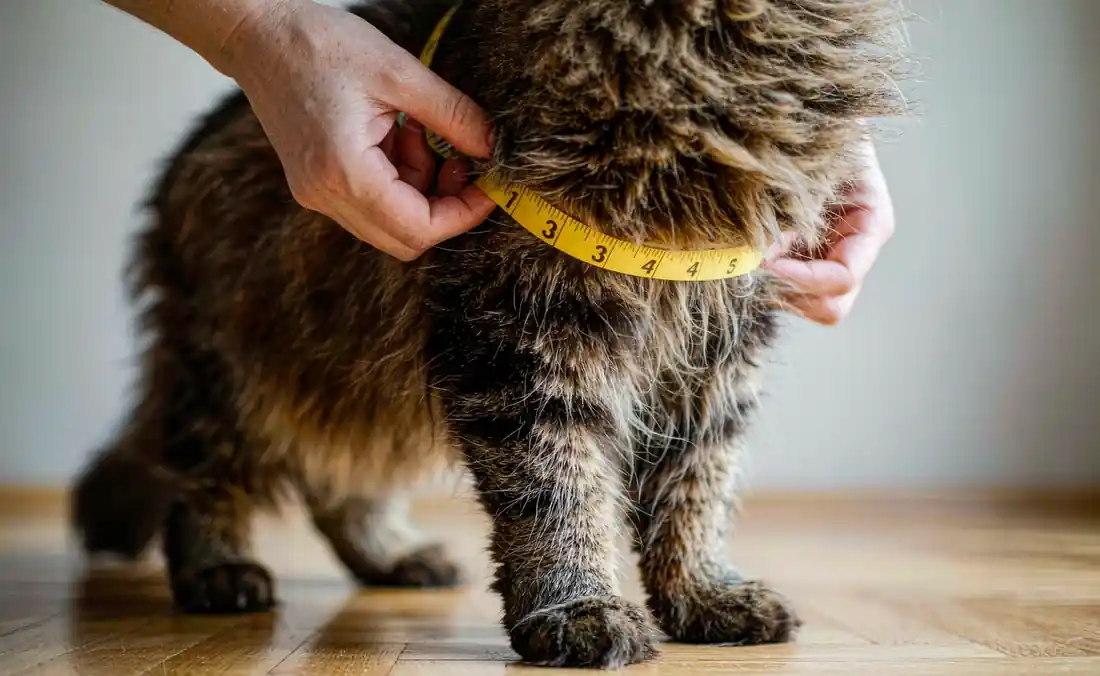
The coat is the second thing that goes wrong. A Maine Coon in full coat carries a ruff, a longer stomach and britches, and a plumed tail, and a tape pulled over that coat reads several centimetres wider than the body underneath. The error is not uniform: it is smallest at the shoulders, where the coat is short, and largest around the ribcage and behind the front legs, which is precisely where a harness measures.
Two rules resolve it. Press the tape until it touches body, not fur, and read the number at that tension rather than letting the tape rest on the coat. Then add the allowance as a pattern decision rather than as a measuring decision, so the same physical cat produces the same number regardless of who holds the tape.
In practice the difference between a coat-inflated reading and a compressed one sits in the range of two to four centimetres of girth, which is a full size step in most ranges. A buyer who measures over the coat and orders to that number will get a harness that fits in winter and swims in summer, because the coat that inflated the reading is the coat that will blow out in spring.
How to measure a Maine Coon without inflating the number
Measure the animal standing on a hard floor, in the morning before a meal, with the coat pressed flat under the tape, and record chest girth as the primary number and neck circumference as the secondary. Every other input — weight, age, breed label, the size the buyer used last time — is a proxy that fails on the Maine Coon at least once during its life. The whole procedure takes under two minutes and removes most of the returns that come from fitting by eye.
- Chest girth, at the widest point. Run the tape around the ribcage immediately behind the front legs, at the deepest part of the chest. This is the number the harness is built from. Keep the tape level, not sloping toward the shoulders.
- Neck circumference, at the base. Measure at the base of the neck where a collar would sit, pressing through the ruff rather than resting on it. Record it separately: on this breed the neck is medium long, and a collar sized from chest girth will be too loose.
- Body length, shoulder to tail base. Measure along the spine from the withers to the base of the tail. This is the number that decides whether a back panel is long enough, and it is the dimension standard cat patterns get wrong on a rectangular torso.
- Weight, as a cross-check only. Weigh the cat and write it down, then ignore it for sizing and keep it as a reference for the next measurement. A weight that drops while the girth holds is a clinical signal, not a sizing signal.
Where the geometry fails
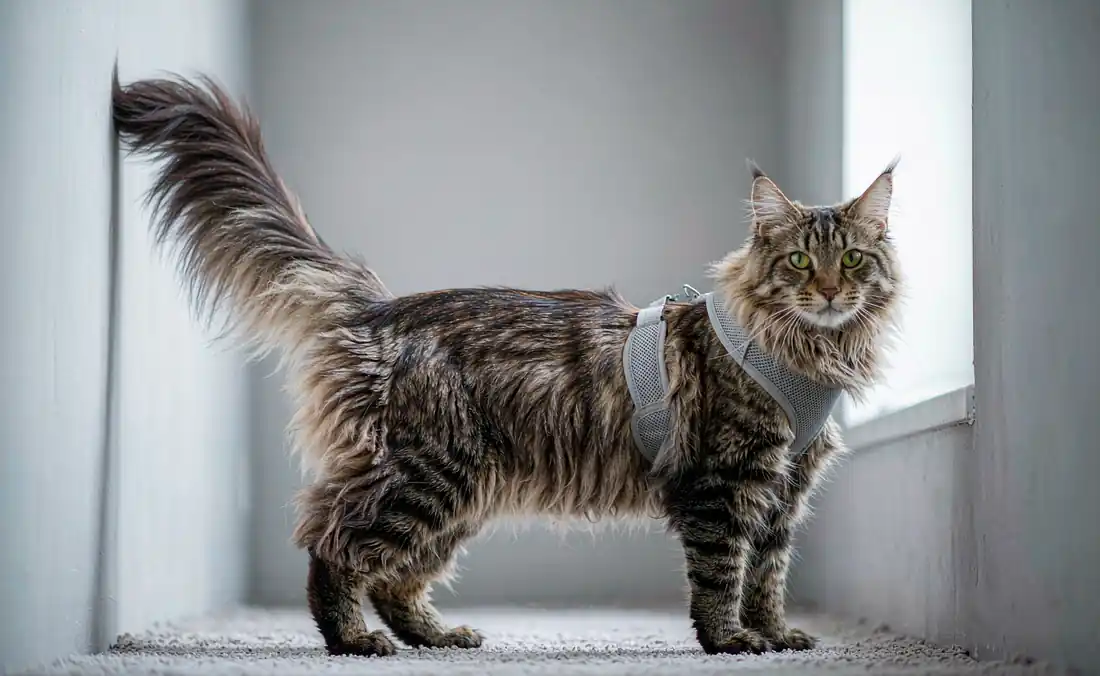
An H-strap harness is cut for a compact, roughly cylindrical cat. The Maine Coon is long, broad-chested and rectangular, and that proportion moves the load in two directions at once: the straps sit forward onto the shoulders, where the chest is deepest and the coat is shortest, and the back panel is too short to bridge the distance to the hips, so the rear strap rides up behind the ribs instead of anchoring there. This is not a fit error that adjustment can remove. It is a pattern that was never drawn for the proportion.
Back panel length and sternum clearance
Two dimensions decide whether a harness stays put on a rectangular cat. The first is back panel length, measured from the withers to the point where the rear strap crosses the ribs; on the Maine Coon that distance is greater than the domestic-cat average even at the same girth, so a pattern graded only on girth will be short in the back. The second is sternum clearance: the gap between the front strap and the base of the neck. Too little and the strap loads the throat; too much and the whole harness slides forward when the cat pulls.
Both are cut decisions, not adjustment decisions, which is why they belong on the spec sheet rather than in a fitting guide.
“Escape-proof” is a marketing claim, not a standard
The term appears on almost every cat harness sold today and it does not describe a test. We have not found a published escape test for cat harnesses: no agreed load, no agreed failure criterion, and no body that certifies the claim. What “escape-proof” usually means in practice is a vest with more fastenings and wider straps, which genuinely helps, but which says nothing about the actual escape route on a long-bodied cat: a strap that loosens over the shoulders once the animal backs up and twists.
The specification that matters is narrower and more useful. How many points of adjustment are there, and do they include the neck as well as the chest? Does the closure sit on the back, or on the side where a twisting cat can reach it? Is there a second fastening behind the ribcage, which is what stops a cat from backing out of a vest in one movement? Ask for those three answers and the marketing word becomes irrelevant.
Load path, and why “cat-rated” hardware is not rated
A nine-kilogram cat that bolts from a standing start generates a load well above its body weight for a fraction of a second, and that load arrives at the smallest piece of metal in the assembly: the D-ring, the slider, or the buckle prong. Hardware sold as “cat-rated” is usually not tested to a stated figure, because the category has no test protocol we have been able to reference.
The workable substitute is to specify by construction instead: webbing width and stitch pattern, a D-ring that is welded rather than bent, and a closure type whose failure mode is a gradual slip rather than a clean release. A side-release buckle that opens under load is the wrong choice on any animal above five kilograms, regardless of what the packaging says.
What the health data changes about the spec
Weight is the least stable input on the Maine Coon, and the cardiac literature explains why. A substantial share of Maine Coons carry the MYBPC3-A31P variant associated with hypertrophic cardiomyopathy, and a proportion of adults will lose muscle mass and body condition as the disease progresses while the skeletal frame stays the same. Gear sized to a weight class therefore drifts out of fit exactly when the animal is least able to tolerate a bad fit, because a cat in heart failure has less tolerance for a strap across the chest, not more. Size to the frame and treat weight as a cross-check.
The numbers, with their boundary conditions
| Finding | Figure | What it actually measures |
|---|---|---|
| A31P variant prevalence | 41.5% of 2,744 European Maine Coons | Carrier frequency in a screened population |
| A31P variant prevalence | 39.4% of 742 Maine Coons, British Isles | Carrier frequency, different population |
| HCM in an echo-screened group | 7% of 164 cats, mean age 2.6 years | Point prevalence in a young cohort |
| HCM risk for carriers | Relative risk 9.91 | Risk ratio, not absolute risk |
| Penetrance, heterozygous | 6–8% | Share of carriers that develop HCM |
| Penetrance, homozygous | 50–58% | Share of homozygotes that develop HCM |
| Share of HCM cases aged 7 or over | 44.3% in one cohort | Age distribution of diagnosed cases |
Those figures come from two independent screening populations: 2,744 Maine Coons in Europe (J Vet Cardiol, 2010) and 742 in the British Isles, with a review of feline HCM models putting the variant at 35–42% across studies (PMC review) and noting that roughly nine in ten carriers are heterozygous.
That table is routinely misread, and the misreading matters commercially because it drives exaggerated claims in both directions. The 7% figure is a point prevalence in a group whose mean age was under three years, in a breed that takes three years to mature and in which the disease is known to be age-dependent; the same literature shows case share climbing sharply after age seven. It is therefore not a lifetime risk, and quoting it as one overstates the disease in young animals and understates it in old ones.
The prevalence figures are similarly easy to misuse. Roughly four in ten Maine Coons carry one copy of the variant, but penetrance in heterozygotes is low, in the range of six to eight per cent, while penetrance in homozygotes is more than half. “Forty per cent of Maine Coons have a heart defect” is a sentence that appears in commercial copy and it is wrong on both halves: it confuses carriage with disease, and it flattens two genotypes with very different prognoses into one number.
For product purposes the usable conclusion is narrow and robust. Body condition in the Maine Coon can change substantially in adult life while frame size does not. A harness whose fit depends on the cat holding a weight class will fail on some of the animals it was sold for, and a size chart built on girth will not.
Why this changes the spec sheet rather than the packaging
The temptation is to put a health claim on the label. Resist it: cardiac status is a clinical matter, and no accessory prevents, treats or mitigates it. The right place for this information is the specification — girth band stated in centimetres, weight rating stated as a structural limit rather than a fitting method, and a note that the fit should be rechecked as body condition changes. That is more useful to a buyer than a badge, and it is defensible if a customer asks where the numbers came from.
The four categories that break first
Four product categories account for most of the fit complaints on the Maine Coon, and in each case the failure is a specific dimension rather than a general problem of being large. The table below sets the market default against what the animal actually needs, and names the number that decides it.
| Category | Market default | What this breed needs | Deciding dimension |
|---|---|---|---|
| Harness | H-strap graded on weight | Vest or wide-strap pattern with a long back panel and a second fastening behind the ribs | Chest girth plus back length |
| Carrier | “Cat” carrier, soft-sided | Rigid base, reinforced handle, lift-rated to the top of the weight band | Internal length and rated load |
| Cat tree | Standard perch and post diameter | Wider perch, thicker post, weighted or anchored base | Perch width and post diameter |
| Litter box | Standard open tray | Longer tray, higher sides, entry wide enough for a large paw | Internal length and entry height |
The carrier is the category where a wrong number has the worst consequence. A nine-kilogram cat in a soft-sided carrier with a single stitched handle is a handle failure waiting for a staircase, and the failure is silent until it happens: the fabric holds, the stitching does not. Specify a rigid base panel, a handle attached to the frame rather than to the shell, and a stated load rating at the top of the weight band rather than the middle.
The cat tree is where the standard’s paw language becomes a purchasing decision. Large, round, well-tufted paws with five toes in front mean a perch that a domestic cat drapes over is a perch this animal overhangs, and a post sized for a light cat wears through faster under a heavy one. Post diameter and base weight are the two numbers that separate a tree built for the Maine Coon from one that is merely tall.
Materials and hardware at nine kilos
Fabric choice matters less than people expect and hardware choice matters more. At this weight the loads are concentrated at four points — two strap junctions, the D-ring and the closure — so the specification that decides service life is the stitch pattern and the metal, not the face fabric. The constructions we build for this weight band, and the reasoning behind each, are set out on the cat harness range page.
On webbing, width does more for comfort than thickness does for strength, because a narrow strap at nine kilograms becomes a pressure line across the chest. On closures, the failure mode is the deciding criterion rather than the breaking load: a metal cam or a well-made side-release with a deep engagement is acceptable, a shallow side-release that pops under a shock load is not, whatever its printed rating. On stitching, box-X at every junction and a bar-tack where the D-ring webbing doubles back is the minimum; a single row of lockstitch is a cosmetic assembly and will not survive a bolting cat.
Mesh deserves one specific note on the Maine Coon. Ventilation is not a comfort upgrade here, it is a fit requirement: a Maine Coon in full coat carrying a solid padded panel across a deep chest traps heat against skin that is already insulated, and the result is a cat that refuses the harness rather than a cat that is merely warm. Open mesh with a breathable backing, positioned over the sternum and the ribcage, solves the problem that padding creates.
What this means if you stock product for the breed
Stocking for this breed is a curve decision before it is a design decision. The population spreads across four size steps, moves through them over three years, and sits at the top of the band for most of its adult life. A range built to that shape sells a different mix than a range built for domestic cats, and the difference shows up in reorder patterns rather than in first orders.
A four-size curve that covers the population
| Size | Chest girth | Back length | Typical wearer | Overlap with neighbour |
|---|---|---|---|---|
| S | 30–38 cm | 22 cm | Kitten from 4 months | 2 cm into M |
| M | 36–45 cm | 26 cm | Adult female, young male | 3 cm into L |
| L | 43–52 cm | 30 cm | Adult male | 3 cm into XL |
| XL | 50–60 cm | 34 cm | Large adult male, full coat | — |
The overlaps are the working part of that table. Without them, an animal sitting between two sizes is covered by neither, and in a breed this variable that is a large share of the population rather than a rounding case. With them, each animal is covered by two sizes, which also means the buyer’s stock covers the gap when one rung sells out. The girth figures are our pattern decisions and should be checked against your own; the shape of the curve — four steps, generous overlap, top step reaching 60 cm — is the part worth copying.
The repurchase cadence is the opportunity
A three-year growth period and four size steps means the average household buys two to three harnesses in the first three years, not one. That is a different commercial shape from a domestic-cat range, where a single purchase usually lasts the animal’s life. It favours the seller who is present at every step: a growth set that ships the first size and lets the buyer claim the second, a size-up reminder printed on the insert, or simply a range that has the next size in stock when the buyer comes back.
It also changes what a first order should contain. A buyer who orders only the top size has bought the destination and skipped the journey; a buyer who orders a balanced curve across all four steps sells through the small sizes first and reorders upward, which is the pattern that builds a repeat account.
What not to do
The failure mode to avoid is the oversized copy: take a domestic-cat pattern, grade it up by fifteen per cent, label it extra large and market it to the breed. It photographs well and it fits badly, because grading scales every dimension at once while the actual difference between the two animals is concentrated in the chest and the back. The other failure mode is the opposite — a bespoke extra-large pattern with no small and no medium, which serves the adult male and abandons the eighteen months before him.
Our terms versus common industry practice
Most of the friction in this category comes from terms that sound comparable and are not. The table below sets out what we quote and what the category convention usually is, so the difference is visible before a sample is ordered rather than after a purchase order is placed.
| Item | Our terms | Common industry practice |
|---|---|---|
| Minimum order | Low and flexible; sizes, colours and hardware can be mixed in one run | Minimum per size, often 500–1,000 units per size |
| Sampling | Sample before production, with cost and lead time stated up front | Sample free but slow, or credited only against volume |
| Size curve | Built from the girth band you name, not from a template | Existing pattern resized, breed name added |
| Private label | Logo, colour, material, packaging and barcode | Logo printing only |
| Lead time | 3–7 days for stock items; 7–30 days for custom production measured from sample approval | Quoted from order date, with sampling counted separately |
| Specification | Girth band, back length, weight rating and hardware grade on the sheet | “For cats up to 5 kg” |
The row that causes the most misunderstanding is the first one, so it is worth being explicit about why we do not publish a single flat minimum. Minimum order in this category is a function of construction: a plain webbing harness and a multi-panel vest with mesh, lining and four adjustment points consume different amounts of cutting, sewing and hardware setup, and quoting one number for both would be either uncommercial on the vest or uncompetitive on the harness. A mixed-batch structure with a stated minimum per construction is more useful than a headline figure that turns out not to apply to the item you wanted.
Six questions to ask any supplier
These six separate a supplier who has built for the breed from one who has resized a domestic-cat pattern. Ask before samples, not after.
- What girth band does each size cover, in centimetres? A range quoted in weight or in breed names has no girth behind it. The answer should be four numbers per size: minimum, maximum, overlap with the next size, and the measurement point.
- What is the back length on your largest size? This is the dimension that fails first on a rectangular torso, and it is the one most often missing from a spec sheet.
- How many points of adjustment, and does the neck adjust independently of the chest? Single-adjustment patterns cannot accommodate a deep chest and a medium-long neck at the same time.
- Where is the closure, and is there a second fastening behind the ribs? A back closure with a secondary fastening is the construction that resists a cat backing out; a single side closure is not.
- What is the hardware grade, and what is the failure mode of the buckle? Ask for the closure type and the stitch pattern at the D-ring, not a load figure, because the category has no test protocol behind its load figures.
- Is the lead time measured from order or from sample approval? The two answers differ by weeks, and the difference is where most delivery surprises come from.
Frequently asked questions
What size harness does a Maine Coon need?
It is set by chest girth, not by weight or by the breed name on the label. Adult chest girth in the Maine Coon commonly falls between roughly 40 cm and 56 cm, with males at the top of that band, which maps to large or extra large in most ranges and to nothing at all in ranges that stop at medium. Measure behind the front legs with the coat pressed flat, then check the maker’s own girth table, because nominal sizes are not comparable between brands.
How much does a Maine Coon weigh?
The CFA standard states that a mature male commonly reaches or exceeds 20 pounds, which is about 9.1 kg, and that females are usually smaller. Pet males above that figure are not unusual. The number is a reference point rather than a fitting input: two cats of the same weight can differ by several centimetres of chest girth, and body condition in the Maine Coon can change in adult life while the frame does not.
Will a standard “large” cat harness fit a Maine Coon?
Usually not, and the reason is geometry rather than circumference. Most large cat harnesses are H-strap patterns cut for a compact torso, so even when the girth adjusts wide enough, the back panel is too short for a rectangular body and the rear strap rides up behind the ribs. A vest pattern with a long back panel and independent neck adjustment fits this proportion; a wider version of a domestic-cat strap does not.
How do I measure a Maine Coon with a thick coat?
Press the tape until it touches body rather than fur, and read the number at that tension. Measuring over a full coat overstates chest girth by roughly two to four centimetres, which is a full size step in most ranges, and the error is largest around the ribcage and behind the front legs, exactly where a harness measures. Record the compressed figure, then add any allowance as a pattern decision rather than as part of the measurement.
At what age does a Maine Coon stop growing?
The CFA standard allows up to three years to reach full growth, and it repeats the allowance for slow maturation in the body section, which makes it a formal position rather than a breeder anecdote. In practice most of the length and height arrive by eighteen months while chest depth and coat continue to develop into the third year. Visual maturity runs ahead of structural maturity on this breed, so a cat that looks adult at twelve months may still be a size away from its final fit.
Is a collar or a harness better for a Maine Coon?
The two do different jobs and the Maine Coon needs both, sized separately. A harness is the walking tool because it distributes load across a broad chest. A collar is the identification carrier, and on the Maine Coon it has two specific problems: the ruff means the collar sits on fur rather than on the neck, and the head is larger than the neck, so a collar loose enough to be comfortable can still be pulled over the skull. A breakaway or safety-release closure is the standard answer to the second problem. The cat collar range covers the closures we build for it.
Can one product range serve Maine Coons and ordinary domestic cats?
Only if the range is built on girth with generous overlap and the top size reaches the heavy end. A big domestic male and a small Maine Coon female can share a girth band, which is the argument for a girth-based ladder rather than a breed-specific one. What cannot be shared is the geometry at the top end: the extra-large size needs a longer back panel, not just a wider chest strap, so the top rung has to be its own pattern.
How strong does the hardware need to be for a nine-kilogram cat?
Strong enough that the failure mode is a gradual slip rather than a clean release, which is a construction question more than a load question. Practically that means a welded D-ring rather than a bent one, box-X stitching with a bar-tack at every junction, and a closure with deep engagement. The category has no published test protocol, so a printed load rating is not evidence; the assembly is.
Do Maine Coons need a bigger litter box and cat tree?
Yes, and the deciding dimensions are specific. A litter tray needs internal length long enough for the animal to turn around and sides high enough for a heavy digger, and an entry wide enough for a large tufted paw. A cat tree needs a perch wide enough that the cat does not overhang it and a post thick enough to carry the weight without flexing, with a base heavy enough or anchored well enough that it does not tip under a jump.
What should a size chart state for this breed?
Four things: the girth band each size covers in centimetres, the overlap with the neighbouring size, the back length on each size, and a weight rating stated as a structural limit rather than a fitting method. A chart that states only a weight bracket transfers the fitting problem to the buyer, and on a breed this variable that is where returns come from.
Where to start
If you are sourcing for this breed, the fastest route is to send the girth band you want to cover, the number of size steps, and the colours you need — we will come back with a pattern recommendation, the size curve that matches it, and a quote. Browse the cat harness range and the cat carrier range for construction reference, the cat products hub for the wider category, or start from the wholesale pet supplies hub if you are building a range that spans both species.
Related reading
Sizing a cat range across several body types? Start from the cat products hub and compare the cat harness, cat carrier and cat collar constructions described above. Deciding between a new pattern and an existing one is covered in OEM versus ODM sourcing, and the 12-week private label launch guide sets out the timeline. The dog harness range shows the same construction logic on a lighter body, and the wholesale pet supplies hub is the entry point if you are building across categories.
Written by the Cuteeye product team, Huizhou, Guangdong. Cuteeye manufactures silicone, nylon and webbing pet accessories for pet shops, e-commerce sellers, distributors and private-label brands. Health information in this article summarises published veterinary literature and the CFA breed standard and is not veterinary advice; fit decisions should be checked against the individual cat.