The Sphynx does not run hot. That is the single most useful correction to make before specifying anything for the Sphynx, because almost every product claim in the category rests on the opposite assumption. The normal rectal temperature range for cats is the same for a Sphynx as for a heavily coated breed — the difference is the rate at which heat leaves the body, not the temperature the body holds. What follows is what the Sphynx standard actually asks for, why the touch temperature misleads, and four specifications that decide whether clothing, bedding and handling products work on hairless skin.
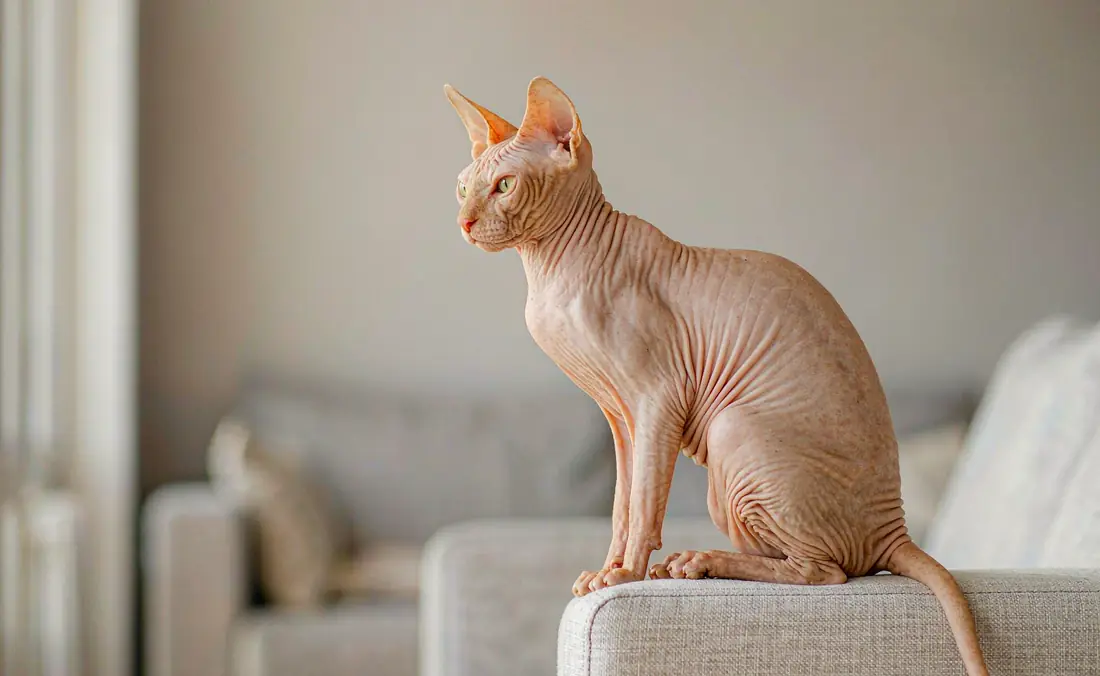
What the standard actually fixes
| Item | CFA standard |
|---|---|
| Overall size | Medium, with “surprising weight for its size” |
| Body | Medium length, hard and muscular; broad rounded chest, full round abdomen |
| Back line | Rises just behind the shoulder blades; rear legs slightly longer than front |
| Point score | Head 35 / Body 35 / Coat-skin 30 |
| Coat | Appearance of hairlessness; short fine hair permitted on feet, ear edges, tail, scrotum |
| Wrinkles | “Wrinkled skin is desirable” around muzzle, between ears, around shoulders |
| Origin | Spontaneous mutation, Toronto, 1966 |
| CFA status | Registered 1998; Championship 2002 |
Two lines in that table carry the commercial weight. The first is “surprising weight for its size” — the standard itself flags that this animal is denser than it looks, which matters directly for anyone sizing clothing from a weight chart.
The second is that the point score gives 30 of 100 to coat and skin, and none of the remaining 70 to any measurement you could put on a tape. As with the Maine Coon, the standard describes shape and skin, not dimensions. There is no published girth figure for the Sphynx from any registry, and any size band you see in a trade chart was drawn by whoever made it.
“Hairless” does not mean hairless
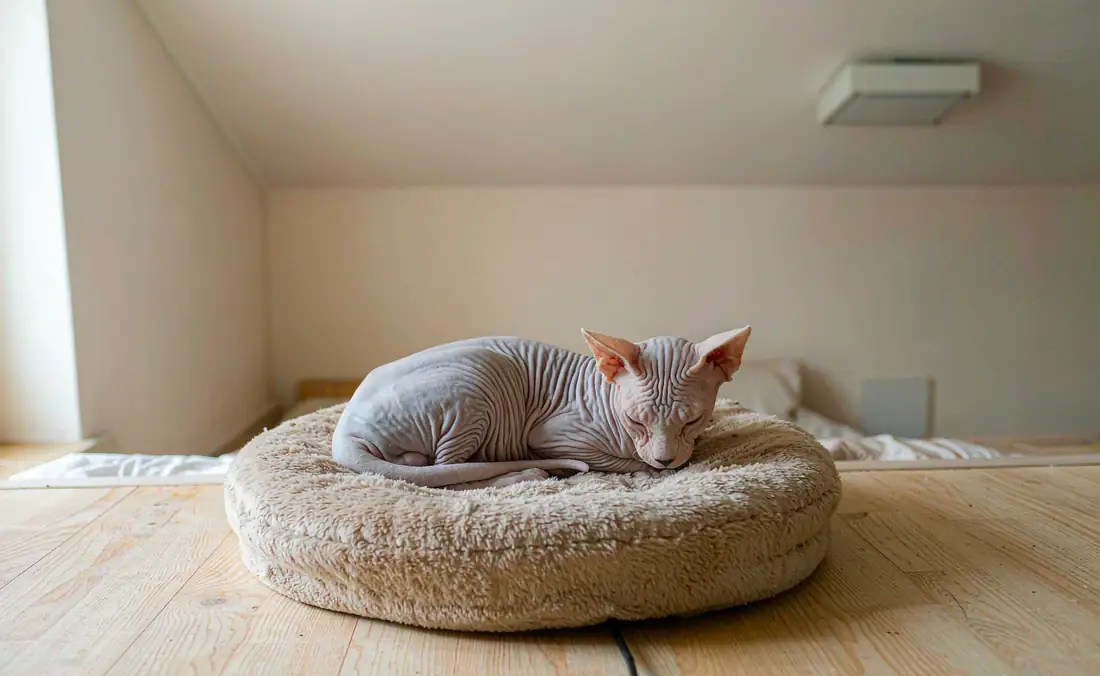
The CFA standard is explicit on this point and is worth quoting directly: the Sphynx is “not actually completely hairless,” and “there should be some evidence of ‘hair’ on the bridge of the nose and the ears.”
Beyond that, short fine hair is permitted on the feet, the outer edges of the ears, the tail and the scrotum, and the bridge of the nose “should be normally coated.” The remainder of the body ranges “from completely hairless to a covering of soft peach-like fuzz whose length does not interfere with the appearance of hairlessness.” Whiskers are usually absent, and where present they are short and sparse.
This matters commercially for a reason that has nothing to do with pedantry. A buyer who assumes the skin is uniformly bare will specify a fabric and a seam finish for one surface, when the Sphynx actually presents several: bare skin over most of the body, a fuzz that behaves differently under friction, and short hair on the extremities that changes how a cuff grips.
“Feels warm” does not mean warmer
Here is where the category goes wrong, and the standard itself supplies the wording that causes it: the Sphynx body “feels warm and soft to the touch, with a skin texture akin to either a soft peach or a smooth nectarine.”
That sentence describes what the hand registers, not what the Sphynx’s core temperature is. A hand touching a coated cat meets an insulating layer of fur that is cooler than the skin beneath it. A hand touching a Sphynx meets the skin directly. The cat is not hotter; the hand is closer to the heat.
The measurement confirms it. Published normal rectal temperature ranges put the cat at 38.1–39.2 °C (100.5–102.5 °F), and the figure is a species-level reference — it does not carry a breed adjustment.
| Species | Normal rectal range (°C) | Normal rectal range (°F) |
|---|---|---|
| Cat | 38.1–39.2 | 100.5–102.5 |
| Dog | 37.5–39.2 | 99.5–102.5 |
Source: MSD Veterinary Manual, adapted from Robertshaw in Dukes’ Physiology of Domestic Animals.
So the heaviest-coated pedigree cat and the hairless one sit in the same band. If a garment, a bed or a heating pad is specified on the premise that a Sphynx needs to be cooled down or runs a higher core temperature, the premise is wrong before the product is drawn.
What is actually different
Not the set point — the cost of holding it. Maintaining that band without insulation takes more energy, which is why the Sphynx is consistently described as eating more than a coated cat of comparable size, and why it seeks external heat. The CFA notes respiratory issues in kittens attributable to the lack of hair, which is the same mechanism.
The practical translation for product: the job is to slow the rate of heat loss, not to add heat. A garment that traps a layer of still air does this. A garment that is merely thick does not, and one that compresses the skin flat removes what little boundary layer there is.
Where heat actually leaves
Heat loss is not uniform across the body, and that decides what a garment has to cover.
- The trunk. The largest surface by area, and the part most clothing covers. This is where the return is.
- The ears. Large to very large in the standard, upright, and with no furnishing on the interior. High surface area relative to volume, and usually left uncovered.
- The paw pads. Thick, and described in the standard as giving the appearance of walking on cushions. Contact with a cold floor is a direct conduction path.
- The inguinal and axillary areas. Thin skin, close to major vessels, and normally uncovered.
A garment that covers the trunk and leaves the legs and ears bare addresses the largest term and ignores two smaller ones. Whether that is acceptable depends on the floor the Sphynx lives on: on a heated indoor floor, trunk coverage is most of the benefit; on tile or in a draught, the conduction path through the paws matters more, and bedding does more than clothing.
This is also why the standard’s note about the back line matters. The topline rises just behind the shoulder blades to accommodate longer rear legs, so a garment cut level along the back will sit short at the rear on a correctly built animal.
What the skin means for fabric
The Cat Fanciers’ Association is unusually direct here: Sphynx cats “have very oily skin that requires regular bathing.” With no coat to absorb it, sebum accumulates on the surface and in the folds.
Four consequences for any product that touches this skin.
Fabric will absorb oil. Clothing worn by a Sphynx takes up the same sebum the skin produces, which means it must be washable at a frequency a coated cat’s garment would never see. A fabric that survives ten washes but not forty is the wrong fabric here.
Seams matter more than on a coated animal. There is no coat between the seam and the skin. A flat seam is not a comfort nicety on the Sphynx; a raised one is a rub point.
Wrinkles are a specification, not a defect. The standard states that wrinkled skin is desirable around the muzzle, between the ears and around the shoulders. Those folds are where oil and debris collect, and they are also where a tight garment will trap moisture. A fit that pulls the skin flat is fighting the standard.
Sun changes the product requirement. The CFA colour section notes that exposure to sun will intensify all colours, which is a euphemism for what happens to unprotected skin. Any product positioned for outdoor or window-side use has to account for it.
The allergy claim
The CFA addresses low-allergen claims directly and rejects them. Bathing reduces the allergens present on the skin, so a freshly bathed cat is less likely to provoke symptoms, but the association’s position is that this “does not add up to a low-allergen cat.” Any product listing that implies otherwise is making a claim the Sphynx’s own registry does not support.
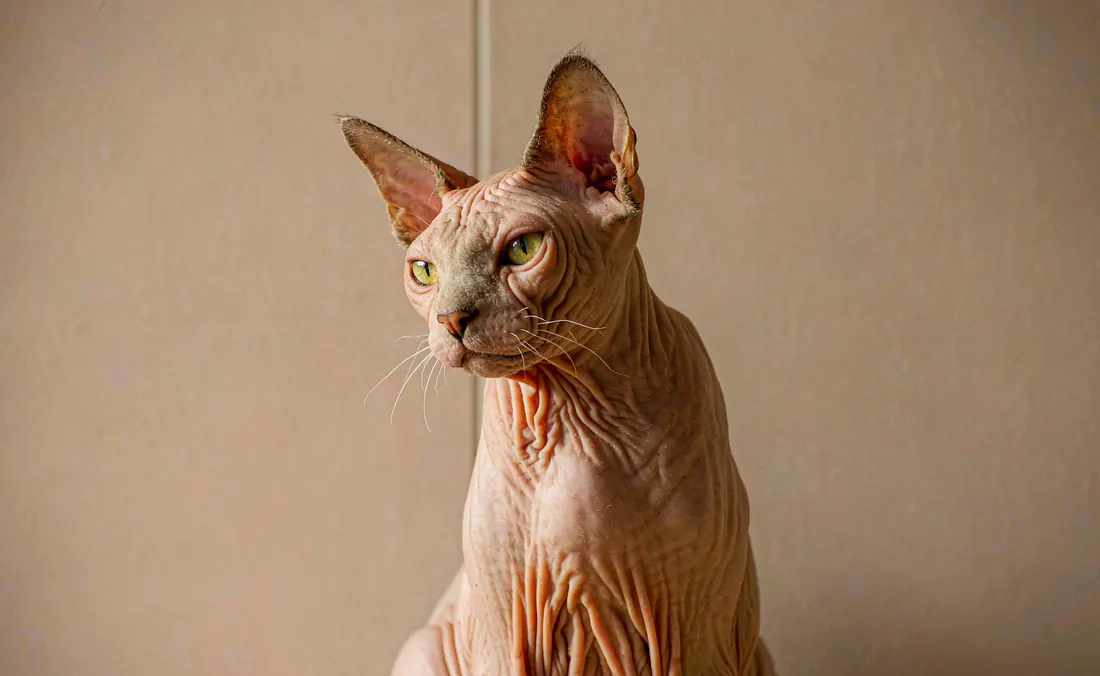
Sizing a Sphynx: the density problem
The standard’s phrase “surprising weight for its size” is the reason weight-based sizing fails on the Sphynx more than on most.
A dense animal of medium frame will fall into a heavier weight band than its dimensions suggest. Buy to the weight and the garment is too big in every linear dimension. Buy to the dimensions and the weight chart will appear to disagree with you. The dimensions are right.
Measure three things, in this order.
- Back length, from the base of the neck to the base of the tail along the topline. This is the primary dimension and the one most charts omit.
- Chest girth, behind the front legs, tape compressed against the body. The standard asks for a broad rounded chest and a full round abdomen, so the girth is not small relative to the frame.
- Neck circumference, taken low. The standard specifies a medium-length, well-muscled neck with allowance for heavy musculature in adult males, which means the neck is a poor proxy for the body.
Record back length and girth together. As with any breed, the combination is what identifies the pattern, and a single number cannot.
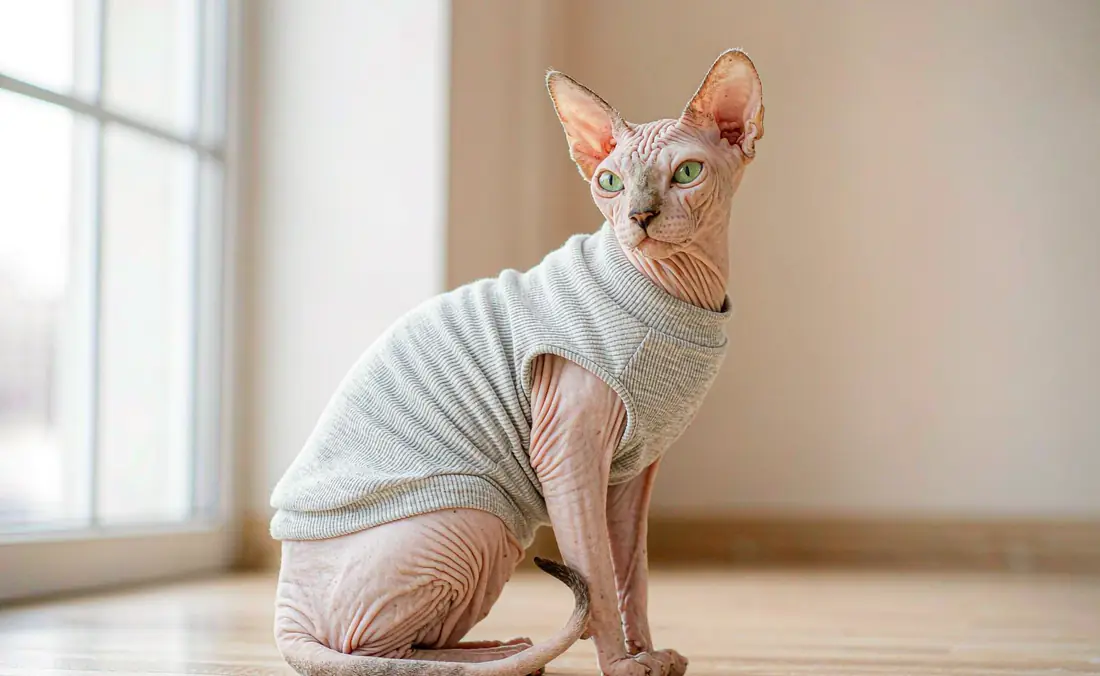
Four product categories this changes
Clothing. The largest and most obvious. The specification that matters is not warmth but the boundary layer: close enough to trap air, loose enough not to compress the skin or pull the wrinkles flat. Our cat sweater range is cut on back length for this reason.
Heated bedding. Where the Sphynx spends its resting hours, bedding does more than clothing because it addresses conduction as well as convection. The specification question is the control: a pad that runs at a fixed output will over-deliver in a warm room. Our heated cat beds are specified with the control behaviour as part of the product rather than as an accessory.
Bathing and handling. Oily skin means frequent bathing, which means the restraint product is used more often on the Sphynx than on any other. A cat bath bag is a higher-frequency item here, and the seam and mesh specification carries accordingly.
Harnesses. Skin without a coat is more exposed to strap friction, and the standard’s full round abdomen changes where a rear strap sits. Our cat harness notes cover padding width for this case specifically.
What does not change
Health screening does not change because the Sphynx is hairless, and the CFA lists the Sphynx’s concerns plainly: hypertrophic cardiomyopathy, hereditary myopathy, sensitive digestion, urticaria pigmentosa and periodontal disease. None of these is a product specification question, and a supplier who implies their garment addresses any of them is overreaching. That is a veterinary matter, and the cat products hub is the right place to compare constructions.
What the Sphynx does to an assortment
This breed behaves differently from every other cat segment in one specific way: clothing is a functional purchase rather than a decorative one. In most cat ranges, garments are an optional add-on with volatile demand. Here they are the reason a customer enters the category, which changes three decisions.
Depth beats breadth. A buyer stocking for Sphynx owners needs the size run to be complete more than it needs a wide colour selection. A customer who finds the right back length in the wrong colour will buy; one who finds the right colour in the wrong length will not.
The garment is the entry, not the basket. Because the owner is already buying against a functional need, the second item attaches more easily than in a decorative category. Heated bedding and bathing accessories are the natural second and third items, and both carry higher repeat rates than the garment itself.
Instructions carry more weight than on any other cat product. The questions this breed generates — how often to wash, whether the animal is cold, what size to buy — are the questions that produce returns when they go unanswered. A size chart printed on the pack does more here than on a coated-breed product, because the weight-chart mismatch described above is the specific thing that goes wrong.
The contrast with a heavily coated breed is instructive. A Maine Coon owner buys for coverage and durability across a large frame; a Sphynx owner buys for thermal behaviour against bare skin. Same category, opposite specification logic, and a range built for one will not serve the other.
Our terms versus common industry practice
| Question | Common practice | Our terms |
|---|---|---|
| Lead time, stocked items | Quoted flat regardless of configuration | 3–7 days, confirmed per order |
| Lead time, custom | Quoted from order date | 7–30 days, counted after sample approval |
| Minimum quantity | Published as a single figure | Low and flexible; confirmed per configuration |
| Mixing categories | One MOQ per category | Mixed batches across categories supported |
| Samples | “Free samples” | Available; terms confirmed per request |
The distinction that matters most on clothing is the sample loop. Fabric hand and seam finish cannot be specified on paper to the standard a hairless-skin product needs, so the sample round is where the decision actually happens. Counting custom lead time from sample approval rather than from order date is the honest formulation, because the approval loop is the variable part and it sits with the buyer.
Five questions to ask any supplier
- Is the garment cut on back length, or on weight bands?
- What is the seam construction at the underarm and the neck — flat, overlocked, or turned?
- How many domestic wash cycles has the fabric been tested to, and does the test include oil soiling?
- Does the heated product modulate output, or does it run at a fixed wattage?
- Can one order cover the full size run in a single colourway, or does each size carry its own minimum?
The third question is the one that separates a supplier who has made hairless-breed clothing from one who has dyed a coated-breed garment. The fifth decides whether a correct size run is affordable.
Frequently asked questions
Do Sphynx cats need clothing?
In a heated indoor environment, not necessarily. Where they benefit is in slowing heat loss, and the need rises with cold floors, draughts and air conditioning. The Sphynx seeks external heat consistently, which is the practical signal.
Is a Sphynx’s body temperature higher than other cats’?
No. The published normal rectal range for cats is 38.1–39.2 °C regardless of breed. The Sphynx feels warm to the hand because there is no coat between the hand and the skin, not because the core temperature is elevated.
Why does my Sphynx eat so much?
Maintaining body temperature without insulation costs energy. A Sphynx eating more than a coated cat of similar size is the expected pattern rather than a problem, and body condition is the thing to monitor rather than portion size alone.
Are Sphynx cats hypoallergenic?
No. The CFA states directly that while bathing reduces allergens on the skin and a freshly bathed cat is less likely to provoke symptoms, this does not amount to a low-allergen cat.
Are they completely hairless?
No. The standard requires some hair on the bridge of the nose and the ears, permits short fine hair on the feet, ear edges, tail and scrotum, and describes the body as ranging from fully bare to a soft peach-like fuzz.
How often do they need bathing?
The CFA describes the skin as very oily and requiring regular bathing. Frequency varies with the individual and the season, but the point for product specification is that it is far more often than a coated cat, and any fabric in contact has to survive that cycle count.
What size clothing should I order?
Order on back length and chest girth, not on weight. The standard describes the Sphynx as having surprising weight for its size, so a weight chart will put the Sphynx in a band that is too large in every linear dimension.
Do wrinkles need special care?
They need to be kept clean and dry. Wrinkled skin is a desirable trait in the standard, particularly at the muzzle, between the ears and around the shoulders, and folds collect oil and debris. A garment that pulls them flat is both fighting the standard and creating a moisture trap.
Can a Sphynx go outside?
Sun exposure is the constraint. The CFA notes that sun intensifies all colours, and bare skin has no ultraviolet protection. Window-side resting is enough to matter over time.
What should I check on a sample?
Put it on a cat and check three things: whether the garment flattens the fuzz on the body, whether any seam sits on a wrinkle at the shoulder, and whether the rear of the garment is long enough for a topline that rises behind the shoulder blades.
Where to start
Send us the size run you need to cover, the fabric hand you are after and the wash-cycle expectation. We will come back with a size curve, the seam and fabric specification, and a quote.
Related reading
The Maine Coon sizing guide covers the opposite problem, a very heavy coat on a long torso, and makes a useful comparison for fabric and fit. The cat carrier range applies the same conduction logic to transport. For a new range rather than a new pattern, the 12-week private label launch guide sets out the timeline, OEM versus ODM covers who owns the pattern, and the wholesale pet supplies hub is the entry point across categories.
Written by the Cuteeye product team, Huizhou, Guangdong. Cuteeye manufactures silicone, nylon and webbing pet accessories for pet shops, e-commerce sellers, distributors and private-label brands. Health information in this article summarises published veterinary reference ranges and the CFA breed standard and is not veterinary advice; fit decisions should be checked against the individual cat.