Why Wholesale Dog Harnesses Get Returned
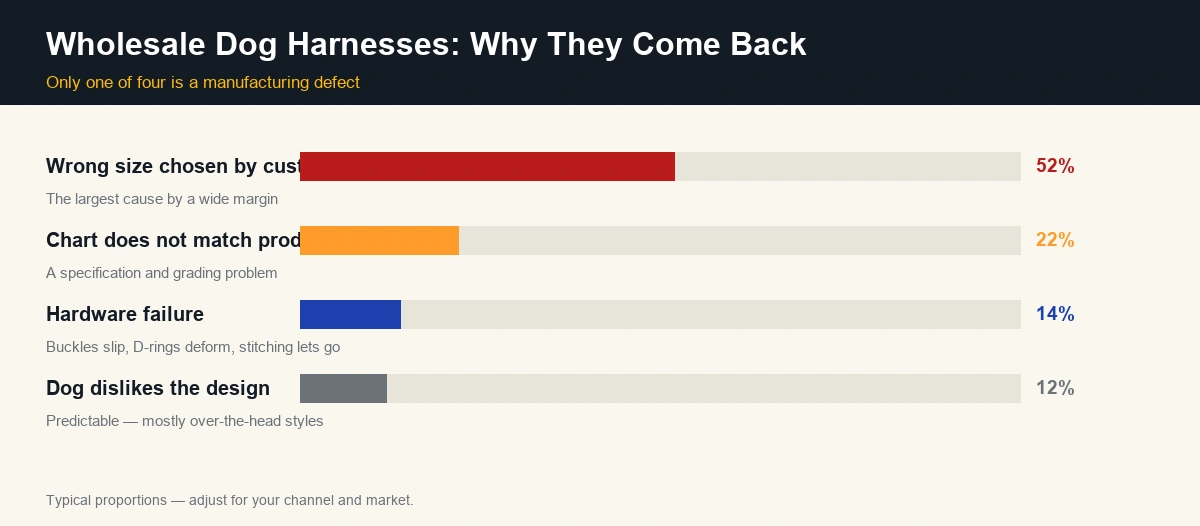
Before discussing specification for wholesale dog harnesses, it is worth naming the failure modes, because they are not evenly distributed. Across the category, returns cluster around four causes, and only one of them is a manufacturing defect:
- Wrong size selected by the end customer. By a wide margin the largest cause. A customer measures a dog at home, guesses, and orders. If your size chart is ambiguous or your labels disagree with it, this is the failure you will absorb.
- Size chart does not match the product. A manufacturing and specification problem. The harness labelled medium measures as a small, or the range is graded inconsistently across colours.
- Hardware failure. Buckles that slip under load, D-rings that deform, stitching that lets go at the load point. Genuinely a quality issue, and the one most easily prevented by naming components.
- Dog dislikes the design. Over-the-head styles in particular. Not a defect, but it generates returns, and it is predictable enough to plan around.
The practical conclusion for wholesale dog harnesses: the highest-return on investment in a harness range is a size chart that is unambiguous and a product that matches it. Everything else is second order.
The Four Measurements That Actually Matter
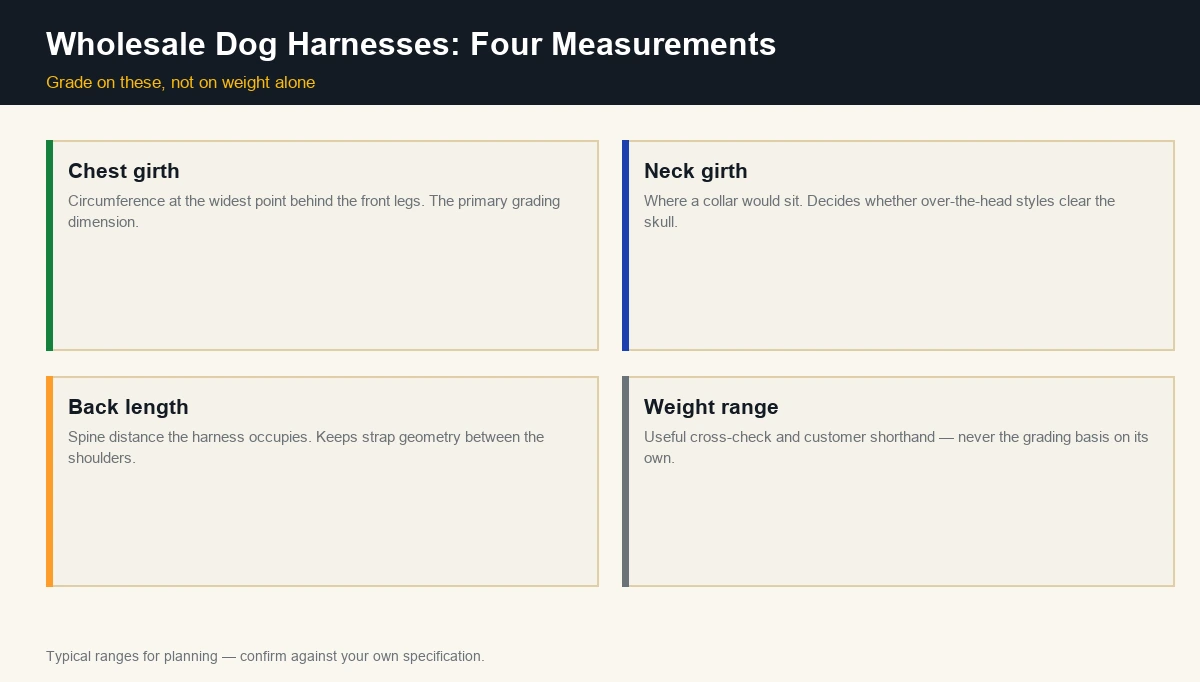
Most wholesale dog harnesses size charts list weight alone. Weight is the least useful of the four measurements you should be specifying, because two dogs of identical weight can have completely different chest geometry. For wholesale dog harnesses, grade on these:
- Chest girth — the circumference at the widest point behind the front legs. This is the primary grading dimension and the one that determines whether the harness sits correctly.
- Neck girth — where the collar would sit. Matters for over-the-head styles, which must pass over the skull as well as fit the neck.
- Back length — the spine distance the harness occupies. Determines whether the strap geometry sits between the shoulders rather than across them.
- Weight range — useful as a cross-check and as customer-facing shorthand, but never as the grading basis on its own.
When you brief a specification for wholesale dog harnesses, ask for the adjustment range on each strap in centimetres, not just the nominal size. A harness with generous adjustment covers more of the population with fewer SKUs, which is the cheapest way to reduce both your inventory risk and your customers' return rate.
Clip Position: Front, Back and Dual
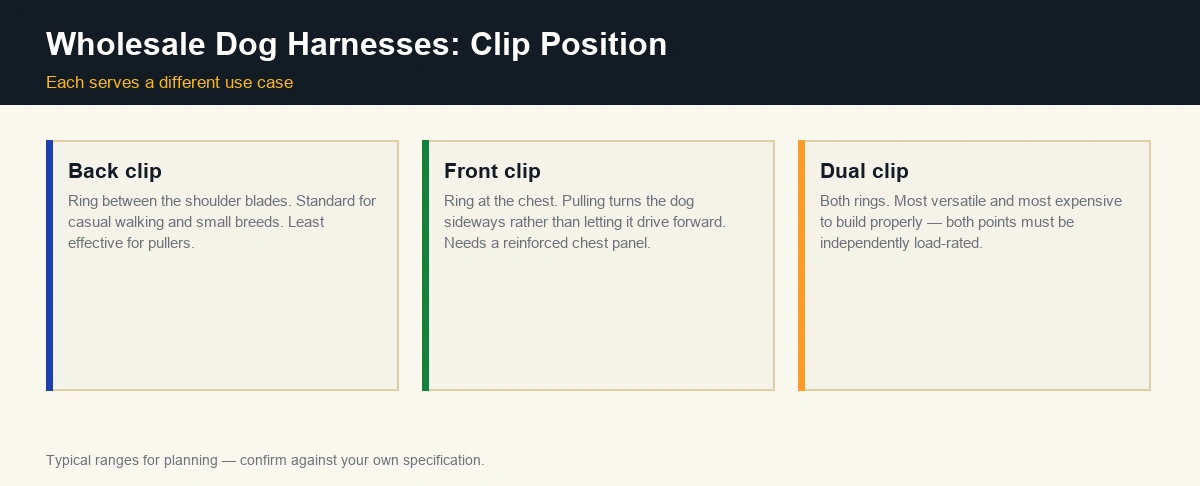
The clip position is the clearest functional division in wholesale dog harnesses in wholesale dog harnesses, and each position serves a genuinely different use case rather than a marketing tier:
- Back clip. The D-ring sits between the shoulder blades. Standard for casual walking, comfortable for the dog, and the right default for small breeds where leash pressure matters less. Least effective for dogs that pull.
- Front clip. The ring sits at the chest. Pulling turns the dog gently sideways rather than letting it drive forward, which is the mechanism behind no-pull designs. Requires sturdier chest construction because load concentrates there.
- Dual clip. Both rings, so the handler can use a double-ended leash or switch based on the walk. The most versatile and the most expensive to build properly, because both attachment points must be independently load-rated.
Worth being precise about wholesale dog harnesses here: a front-clip ring attached to a lightly constructed chest panel is not a no-pull harness, whatever the packaging says. The load path has to be reinforced. If you are buying on the no-pull claim, specify the reinforcement and ask what the attachment is rated to.
Building the Size Split for a First Order
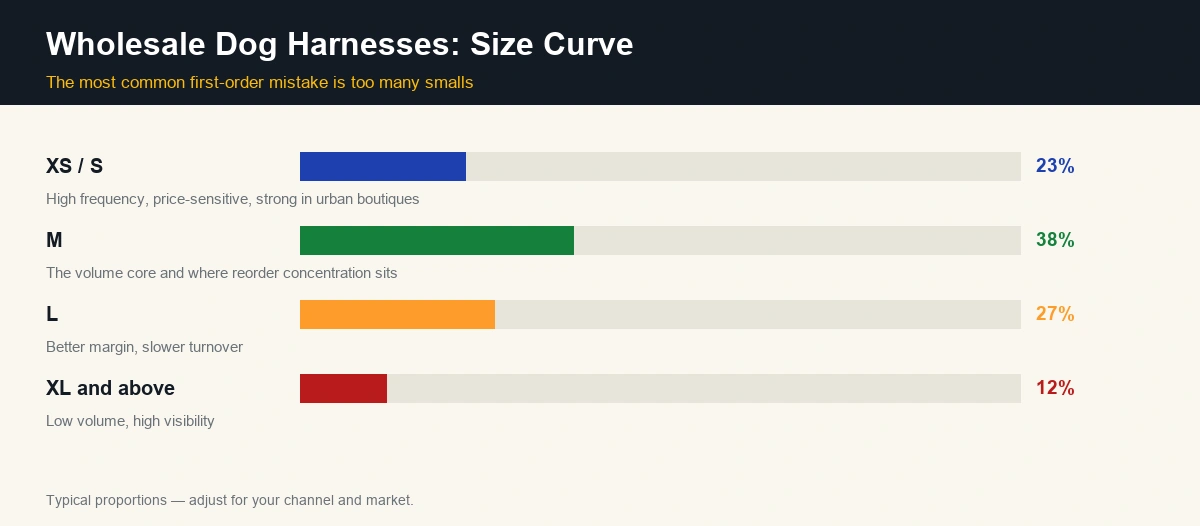
The same mistake repeats across almost every first wholesale dog harnesses order: too many smalls. Buyers visualise the product on a medium dog and produce a distribution that does not match the demand curve.
A reasonable starting distribution for a general retail range:
- XS / S — 20–25% of units. High frequency, price-sensitive, strong in urban and boutique channels.
- M — 35–40% of units. The volume core and where reorder concentration sits.
- L — 25–30% of units. Better margin, slower turnover.
- XL and above — 8–12% of units. Low volume, high visibility; the sizes customers notice when a brand stocks them.
Adjust the wholesale dog harnesses split for your channel. Working-breed and rural retail skew larger; city boutiques and small-breed specialists skew sharply smaller. The point is to commit to a curve explicitly and write it into the order rather than letting it emerge by default, because the cost of being wrong is a warehouse full of sizes nobody is buying while you reorder the ones everybody is.
Webbing, Hardware and Stitch Specification
Two wholesale dog harnesses can look identical in a photograph and differ by a factor of three in load capacity. The difference lives in components worth naming in your specification:
- Webbing — polyester webbing is the standard; nylon is softer against the coat and absorbs more water. Specify width and breaking strength in writing.
- Buckles — side-release buckles are the most common failure point. Name the supplier and the rated load. Unbranded buckles are the single largest source of hardware complaints in the category.
- D-rings and hardware finish — welded rings rather than bent wire, and a finish rated for salt spray if you sell into coastal or wet-weather markets.
- Stitch density and bar-tacking — specify stitches per inch, and require bar-tack reinforcement at every point where webbing meets the panel. This is where load concentrates.
- Padding and lining — breathable mesh or neoprene lining reduces chafing complaints substantially on medium and large sizes.
Reflective stitching or binding on wholesale dog harnesses is worth specifying as standard rather than as an upgrade: it is inexpensive at the specification stage and it is the feature most often cited in positive reviews for this category.
For webbing and textile components, documentation such as OEKO-TEX standards is worth asking about where your market requires it.
Harness Styles and What Each Is For
Beyond clip position, the structural styles available in wholesale dog harnesses in wholesale dog harnesses divide by how the harness goes on, and this is what drives the "dog dislikes it" return category:
- Step-in harnesses. The dog places two feet in and the harness clips over the back. Fast, low-fuss, good for small dogs and for dogs that resent things going over the head. Can be escaped by determined backing out.
- Over-the-head harnesses. Pass over the skull and buckle under the chest. Secure and popular for medium and large breeds. Requires adequate neck opening, which is why neck girth belongs in the spec.
- Tactical and padded working harnesses. Heavier webbing, handle on the back, MOLLE or attachment points. Serves working dogs, service-dog applications and a growing outdoor segment.
- No-pull and front-lead designs. Engineered around the chest attachment as described above.
- Lightweight mesh and vest styles. Summer and small-breed lines; the volume driver in warm climates.
Most successful wholesale dog harnesses ranges carry two or three of these rather than one style in many colours. Colour depth is cheaper to add later; style coverage is what determines whether a customer finds something that suits their dog.
Customisation and Private Label
Wholesale dog harnesses brand well because the webbing and the chest panel both take decoration. Typical options for wholesale dog harnesses:
- Woven or printed label on the chest panel
- Custom webbing colour, pattern or jacquard weave
- Branded buckles at sufficient volume
- Custom hangtags, retail packaging and barcode application
- Matching leash sets, which materially improve basket value
Stock configurations dispatch in roughly 3–7 days; custom webbing, colours or branding move into the 7–30 day production window measured from artwork approval. If you are building a range, pairing harnesses with wholesale dog collars in matched colourways is the most reliable way to lift average order value.
How We Test Before Shipment
Testing is only meaningful if it is specified, so these are the checks for wholesale dog harnesses worth requiring in writing from any supplier of wholesale dog harnesses, including us:
- Pull test on the load path — apply sustained load to the D-ring and the buckle, and record the result.
- Buckle cycle test — open and close cycles to confirm the release mechanism does not wear loose.
- Wash or abrasion test on webbing and print — particularly for printed patterns and for webbing that will be washed.
- Dimensional check against the size chart — measure production samples, do not trust the grading on paper.
- Salt spray on metal hardware where the destination market justifies it.
Ask for the results on your wholesale dog harnesses, not the assurance. A supplier who measures can show you numbers.
Harness or Collar: What Your Range Should Say
Buyers frequently treat harnesses and collars as competing products when customers experience them as complementary, and the range decision follows from understanding when each is right.
- Collars carry identification and suit dogs that walk calmly. They are the higher-frequency purchase, the lower price point, and the natural attachment for ID tags.
- Harnesses distribute load across the chest and suit dogs that pull, small breeds where neck pressure is a concern, and brachycephalic breeds for whom collar pressure is genuinely problematic.
- Both is what most owners end up owning, which is why matched sets across wholesale dog collars and harnesses sell so reliably.
For wholesale dog harnesses specifically, the commercial argument is margin and differentiation: the category carries a higher ticket than collars, is less price-transparent to consumers, and rewards a supplier who can explain fit. That last point is worth acting on — retail staff who can measure a dog correctly sell more harnesses and return fewer.
If you are choosing where to start, note that collars are the easier first category and harnesses the better second one. Collars teach you the size distribution of your market, and that data is directly transferable when you build the harness range.
Writing a Specification That Prevents Disputes
Most disagreements between a buyer and a factory in this category come from specifications that were never written down. A workable spec for wholesale dog harnesses fits on one page and contains the following, each as a number rather than an adjective:
- Chest girth range and neck girth range per size, in centimetres, with tolerance
- Webbing material, width and minimum breaking strength
- Buckle supplier and rated load
- D-ring type — welded or bent — and finish specification
- Stitches per inch, and bar-tack requirement at every load junction
- Reflective element specification, if applicable
- Pull-test method and acceptance threshold
Seven lines, and it converts most quality conversations from opinion into measurement. A supplier who will not sign against a specification like this is telling you something about how quality will be handled when something goes wrong.
Ordering, Lead Times and Consolidation
Stock wholesale dog harnesses dispatch in roughly 3–7 days; custom webbing, colours or branding run 7–30 days from artwork approval, with freight additional. Because harnesses are dense and pack flat, they are among the better consolidation partners in a mixed container — they occupy the dead space that bulky categories cannot use.
For a first order, the sequence that tends to work is: sample the two sizes you expect to sell most, run a mixed first order across the size curve, then reorder against actual sell-through rather than against the original forecast. Buyers who reorder from data rather than from the initial estimate consistently carry less dead inventory in this category.
Seasonality and Reorder Rhythm
Harness demand is steadier than most pet categories, with one exception worth planning for: puppy season. Cohorts of new dogs arrive in predictable waves, and each wave buys a collar and a harness within its first few months. Buyers who align wholesale dog harnesses reorders to those waves carry less inventory and miss fewer sales than buyers who reorder on a flat calendar.
The second pattern is weather-linked. Padded and tactical styles lift in cold months; lightweight mesh styles lift in warm ones. If you serve a market with a pronounced seasonal swing, plan the mix at least one production cycle ahead, because the lead time is longer than the demand signal.