



Last updated: October 18, 2026 · Written by the Cuteeye Pet B2B sourcing team, Huizhou, Guangdong, China
The sections above covered what we make and how to brief us. This part covers the decisions that come before any of that — how pet supplies wholesale pricing is actually built, whether to buy through a distributor or direct, how to spread a first order across categories, and what to confirm before releasing a deposit. It is written for buyers comparing suppliers rather than browsing a catalogue.
Nothing here is a quote. Ranges in pet supplies wholesale are typical rather than promised, and your own numbers depend on material, order size, freight mode and destination market. Ask any supplier — including us — to put theirs in writing.
Why bother with this level of detail about pet supplies wholesale? Because pet supplies wholesale is one of the few sourcing categories where the gap between a good outcome and a mediocre one is almost entirely decided before production starts. The product itself — a collar, a bowl, a bed — is rarely the hard part. The hard part is knowing what you are actually paying, what you are committing to, and what happens when something goes wrong three months later.
What this section covers:
- How pet supplies wholesale pricing is actually built
- Distributor, wholesaler or direct factory
- A category map for wholesale pet supplies buyers
- Building a balanced first order
- What to check before your first bulk order
- MOQ, lead times and shipping
- FAQ
How Pet Supplies Wholesale Pricing Is Actually Built
The number in a quotation is the ex-works unit price. It is rarely half of what the unit costs you by the time it is sellable. Buyers comparing pet supplies wholesale quotes on that number alone consistently lose money on the deals that looked best on paper.
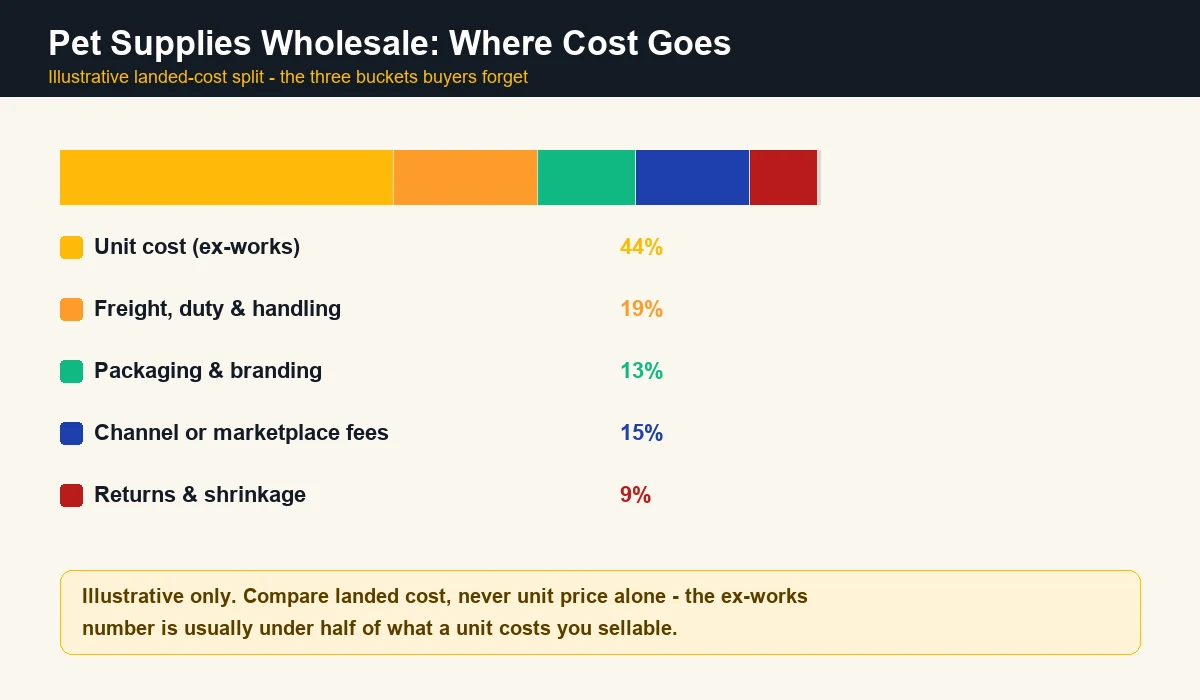
Five buckets make up the real cost of a pet supplies wholesale order:
- Unit cost ex-works — around 44 percent. Materials, labour, hardware and basic packing. This is what gets quoted.
- Freight, duty and handling — around 19 percent. Varies more than anything else on this list. Light, flat-packed accessories consolidate far better than bulky items, which is why a mixed carton of collars and toys behaves very differently from a pallet of cat trees.
- Packaging and branding — around 13 percent. Woven labels, printed cartons, hang tags, barcodes, inserts. Almost always underestimated in a first budget.
- Channel or marketplace fees — around 15 percent. Referral fees, fulfilment, payment processing, returns handling.
- Returns and shrinkage — around 9 percent. Mostly sizing and expectation mismatches rather than manufacturing faults.
Two consequences follow, and they matter more than the percentages. First, a supplier charging ten percent more ex-works can still land cheaper if their packing is better or their cartons consolidate more efficiently — so ask for a landed-cost quote, not a unit price. Second, a cheap unit price achieved by thinning material or substituting hardware will reappear in your return rate, which is the most expensive line here.
How volume tiers actually work
Most pet supplies wholesale pricing is tiered rather than linear, and the steps are rarely where buyers expect them. A jump from 300 to 500 units may change the unit price very little, while 500 to 1,000 can move it considerably, because the second step lets the factory run the material in one continuous batch instead of two. Ask where the tiers sit before you finalise quantities — it is common to find that a slightly larger order costs almost the same in total.
Seasonality matters in pet supplies wholesale too. Factories running near capacity in the months before peak retail season will quote longer lead times and hold firmer on price. Ordering against the seasonal grain, where your own calendar allows it, is one of the few reliable ways to improve both.
Distributor, Wholesaler or Direct Factory
Three routes exist in pet supplies wholesale, and the right one depends on where you are rather than which sounds best.
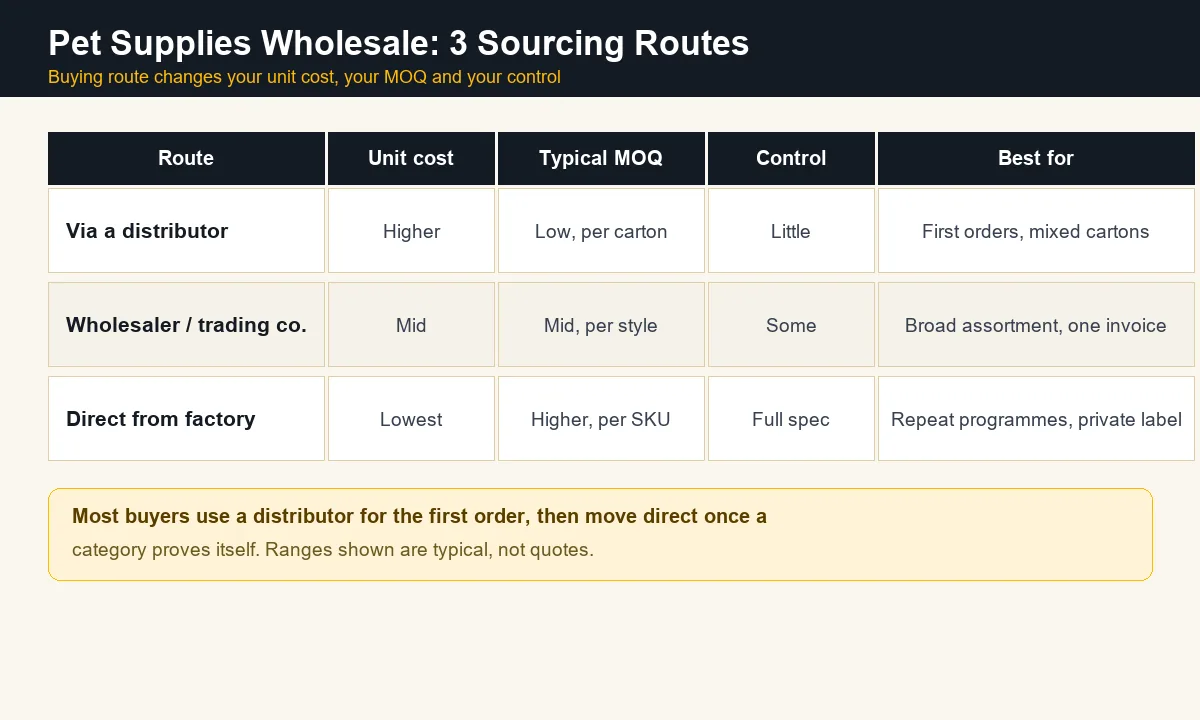
- Through a distributor. Highest unit cost, lowest commitment, minimal control. You buy cartons of what someone else already imported. Sensible for a first order, or when you need mixed cartons immediately.
- Through a wholesaler or trading company. Mid cost, mid minimums, some control. The real advantage is breadth — many categories on one invoice, one point of contact, one shipment.
- Direct from a factory. Lowest unit cost, higher minimum per SKU, full control over specification. Right once a category has proven itself and you are reordering rather than testing.
The pattern we see most often in pet supplies wholesale: a buyer starts with a pet supplies distributor to test demand without committing, then moves direct on the two or three categories that sell. Skipping straight to factory-direct on an unproven category is the most common way to turn working capital into slow inventory.
Industry bodies such as the American Pet Products Association publish annual category spending data that is worth reading before you decide which segments to enter at all.
One thing worth understanding about route choice in pet supplies wholesale: it is not permanent, and treating it as permanent is itself a mistake. The distributor you use for a first test order and the factory you reorder from eighteen months later do not have to be the same company, and often should not be. What matters is that each stage matches the question you are actually asking — “does this sell?” at the start, “how cheaply can I make this repeatedly?” later.
A Category Map for Wholesale Pet Supplies Buyers
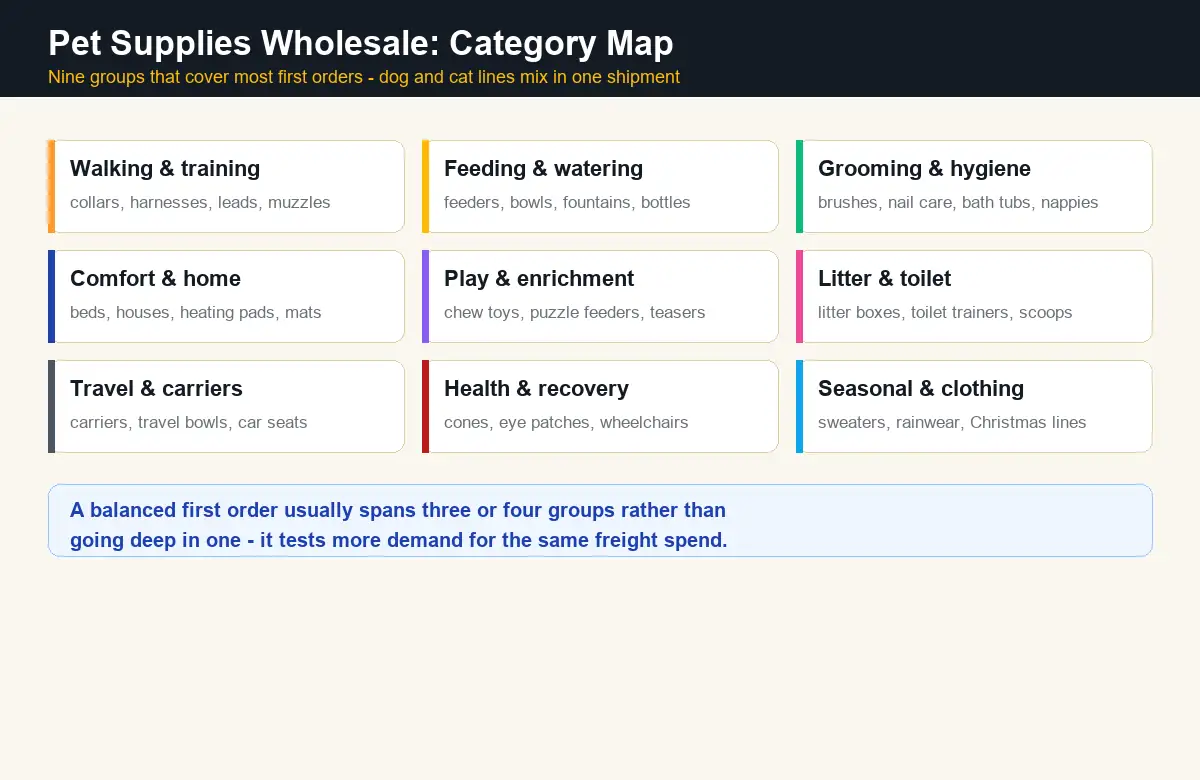
Most pet supplies wholesale first orders are built from three or four of these groups rather than going deep in one. Spreading across groups tests more demand for the same freight spend, which is usually the better use of a first container. Here is how our own range maps onto them — each link opens the wholesale page for that category.
Walking, Training and Outdoor
The most reliable starting group for dog lines, because collar, harness and lead ranges can be ordered in matching colourways. See wholesale dog collars, dog harnesses, dog ID tags and cat harnesses. Safety-led items such as rain protection sit in the same group and sell seasonally.
Feeding and Watering
Repeat-purchase products, which makes them good for retention but competitive on price. Our range includes dog feeders, travel water bottles and cat feeders.
Grooming and Hygiene
Strong margin and low return rates, but sizing and fit drive satisfaction. Covers grooming tools, bath tubs, dog nappies and cat toilet trainers.
Comfort and Home
Higher unit value, higher freight sensitivity. Includes dog beds and cat trees and scratchers. These need more attention to carton protection than flat-packed accessories.
Play and Enrichment
Visual products that sell on listing quality. See dog toys, cat toys and cat exercise wheels.
Litter, Travel, Health and Seasonal
Smaller groups that round out a range: litter boxes, carriers, recovery cones and pet knitwear. Seasonal lines are worth planning six months ahead rather than ordering in-season.
The full pet supplies wholesale lists sit on our dog products and cat products hubs.
Building a Balanced Pet Supplies Wholesale Order
A balanced pet supplies wholesale first order usually has three properties: it spans several categories, it is weighted toward the middle sizes, and it leaves room to reorder quickly.
- Span categories, do not go deep in one. Four categories at moderate depth tests four hypotheses. One category at high depth tests one, and concentrates the risk.
- Weight the size curve. Demand is not even across sizes. Buying evenly guarantees a stockout in the middle while the extremes sit unsold.
- Keep one reorder slot open. Budget for a second, smaller shipment after eight to ten weeks rather than spending everything on the first.
- Specify mixed cartons. Confirm that colours, sizes and categories can ship in one carton. If every variant carries its own minimum, your first order is much larger than you think.
Sizing deserves its own note, because it causes more lost money in pet supplies wholesale than any other single decision. If you buy evenly across sizes you will be out of stock on the middle while the extremes sit unsold. Ask your supplier for the size curve they ship to comparable retailers, then revise it after two reorders using your own sell-through data rather than anyone’s assumption — including ours.
Five mistakes that cost first-time pet supplies wholesale buyers money
- Designing before costing. Artwork that lands twenty percent above your target retail price is a dead project, however good it looks. Cost the concept first.
- Comparing unit prices instead of landed cost. The single most common error in pet supplies wholesale, and the easiest to fix.
- Skipping the sample. Every reason for skipping it sounds reasonable right up until the container arrives.
- Buying evenly across sizes. It guarantees a stockout and dead inventory at the same time.
- Treating pet supplies wholesale as a transaction rather than a programme. Pet supplies wholesale is a repeating relationship. The supplier who gets your range right on reorder three is worth more than the cheapest quote you will get this week.
How to Brief a Pet Supplies Wholesale Supplier
In pet supplies wholesale the quality of a quotation is almost entirely determined by the quality of the brief it responds to. A vague inquiry produces a vague price, and the buyer then spends two weeks discovering what the number actually covered. A useful brief takes about ten minutes to write and covers six things:
- Product reference. Name, photo, or a link to what you have in mind. A picture resolves more ambiguity than three paragraphs.
- Quantity and how it is split. Total units, and how many per colour or size. State whether you expect to mix in one carton.
- Material and finish. Be specific: webbing type, metal plating, fabric weight. “Nylon” is not a specification.
- Branding requirement. Whether you need a logo, where, and on what — webbing, hardware, packaging or all three.
- Packaging. Retail-ready, bulk carton, or private-label presentation. This changes cost more than buyers expect.
- Destination and timing. Country, preferred Incoterm, and when the goods need to be on shelf rather than shipped.
Sending those six items up front is the difference between a quotation you can act on and one you have to interpret. It also tends to get faster replies, because it does not require anyone to guess.
What to Check Before Your First Bulk Pet Supplies Order
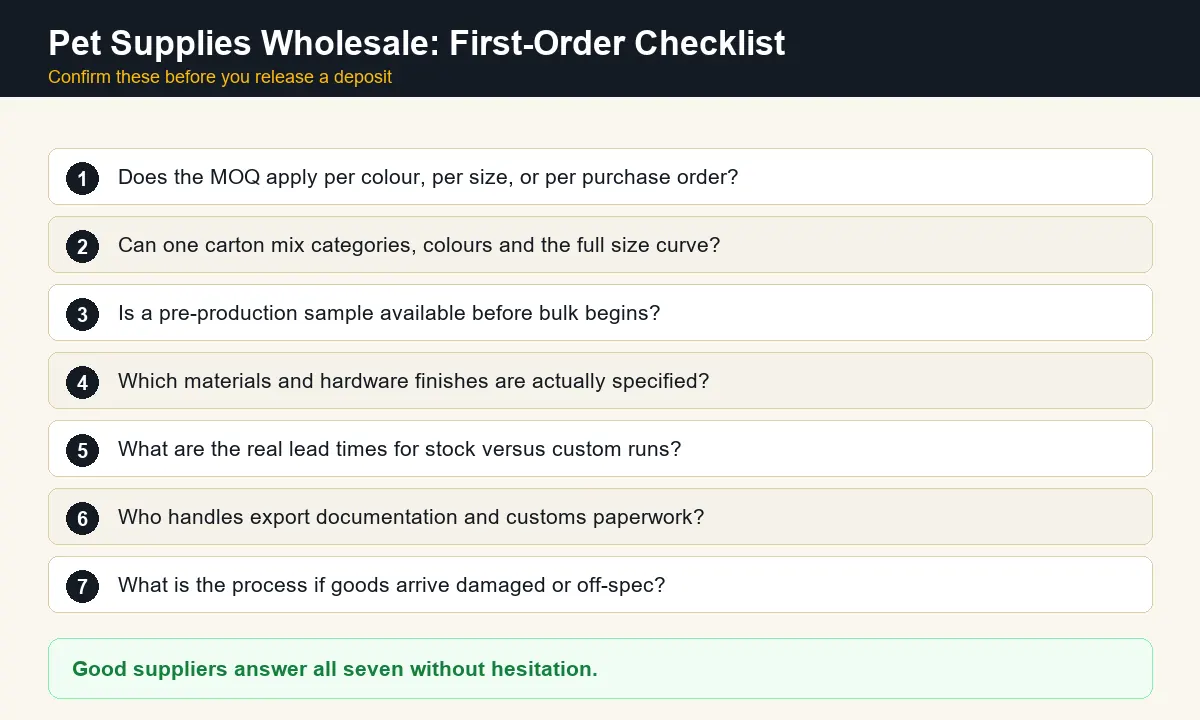
Ask these before releasing a pet supplies wholesale deposit, and use the same list on every candidate — including us.
- Does the minimum apply per colour, per size, or per purchase order? Those three answers describe very different commitments.
- Can one carton mix categories, colours and the full size curve? This determines both your true minimum and your freight cost per unit.
- Is a pre-production sample available before bulk begins? Never skip it, whatever the schedule pressure.
- Which materials and hardware finishes are actually specified? “Nylon” is not a specification; denier, weave and hardware plating are.
- What are the real lead times for stock versus custom runs? Ours are 3–7 days for in-stock items and 7–30 days for custom production, but every supplier’s numbers differ.
- Who handles export documentation and customs paperwork? Confusion here costs weeks at the destination, not days.
- What is the process if goods arrive damaged or off specification? Ask for the actual procedure and the window, not a reassurance.
Where your market requires them, ask which documents exist today rather than what might be arranged — composition statements, and third-party testing such as OEKO-TEX standards or REACH-related documentation for textile and plastic components.
Two further checks rarely appear on buyers’ lists but should. Ask who actually owns production — some suppliers run their own lines, others coordinate a network, and both can be legitimate, but you should know which one you are paying because it determines who controls your lead time. And ask who answers in month eleven, because some of the cost of a supplier is only visible after several orders have gone through.
MOQ, Lead Times and Shipping for Wholesale Pet Supplies
Three numbers decide whether a pet supplies wholesale programme works, and only one of them appears in most quotations.

- Minimum order quantity. Flexible and low in our case, but the definition matters more than the number. Per colour and per order are different by a factor of several.
- Production lead time. In-stock items ship in about 3–7 days; custom production typically completes in 7–30 days depending on specification and order size.
- Freight and clearance. Sea is cheapest per unit and slowest; air and courier cost several times more and buy weeks. Collars, toys and small accessories pack flat and consolidate well, which is genuinely favourable; beds, trees and carriers pay a volume penalty because they ship air.
One practical point that saves real money: consolidating several categories into one shipment spreads freight across more units. A container carrying collars, toys, grooming tools and feeders lands far better per unit than four separate shipments of the same total volume.
It also changes how you should think about pet supplies wholesale economics generally. Because freight is a large share of landed cost and does not scale linearly with order value, the cheapest-looking order is often the least efficient one. A buyer who consolidates well at modest volume can land below a buyer who negotiates a better unit price but ships in small, poorly packed lots.
What delays actually happen
In pet supplies wholesale our experience is that delays are rarely where buyers fear them. Production itself is usually predictable once a specification is locked. What slips is everything around it: artwork approval loops inside the buyer’s own organisation, barcode allocation that was left until artwork was already finished, and samples that sat unopened for a week. Budget time for your own side of the process, not just the factory’s.
Frequently Asked Questions
What is the difference between buying from a pet supplies distributor and buying direct?
In pet supplies wholesale a distributor holds stock you can buy in small quantities immediately, at a higher unit cost and with little say over specification. Buying direct usually means a higher minimum per SKU and a longer lead time, in exchange for a lower unit cost and control over material, colour, branding and packaging. Most buyers use a distributor for the first order and move direct once a category proves itself.
Can I mix dog and cat products in one order?
Generally yes, and it is one of the most useful things about working with a supplier covering multiple categories rather than a single specialist line. Mixed cartons let you test more products per shipment and spread freight across more units. Confirm whether the minimum applies per category or per purchase order.
How is pet supplies wholesale pricing usually calculated?
Quotations normally show an ex-works unit price, which excludes freight, duty, branding and channel fees. Those excluded items are typically more than half of what a unit costs you sellable, so always compare landed cost rather than unit price. Ask for a landed-cost quote and check what is included.
What should a first order include?
Spread it across three or four categories rather than going deep in one, weight quantities toward the middle of the size curve, and keep budget for a second smaller reorder after eight to ten weeks. Confirm that colours and sizes can ship mixed in one carton, otherwise your effective minimum is much higher than quoted.
Are samples available before bulk production?
Yes, and we recommend it without exception. Sampling costs about two weeks on the calendar and removes most of the realistic ways to lose money on a first order. Treat reluctance to provide samples as a warning sign from any supplier.
How long does delivery take?
In-stock items typically ship in 3–7 days and custom production completes in 7–30 days, depending on specification and order size. Freight adds weeks on top depending on mode and destination, so plan from the landed date rather than the production date.
Which documents should I ask for?
Ask what exists today rather than what could be arranged. For most markets that means composition statements, and for textile or plastic components, third-party testing such as OEKO-TEX standards or REACH-related documentation where required. Get the answer in writing before you commit.
Does a pet supplies wholesale order have to be large to be worth it?
Not necessarily, but it does have to be consolidated. Small orders are viable when several categories share one shipment, because freight is then spread across more units. What makes an order uneconomic is usually fragmentation — several small shipments rather than one well-packed one — rather than low volume as such. Ask whether mixed cartons are allowed before assuming you need a large quantity.
Can I move from a distributor to buying direct later?
Yes, and it is the normal path. Buyers typically start through a distributor to test demand without committing, then move direct on the categories that sell. Keeping the same supplier across both stages is convenient but not required. The point of the first stage is to answer whether the product sells; the point of the second is to make it cheaper.
Where to Go Next
If you are weighing up pet supplies wholesale routes, the practical next step is a short conversation rather than another hour of reading: send your target market, the categories you want, estimated quantities and whether you need branding. Our team will tell you which route actually fits — including when buying direct is the wrong answer.
Browse the dog products and cat products ranges first if you are still deciding on categories, or start a conversation on our contact page.