
UPC barcodes are the most standardized and most misprinted element on pet product packaging. The digits themselves are trivial to get right — they are issued by one organization and follow one formula — yet rejected shipments and failed retail scans still trace back to avoidable print errors. In practice most problems with UPC barcodes are print problems rather than number problems: the number was correct on the proof and unreadable on the carton. This guide covers who needs a UPC, how the 12 digits and the check digit actually work, which print specifications keep a barcode scannable, and the five checks to run before any pet product order ships.
Who actually needs a UPC (and who does not)
A UPC is a retail scanning code, so the first question is whether your product ever crosses a point-of-sale scanner. If pet products are sold through retail chains, on Amazon or any marketplace that reads GTINs, or into distributor networks that scan at the warehouse, the packaging needs a scannable retail code. If the product ships only business-to-business — bulk cartons to a distributor who repacks and retails under their own numbers — the outer carton may never need a UPC at all, though a case-level code is still good practice.
The party that needs to own the number matters as much as the decision to have one. Under GS1 rules, the company that brands the product — not the factory that makes it — licenses the company prefix and assigns item numbers. A private label brand licenses its own prefix through GS1 US (or its national GS1 member organization) and hands the factory a list of item numbers to print. When a factory “gives” buyers a barcode, that number belongs to the factory’s prefix, and the listing will identify the wrong brand owner.
For a private label program this is a real problem: Amazon matches the GTIN to the brand, and a mismatch triggers listing rejections. Our own private label service therefore asks the buyer to supply the item numbers, and we print them — the number stays the brand’s property. That is our policy, not universal industry practice; plenty of suppliers will happily print their own numbers, and plenty of listings have later paid for it.
If you do need numbers, GS1 US issues company prefixes directly, and the cost scales with the number of unique items you plan to identify — a structure designed so a small brand does not pay for a supermarket’s capacity.
The anatomy of a UPC-A: what the 12 digits actually encode
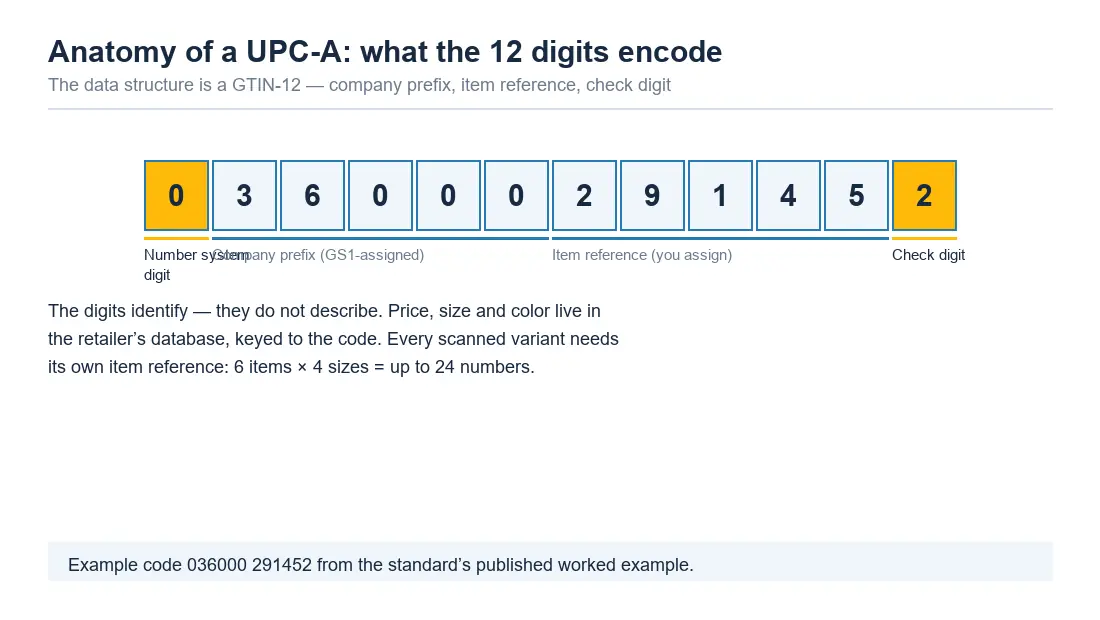
The standard retail symbol in the United States is the UPC-A, a 12-digit code unique to each trade item. Its structure is a company prefix, an item reference, and a check digit:
- Number system digit (1st position): the leading digit classifies the item. Values 0, 1, 6, 7, 8 and 9 cover most regular products; 2 marks items sold by variable weight; 3 marks pharmaceuticals (NDC numbers); 5 marks coupons.
- Company prefix (next several digits): assigned by GS1 to your company. Its length varies — longer prefixes leave fewer digits for items.
- Item reference: the digits your company assigns to each distinct product, size and pack configuration. Every variation that is scanned separately needs its own item reference: a large blue collar and a medium red collar are two items.
- Check digit (last position): one digit computed from the other eleven, which lets a scanner detect misreads.
Two structural facts matter for buyers. First, the digits identify, but they do not describe: a UPC carries no price, size or material information — all of that lives in the retailer’s database, keyed to the code. Second, the same product in a different pack or size is a different number, which is why a pet product range of six items in four sizes generates up to twenty-four item references, all under one prefix.
The naming you will meet in supplier conversations reflects the same system at different layers. “GTIN-12” is the formal GS1 name for the 12-digit data structure; “UPC-A” names the physical symbol that encodes it. When a retailer or marketplace asks for the GTIN, it wants the same 12 digits printed under the bars. The symbol itself is older than the system around it — the first retail scan of a UPC happened in June 1974 at a supermarket in Ohio, on a pack of chewing gum — but the digit structure has been stable ever since, which is why packaging artwork from a decade ago still scans correctly today.
How the check digit works (and why factories must not invent numbers)
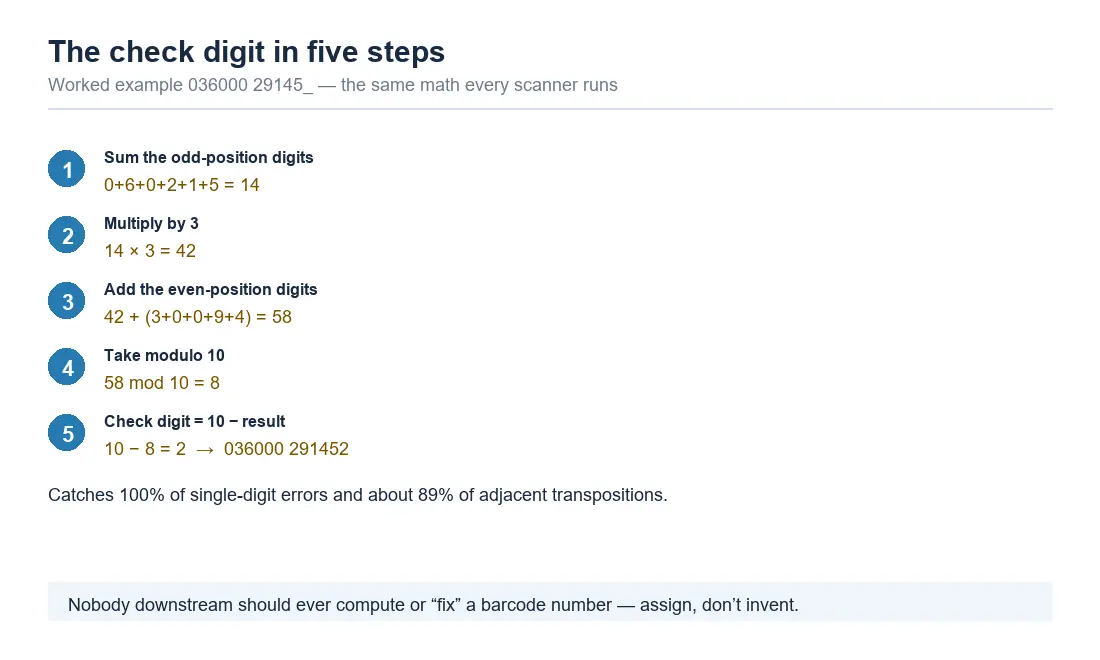
The check digit is computed with a 3-1 weighting, alternating across the first eleven digits: odd positions are multiplied by 3, even positions are summed as-is, the total is taken modulo 10, and the check digit is whatever makes the grand total a multiple of 10. Wikipedia’s worked example, 03600029145x: the odd-position digits sum to 14, times 3 gives 42; adding the even-position digits (3+0+0+9+4=16) gives 58; 58 mod 10 is 8, so the check digit is 10−8 = 2, and the full code is 036000291452.
That single digit catches 100% of single-digit errors and about 89% of adjacent transpositions — the two mistakes humans and scanners most commonly make. It is why a scanner can reject a smudged read instantly.
The sourcing rule that follows is strict: nobody downstream should ever compute, guess or “fix” a barcode number. The brand owner assigns item references from its GS1-licensed prefix; the check digit is a mechanical consequence. When a factory helpfully invents a plausible 12-digit code to fill an empty carton, the result usually passes a local test scan (the math is internally consistent if they computed the check digit) and then collides with a number someone else legally owns, or fails the brand-verification check at the marketplace. If your packaging files arrive with a barcode you did not supply, treat it as a defect in the proof, not a convenience.
UPC barcodes, EAN-13 and the other symbols you will meet
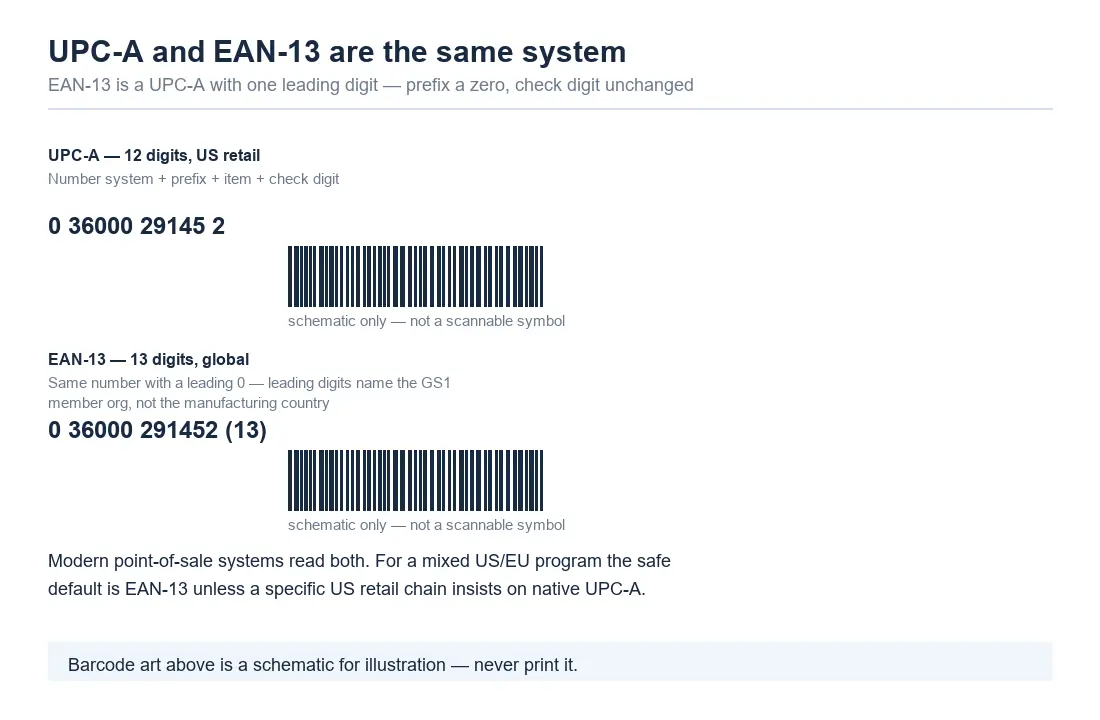
UPC-A is the North American face of a global system. EAN-13 is the 13-digit superset used nearly everywhere else; it is a UPC-A with one extra leading digit, and prefixing a UPC-A with a zero produces the equivalent EAN-13 without changing the check digit. Modern point-of-sale systems read both, which means the practical choice is usually about where the product retails and what the marketplace expects, not about technical compatibility.
Three further distinctions matter on pet packaging:
- Retail symbol versus case code. The code on the collar card is scanned at the till; the code on the shipping carton is scanned at the warehouse. Case-level codes (such as ITF-14 built from the GTIN) are printed larger and tolerate corrugated surfaces that would ruin a retail symbol.
- Store-internal codes. Codes beginning with 2 (variable weight) or 4 (in-store use) belong to the retailer’s internal system. A pet food item sold by weight at a counter might carry one; your packaged toy or harness will not.
- Country codes in EAN-13. The first three digits of an EAN-13 indicate the GS1 member organization that issued the prefix — the country of the brand owner’s registration, not of manufacture. A Chinese-made product branded by a US company legitimately carries a US-registered number, and a “made in China” claim is carried by the origin marking, not the barcode.
Buyers sourcing for both US and EU retail should decide early which symbol set each SKU needs, because packaging is printed once. The safe default for a mixed program is EAN-13 (which subsumes UPC-A) unless a specific US retail chain insists on a native UPC-A.
Print specifications that keep a barcode scannable
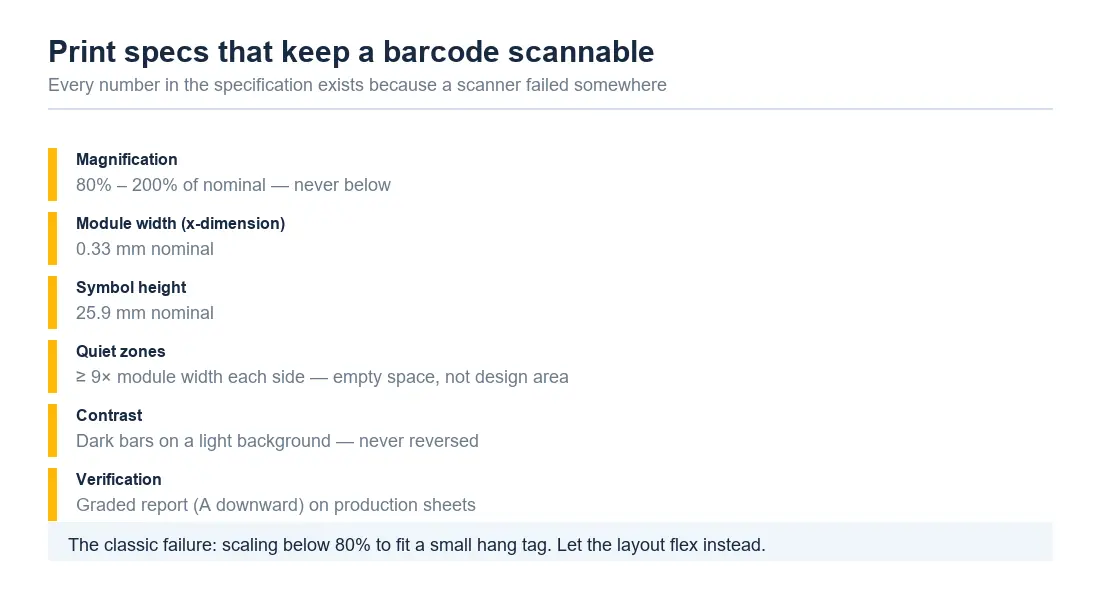
The GS1 specification for the UPC-A symbol is precise, and every number in it exists because a scanner failed somewhere:
- Magnification between 80% and 200%. The nominal module width is 0.33 mm and the nominal symbol height about 25.9 mm; you may scale within that range, but not below.
- Quiet zones of at least 9× the module width on each side. The quiet zone is empty space, and packaging designers erase it constantly — a barcode that runs to the edge of a hang tag scans unpredictably.
- Contrast: dark bars on a light background. Reversing the colors (light bars on dark) fails scans even when it looks striking on the shelf.
- No overprint through the symbol. Glossy lamination over a barcode can add specular glare; red bar colors are a classic failure because red reads as white to scanner light.
For quality control, barcode print quality is graded rather than pass/fail: graded scans run from A down, and retail chains and marketplaces commonly demand a minimum grade on the verification report. The grade is built from several measured parameters — edge contrast, reflectance, decode-ability, defects and the quiet zones — so a symbol can be fully readable to a human eye and still fail a verifier on one parameter.
Ask the printing plant to run a verifier on the first production sheets — it takes minutes and catches a defect that would otherwise be discovered at a retailer’s receiving door. On woven labels and small hang tags, where space is tight, the failure mode is predictable: the barcode gets scaled below 80% to fit. Specify the minimum size in the artwork instructions and let the layout flex instead.
Packaging marks beyond the barcode
A scannable code is one of several marks a pet product legally or commercially needs. Three others appear repeatedly in cross-border orders:
- Country of origin. US customs requires imported goods to be marked with their country of origin, and penalties attach to unmarked or mis-marked goods, as the CBP import rules set out. “Made in China” must be legible and permanent on the product or its packaging as the rules require — the barcode carries no origin information.
- Batch or lot marking. Batch codes support recalls and retailer traceability requirements. They can be printed, etched or applied, but they must survive handling.
- Market-specific warnings and labeling. US pet toys and consumables may need CPSIA tracking labels depending on the product class; EU packaging needs the importer’s details under labeling regulations. Which set applies depends on the product and market, and it belongs in the RFQ, not in a discovery email after production.
These marks share one property with barcodes: they are cheap to print correctly and expensive to fix after the fact. Cartons printed without an origin mark get relabeled by hand or turned back at the border; a wrong GTIN on a printed run means new packaging.
The 5 checks before export
Before any pet product order leaves the factory, run five checks on the barcode work:
- Provenance. Does every item number come from the brand’s own GS1 prefix, with the assignment list on file? Numbers invented at the factory fail this check.
- Uniqueness. Is every scanned-separately variant — every size, color and pack — a distinct item reference? Two SKUs sharing a number is the most common private label defect.
- Print quality. Were the production barcodes verified to grade, not just eyeballed? Ask for the verifier report with the shipment documents.
- Placement. Do the barcodes keep their quiet zones on the actual dieline, survive the lamination and curve of the packaging, and stay off edges and seams? A symbol printed across a carton seam or around a curved corner can verify perfectly on the flat proof and fail on the finished box.
- Consistency across documents. Do the barcode, the carton label, the packing list and the marketplace listing all name the same GTIN? Mismatches between carton and listing are how inventory ends up in the wrong bin.
These five checks take an hour on a shipment and prevent the four classic failures — rejected listings, turned cartons, unscannable units and brand/GTIN mismatches. We run them as standard before export on any order where the buyer supplied numbers, and we ask for the assignment list when they did not — because a barcode error discovered at a distribution center costs roughly a hundred times what it costs on a proof.
Our terms versus industry practice
Industry practice is that barcode numbers are the brand’s job and print execution is the factory’s job. Our own terms at Cuteye follow that split: for OEM and private label orders we print from buyer-supplied GS1 numbers, we flag missing or invented numbers at proof stage, and we verify the printed barcodes to grade before export. We also quote barcode work as part of the packaging line item rather than a hidden extra — the same nine-field quote structure described in our RFQ guide, with packaging listed explicitly. What varies across the industry is how eagerly suppliers fill barcode gaps themselves; our position is that a gap should surface as a question, not a printed carton.
If you are planning a private label range and want the barcode work in context of the whole launch, the private label launch guide walks the 12-week timeline, and the wholesale pet supplies hub shows the product categories the numbering would cover.
Frequently asked questions
Do I need a different UPC for each size and color?
Yes. Every variant that is scanned separately at retail is a distinct trade item and needs its own item reference under your prefix. A harness in four sizes and three colors is twelve numbers, not one.
Can the factory give me a barcode instead?
A factory can print any number, but a number under the factory’s prefix identifies the factory as the brand owner in the GS1 database and at marketplaces. For private label and Amazon listings this causes brand/GTIN mismatches. License your own prefix through GS1 US or your national GS1 organization and supply the item numbers.
Is EAN-13 acceptable in the United States?
Yes. EAN-13 with a leading zero is identical in meaning to the UPC-A, and modern US point-of-sale systems scan both. Some legacy retail chains still ask for native UPC-A artwork; confirm with the retailer before printing.
What barcode print quality grade do retailers require?
Graded verification runs from A down, and common retail and marketplace requirements set a minimum grade on the verification report rather than accepting a visual check. Ask the printer to verify production sheets, and file the report with the shipment.
Where does “Made in China” go if the barcode says something else?
The country-of-origin marking stands on its own, required by customs rules for imported goods. The barcode’s leading digits (in EAN-13) reflect where the brand’s prefix was registered, not where the goods were made. Both marks belong on the packaging, and neither substitutes for the other.
What if a marketplace lists my product without a GTIN?
Most marketplaces offer a GTIN exemption process for brands that genuinely do not have numbers, typically requiring evidence such as photos of the packaging without a barcode. Exemption is the correct route when numbers do not exist; it is not a workaround for using another company’s number, and licensing your own prefix is usually cheaper than the exemption paperwork across a full range.
Related reading
the RFQ guide, the 12-week private label launch guide, OEM versus ODM and the wholesale pet supplies hub
One list, printed once
Barcode work rewards the same discipline as every other packaging decision: get the numbers right before the plates are made. Supply proven numbers, keep every variant unique, insist on verified print quality, and the code becomes the least interesting thing on the package — which is exactly what a barcode should be.
For any order where packaging is quoted — stock product with your label or a full OEM build — send the item numbers with the artwork and we will return a proof with the barcode placement, quiet zones and origin marking called out for your approval before printing.