
A request for quotation, or RFQ, is the document that decides whether a pet product quote comes back usable or vague. Most quotes fail before the factory even replies, because the RFQ left out a spec the buyer assumed was obvious. This guide lists the nine fields a pet product RFQ should contain, shows how to write each one so it survives translation into a factory work order, and explains the numbers — quantity ladders, sampling fees, lead time calendars and payment terms — that turn a one-line price into a comparable offer.
Why quotes come back different from what you asked
Send two factories the same one-line request — “please quote a dog harness, 500 pieces” — and the answers will not be comparable. One price assumes webbing you chose; the other assumes whatever is in stock. One includes a sewn-in label; the other treats branding as an extra. Neither is wrong. They are quoting different products, because the RFQ did not pin the product down.
An RFQ is not a formality. In manufacturing sourcing it is the document that converts your intent into a specification another company can price against. The Wikipedia entry on requests for quotation is blunt about the purpose: the buyer invites suppliers to submit a quote for a clearly defined item, and the structured comparison that follows only works if every supplier is pricing the same thing. Every vague field in an RFQ is a place where two suppliers can quietly price two different products.
The fix is not more words. It is nine specific fields, written so that a factory in another time zone cannot misunderstand them.
What an RFQ actually means (and why buyers use the term loosely)
The terminology around RFQ gets confused because three documents look similar and get named inconsistently across the industry. An RFI (request for information) asks a supplier to describe its capabilities. An RFQ asks for a price against a defined specification. An RFP (request for proposal) asks for a solution to a problem, where the supplier proposes the specification. In pet product sourcing the confusion is real: buyers often send what is actually an RFI — “what can you make in silicone?” — and call it an RFQ, then complain the answer has no price.
The practical rule: if you already know what you want made, send an RFQ. If you are still deciding what to make, send an RFI and say so. Factories respond well to buyers who label the stage correctly, because it tells them how much estimating work to invest. A matching pair of documents also makes the quote comparison later honest — a quote against your specification is a commitment; a price range against a category is not.
This guide is about the first case: you know the product, and you need a price you can act on.
The 9 fields a pet product RFQ should contain
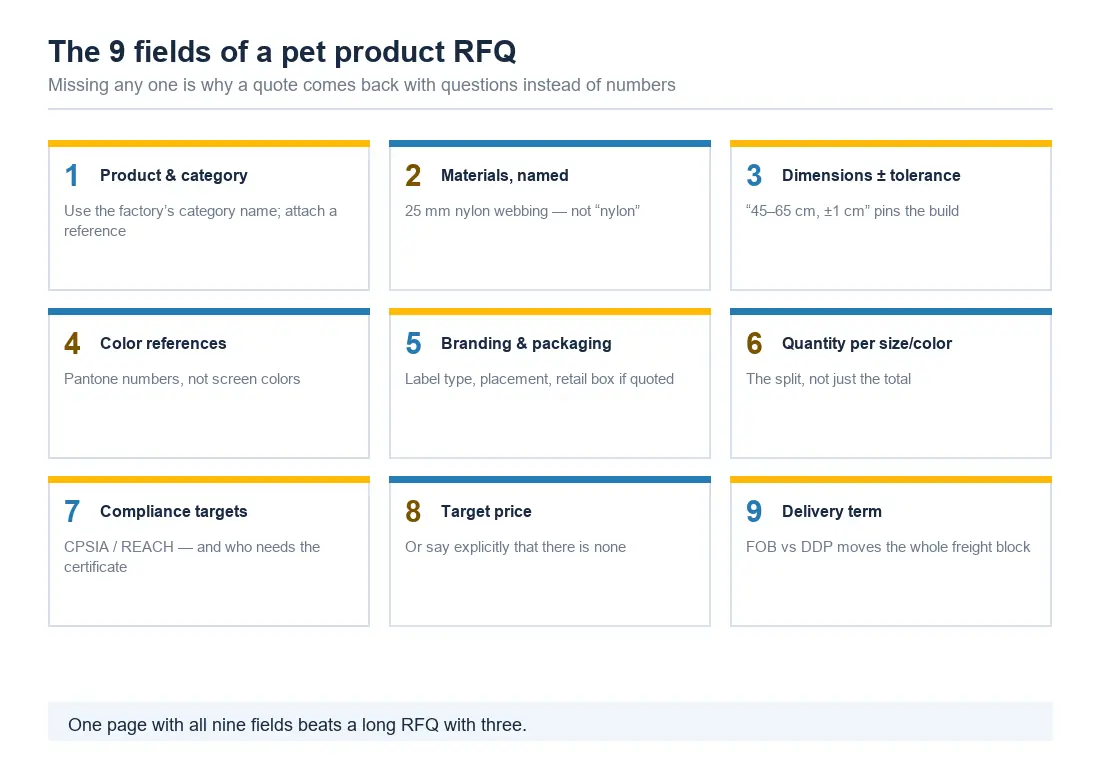
An RFQ that survives contact with a factory work order contains nine fields. Missing any one of them is the most common reason a quote comes back with “please confirm” questions instead of numbers.
- Product name and category. Use the category the factory uses — “dog harness”, not “pet accessory”. If you have a reference photo or an existing SKU, attach it and say which parts change.
- Materials, named precisely. “Nylon” is not a material; “25 mm nylon webbing, 1.5 mm thick, plain weave” is. State the material for every component: webbing, buckles, D-rings, thread, foam, fabric shell.
- Dimensions with tolerance. Give the finished dimensions and the tolerance you will accept, for example “chest strap 45–65 cm adjustable, length tolerance ±1 cm”. Without a tolerance, a factory can ship the cheapest build that is roughly the right size.
- Color references. Refer to a standard, not a mood: “Pantone 2757 C webbing, matte black buckles”. Screen colors lie; a Pantone number does not.
- Branding and packaging. Say what carries your brand — woven label, heat-transfer logo, embossed rubber patch — and where it sits. Include retail packaging if you want it quoted, with dimensions and print colors.
- Quantity per size and color. Give the split, not just the total: “500 pcs = 100 S / 200 M / 150 L / 50 XL, all in navy”. A factory prices size mixes differently from flat quantities because cutting and stitching differ per size.
- Compliance targets. Name the tests and limits the product must pass — for example REACH for the EU market or CPSIA for the US — and say whether certificates are needed for your listing or just for the factory file.
- Target price, if you have one. A target does three things: it filters suppliers who cannot reach it, it tells the factory which construction tier to assume, and it exposes disagreement early. If you have no target, say so explicitly rather than staying silent.
- What “delivered” means. Name the Incoterms-style destination: “FOB Shenzhen” or “DDP Los Angeles” changes the quote by the entire freight and duty block. Say whether packaging weight is included in the quoted price.
A one-page RFQ with these nine fields fits in an email. It does not need a template library; it needs those nine answers.
How to write specifications that survive translation
The nine fields are the skeleton; the specification is the muscle. Three habits keep a spec intact as it moves from your desk to a cutting table.
Write measurable, not descriptive. “Strong webbing” means nothing on a factory floor. “25 mm polypropylene webbing, break strength above 1,500 N” is a specification a machinist and a QC inspector can both act on. If a property matters, attach a number and, where possible, the test method that measures it.
Separate must-haves from preferences. Mark each line “required” or “preferred”. Factories quote the union of your requirements, and a spec that reads as all-required pushes the price up to cover options you did not need. Buyers who mark preferences get a base quote plus a priced option list — which is exactly the comparison you want.
Reference samples instead of describing them. If the RFQ references a physical sample — “buckle like the attached, but in matte finish” — say whether the sample is for look only or for construction too. A sample you send becomes part of the contract; a sample you describe becomes a dispute.
Quantity and price ladders: ask for the curve, not the point
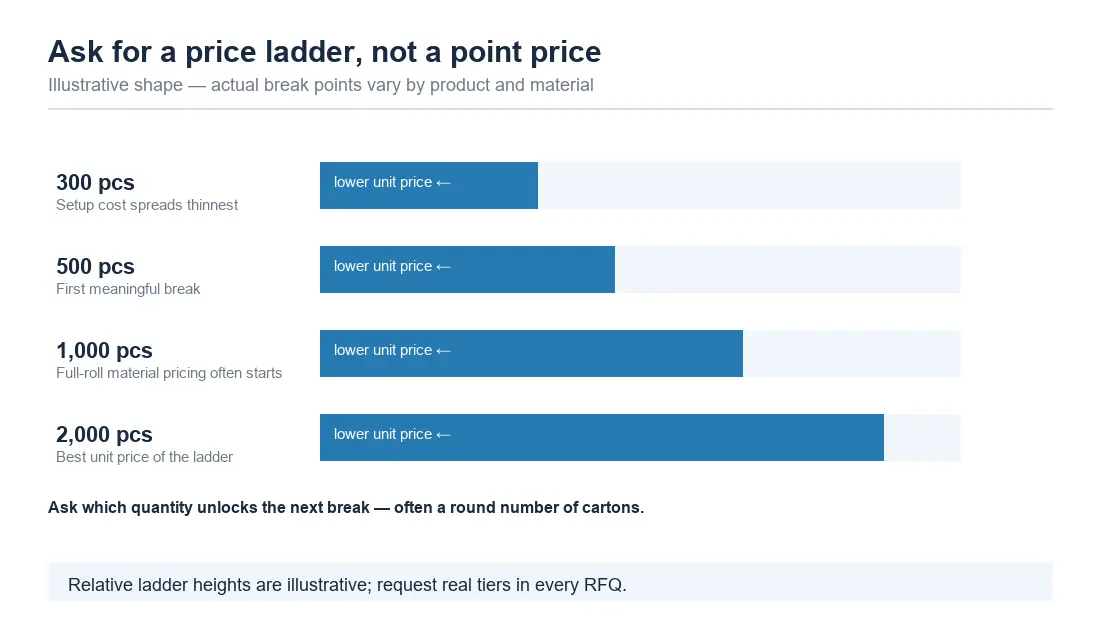
One quantity produces one price and hides the deal you could have had. Ask for a ladder — for example 300, 500, 1,000 and 2,000 pieces — and the quote becomes a curve you can plan against. Two things change along that curve: the unit price drops as setup costs spread over more pieces, and the material cost drops when order volume crosses into full-roll or full-carton purchasing.
Ask the ladder in the same RFQ as the quantity split by size and color. A mixed-SKU order — 500 pieces spread over four sizes and two colors — prices differently from 500 of one SKU, because dye lots, cutting changes and labeling all multiply. If you support mixed batches across products (as we do, alongside low and flexible minimums per item), say what mix you intend so the quote reflects it.
One more habit: ask which quantity unlocks the next price break. Often the answer is a round number of cartons, and ordering 60 more pieces moves the whole ladder down. That is the cheapest negotiation you will ever run, because nobody has to concede anything.
Sampling, tooling and setup fees: ask before you compare
The first price on a custom pet product quote is rarely the whole price. Three cost blocks hide outside the unit price, and the RFQ should drag them into the open:
- Sample fee. A pre-production sample costs a technician’s time and a setup run. Ask what the sample costs, how long it takes, and whether the fee is credited against the production order.
- Tooling and setup. Custom logos (a mold for an embossed rubber patch, a die for a heat transfer), custom packaging and special color matching each carry a one-time cost. Ask for these as separate line items, not baked invisibly into the unit price.
- Re-sample policy. If the first sample misses the spec, ask who pays for the correction. Factories that own their mistakes re-sample at their cost; factories that do not will quote a “correction fee”. The answer tells you a lot before you wire any money.
None of these blocks is a red flag. Hiding them inside a unit price is. A quote that shows sample, tooling and unit costs separately is a quote you can audit later.
Lead time: ask for a calendar, not a number
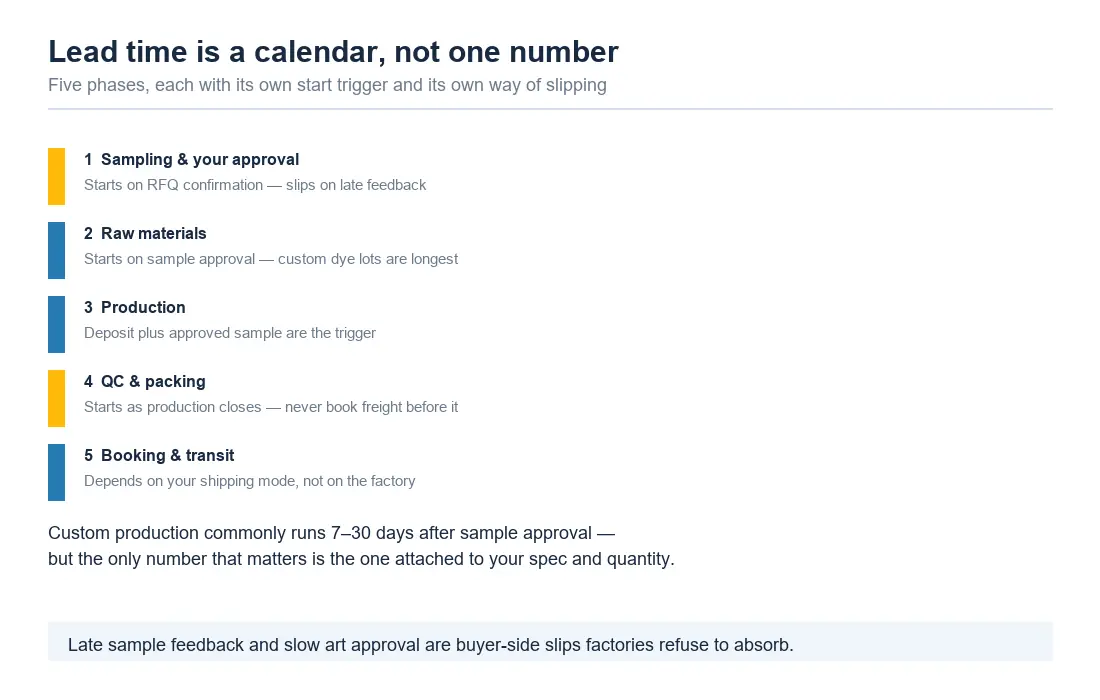
“25 days” is not a lead time; it is one segment of one. A pet product order has at least five phases, and each can slip independently:
- Sampling and your approval — days to weeks depending on how many revision rounds the spec needs.
- Raw material procurement — webbing, hardware and dyes, longest when a color must be custom-dyed.
- Production — cutting, stitching, assembly, which scale roughly linearly with quantity.
- QC and packing — inspection, carton packing, label application.
- Booking and transit — the freight leg, which depends on the shipping mode you choose, not on the factory.
Ask the quote to break lead time into these phases with a start trigger for each: production starts on sample approval plus deposit, for example. Industry practice for custom pet products runs roughly 7 to 30 days of production after sample approval depending on complexity, but the only number that matters is the one attached to your spec and your quantity. A calendar with triggers also shows you which delays are yours to cause — late sample feedback and slow art approval are buyer-side slips that factories correctly refuse to absorb.
Payment terms, compliance and IP: front-load the awkward questions
Three awkward subjects get postponed because they feel confrontational. Postponing them costs more than asking.
Payment terms. Ask what terms the factory offers: deposit plus balance before shipment is common in this industry; letters of credit and escrow exist for larger orders. Ask what the deposit is and when the balance falls due. Then ask what happens on a change order — who pays for a mid-production spec change is a dispute that starts at 50% completion.
Compliance. Name your market’s rules in the RFQ: CPSIA and California Prop 65 warnings for the US, REACH and country-of-origin marking for the EU. Country-of-origin marking is a legal requirement for imported goods in the US, not a label preference — the CBP guidance on importing and exporting sets out what “legibly and permanently” means in practice. Ask which certificates the factory holds and which would need to be ordered for your product specifically. If you sell on Amazon, compliance documentation for the listing is a deliverable you should request in the RFQ, not after production.
Intellectual property. If you supply artwork or a custom mold, ask who owns the tooling and what happens to it if the relationship ends. A factory that answers without hesitation has answered this question before; hesitation is information.
Comparing quotes apples to apples
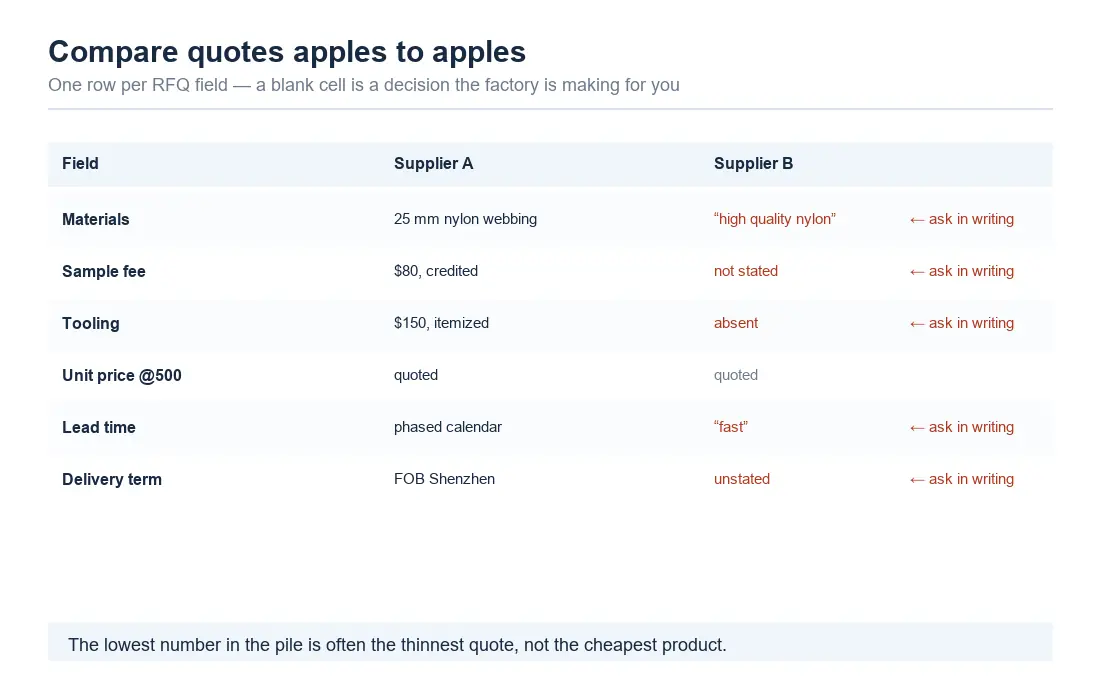
With two or three quotes in hand, comparison only works if each quote prices the same nine fields. Build a simple matrix: one row per RFQ field, one column per supplier, and fill every cell from the quote itself. Cells the quote left blank are not free — they are decisions the factory is silently making for you.
| Field | Supplier A | Supplier B | What to check |
|---|---|---|---|
| Materials | 25 mm nylon webbing | “high quality nylon” | Named spec or marketing copy? |
| Sample fee | $80, credited | Free-looking, not stated | Is the fee credited? |
| Tooling | $150, itemized | Absent | Who owns the mold? |
| Unit price @500 | Quoted | Quoted | Same size split? |
| Lead time | 7–30 days, phased | “fast” | Calendar or adjective? |
| Delivery term | FOB Shenzhen | Unstated | Freight included or not? |
A blank cell is a question for the supplier, and the answer belongs in writing before the deposit. The matrix also protects you from the anchor effect: the lowest number in the pile is often the thinnest quote, not the cheapest product.
5 mistakes that get an RFQ a vague answer
- Quoting quantity without a split. “1,000 pcs” without sizes and colors returns a price for 1,000 of whatever is easiest to make.
- Describing instead of specifying. Adjectives (“premium”, “heavy-duty”) get priced as whatever the factory’s mid-tier is.
- Hiding the market. A quote for the EU must assume REACH and metric labeling; leave the market out and the compliance cost appears later as a surprise.
- Asking ten suppliers and filtering only on price. The cheapest response to an underspecified RFQ is usually the supplier who read it least carefully.
- Skipping the delivery term. An FOB price and a DDP price differ by freight and duty; comparing them side by side is the classic sourcing error.
Each mistake has the same root: the RFQ left a decision unmade, so the factory made it. Nine fields, written plainly, close the gaps.
Our terms versus industry practice
Buyers reading several quotes need to know which parts of this guide are our own policy and which are simply how the industry works. Industry practice: phased lead times after sample approval, one-time tooling charges for custom logos and molds, and deposit-plus-balance payment are all normal for custom pet products, and any supplier that quotes without them is quoting incompletely.
Our own terms at Cuteye: we quote in the nine-field structure described above, and if a field is missing we return a written list of the questions instead of a guess. Stock items ship in 3–7 days; custom OEM and ODM orders run 7–30 days of production after sample approval.
We support low and flexible minimums, mixed batches across products, private label branding (logo, color, material, packaging and barcodes) and sample requests before commitment — sample fees are quoted per project rather than advertised as free. If you want to see the structure applied to a real product line, the wholesale pet supplies hub lists the categories we quote against, and our guide to OEM versus ODM explains who owns the design at each level of customization.
Frequently asked questions
How long should an RFQ be?
One page for a stock-adjacent custom item; two pages if compliance documents or packaging dielines are attached. Length is not the goal — completeness on the nine fields is. A short RFQ with all nine fields beats a long one with three.
What is a realistic response time for a pet product RFQ?
Simple stock-based quotes can come back in days; custom items with sampling and tooling questions typically take longer because the factory is estimating several cost blocks. Ask for the quote or a list of missing fields — a supplier who replies with questions is working, not stalling.
Should I include a target price in an RFQ?
Yes, if you have one that is grounded in the market. A target filters mismatched suppliers, sets the construction tier, and surfaces disagreement before sampling money is spent. If you have no target, say so — silence reads as either naivety or a negotiating ploy.
What is the difference between an RFQ and an RFP?
An RFQ prices a specification you define; an RFP asks the supplier to propose the solution. In pet product sourcing, most first contacts are RFIs, most purchase decisions run on RFQs, and RFPs appear when a retailer sources a whole program rather than a single SKU.
How many suppliers should I send the RFQ to?
Three to five. Two gives no comparison leverage and no backup; ten attracts quotes from suppliers who skimmed the spec. Three to five gives a real spread, and the comparison matrix stays readable.
Related reading
UPC barcodes and packaging marks, OEM versus ODM, the 12-week private label launch guide and the wholesale pet supplies hub
The RFQ, step by step
The nine fields are easy to get wrong the first time and easy to get right the second. Send the first one to a supplier you trust with questions, let the missing-field reply show you what you forgot, and correct the document before it goes to the wider list. After one round, the RFQ becomes your standard document — and the quotes that come back against it finally say the same thing.
Whether you start from a stock item or a full OEM build, the document is the same. Send us the nine fields — category, materials, dimensions, colors, branding, quantity split, compliance, target and delivery term — and we will answer with a quote or a written list of what is missing, never a guess.