
A lick mat is a flat, textured silicone or rubber pad that holds a soft spread — peanut butter, yogurt, pumpkin, wet food — while a dog works it clean with its tongue. What a bowl finishes in seconds, the same textured surface stretches into five to fifteen minutes of focused, calming activity. For pet brands and retailers, that simple mechanic has turned the lick mat from a niche grooming aid into one of the fastest-moving enrichment SKUs on the shelf. This guide explains how it actually works, which claims survive scrutiny, what food-grade silicone brings to the material conversation, and the seven specification points to confirm before you place a wholesale order.
What a lick mat actually does
The mechanism behind a lick mat is behavioral, not magical. Repetitive licking is a self-soothing behavior: trainers and veterinary behaviorists use it deliberately because the steady, rhythmic motion helps shift a dog out of an aroused or anxious state into a calmer, more focused one — the same principle behind the enrichment routines described in VCA Animal Hospitals’ preventive guidance. Dogs also have a natural foraging drive — working food out of grooves and ridges satisfies the problem-solving instinct that a flat bowl never touches.
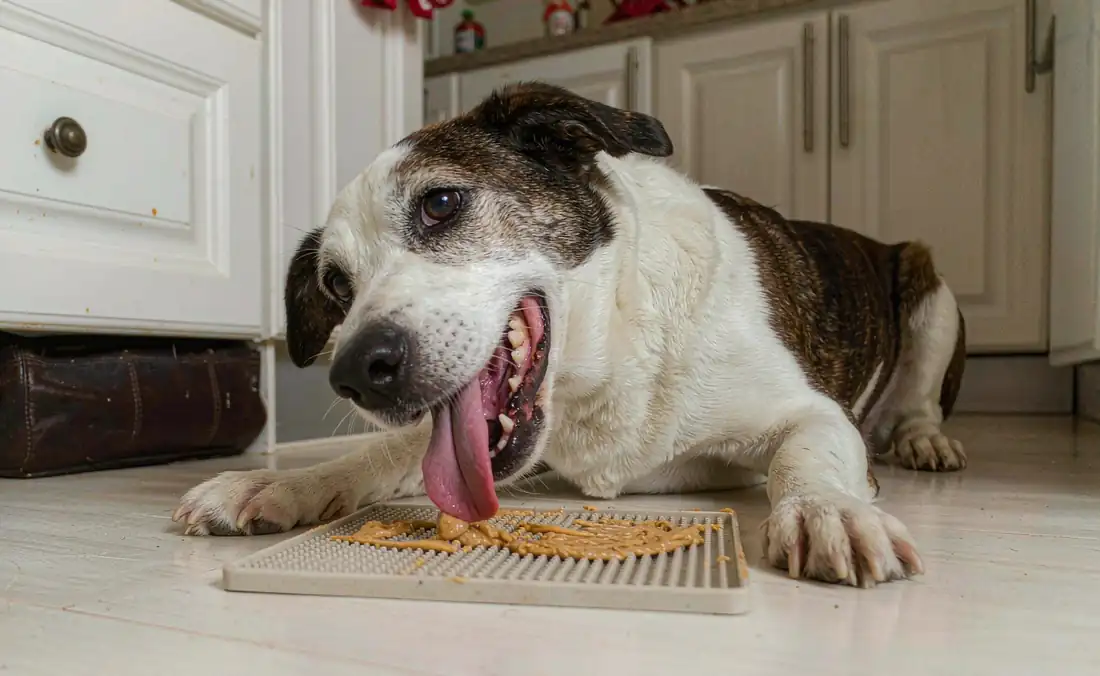
Three practical effects follow from that mechanism, and each one is measurable enough to put on packaging without overclaiming:
- Calming. The repetitive tongue motion is the active ingredient. Presented before a stressful event — baths, nail trims, vet visits, fireworks — the pad gives the dog a competing, soothing behavior to focus on. The effect is proactive: you present it before and during the stressor, not after the dog is already panicking.
- Slower eating. A bowl of wet food disappears in seconds; the same portion spread across the textured surface typically takes five to fifteen minutes. Slower intake supports digestion and, for dogs that gulp, reduces the rushing that veterinarians associate with bloat risk.
- Enrichment without exertion. A frozen session can hold a dog’s attention for twenty to forty-five minutes depending on the food and the dog, which makes it one of the few enrichment tools suited to crate rest, post-surgery recovery, or a rainy day with zero physical output.
The numbers above are ranges observed across dogs and spreads, not promises — a determined Newfoundland will out-lick a delicate Whippet by a wide margin. Put boundaries on any duration claims your own packaging makes, and your returns rate will thank you.
Which claims survive scrutiny — and which to soften
The lick mat category attracts both genuine science and enthusiastic marketing, and the gap between them matters when you write retail copy. Separate the two now, because the claims your buyers repeat to their customers become your liability.
Supportable. The calming effect of the repetitive motion, the slowing of intake, and the mental stimulation of working food out of a texture are all consistent with how trainers and behaviorists describe the tool. The American Kennel Club’s own guidance presents the tool as an enrichment staple for soothing anxious dogs, entertaining puppies and slowing fast eaters.
Overclaimed. Dental health is the classic example: the ridges scrape some residue as the tongue works across them, and the AKC hedges exactly this way — lick mats “can be part of a balanced dental maintenance routine” but are not a substitute for tooth brushing. Copy that promises cleaner teeth will disappoint; copy that says “supports a dental routine” will not. The same discipline applies to anxiety: it manages situational stress during baths and storms, and it can help a crate-training routine by building positive associations, but it is not a treatment for separation anxiety, and no mat should be left with a dog as a “leave-it-and-forget-it” toy.
One more boundary belongs in your buyer’s documentation rather than your packaging: the word food-grade means the material is permitted to contact food — it does not mean the mat itself is safe to eat. That distinction drives the supervision guidance in the next section and the certification questions in the sourcing checklist.
Materials: food-grade silicone versus rubber versus TPR
Material choice is where this SKU differentiates itself at wholesale, and where the cheapest competitors quietly cut corners.
Food-grade silicone is the premium standard and the material we run on our own production line. It is flexible without being floppy, tolerant of both freezer and dishwasher cycles, odor-resistant, and easy to keep hygienic because flat silicone surfaces do not trap food the way hollow rubber toys do. Silicone also takes color well, which matters for private label ranges built around a brand palette. The trade-off is cost: silicone resin is more expensive than rubber compounds, and a pad that looks identical on a shelf listing can differ enormously in purity.
Natural rubber is the traditional alternative — heavy, grippy, and fine wiped down with soap and warm water. It ages faster, holds odor sooner, and cannot go through the dishwasher the way silicone can, which raises the hygiene conversation at retail.
TPR and unknown compounds are where caution is warranted. Non-food-grade compounds risk leaching dyes and additives into the food spread across them — the AKC flags exactly this risk for buyers checking packaging labels. If a supplier cannot name the compound and produce a food-contact certificate, the price difference is not a bargain; it is a recall waiting for a jurisdiction.
For B2B buyers the practical rule is simple: ask what the pad is made of, ask which food-contact standard it meets, and ask for the certificate that proves both. A silicone lick mat supplied against LFGB or FDA food-contact documentation costs a little more per unit and removes the single largest category risk on this SKU.
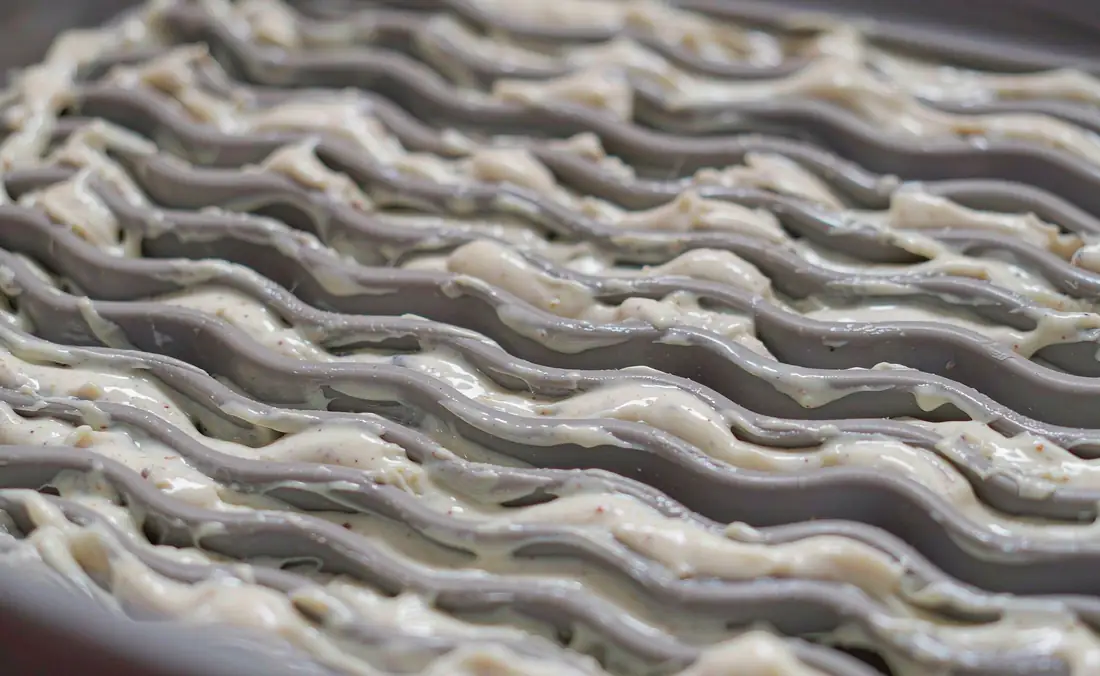
Texture zones, suction and the feature matrix
The category is not one product — this is a family of features that map onto different use cases, and knowing the map is what lets a buyer assemble a range instead of duplicating SKUs.
- Texture depth controls session length and dog size fit. Shallow, wide grooves suit small dogs and puppies and release food quickly; deep, complex patterns slow large or determined dogs and extend the session. Four-quadrant designs with different patterns per quadrant let one mat serve both, with a different spread in each zone.
- Suction cups turn a floor design into a grooming tool: stuck to a tub wall or tile, the pad occupies a dog at exactly the height where brushing, ear cleaning and bathing happen. Retail copy should present suction models as bath-time products, not generic enrichment.
- Non-slip bases keep it under a vigorous tongue instead of across the kitchen floor — relevant for liquid spreads and broths poured straight onto the surface.
- Lids convert the pad into a travel product, sealing the spread for car rides, park visits and boarding drop-offs.
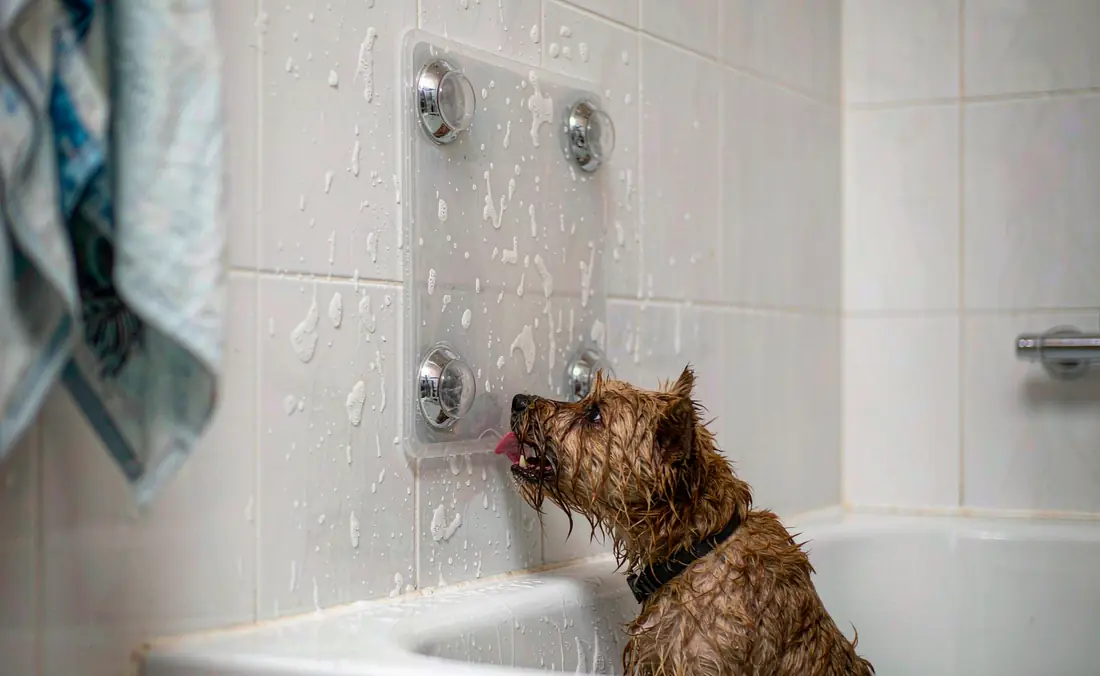
Feature choices also set the retail price band. A basic floor model, a suction grooming version, and a lidded travel edition can be three price points in one product family rather than three competing listings — which is exactly how we quote them for OEM and private label orders.
Where a lick mat sits in a wholesale range
Enrichment SKUs sell together, and the lick mat earns its shelf slot by pairing naturally with adjacent products rather than replacing them.
For feeding-adjacent ranges, it complements a slow feeder bowl rather than substituting for one: the bowl manages dry kibble at mealtimes, the textured pad handles wet food, spreads and frozen sessions. Retailers who merchandise them side by side sell both, because the use cases overlap but the foods differ. Our own dog feeder line is merchandised exactly this way. For cat ranges, smaller-format pads work as slow-release feeding surfaces for wet food and treats — the same soothing logic applies to cats, and cat buyers are habitually underserved on enrichment, which makes the crossover listing an easy win alongside a cat toy assortment.
Margin structure is the quiet argument for the category. Enrichment products carry impulse-level price points, light weight for shipping, and no sizing complexity — none of the return friction that haunts apparel and harnesses. For a pet brand building out an accessory line, a lick mat is usually the lowest-risk SKU to private label first, which is why our OEM-versus-ODM guide treats it as a textbook starter product.
Price bands, margin math and the private label entry point
Talk to enough pet brands and a pattern emerges in how lick mat ranges are priced, and it is worth knowing before you design your own.
At retail, basic floor pads typically sit in the ten-to-fifteen-dollar band, suction grooming versions command a premium for the added hardware, and lidded travel editions reach the top of the range on convenience alone. Against that retail ladder, a food-grade silicone pad sourced from a qualified factory leaves room for healthy accessory margins even at wholesale pricing — one reason the category has attracted so many private label entrants in the past three years. The unit economics also resist discounting pressure better than apparel: there is no size to return, no seasonal shape to mark down, and a customer who replaces a worn pad after a year is buying the same SKU twice.
Private label entry is equally forgiving. The product has no sizing curve to grade, no fabric to match across dye lots, and no seasonal style risk — the artwork decisions are texture pattern, color and packaging. That makes it a natural first OEM project for a brand that has never run custom production: the specification sheet is one page, the sample iteration is fast, and the compliance surface is narrow compared with ingestible products or toys with small parts. Brands that launch with a three-variant pad set — floor, suction, travel — get a complete merchandising story out of a single tooling decision, and every later SKU in the range borrows the same food-contact paperwork.
None of this removes the homework: the seven-point checklist below still applies in full, because the same simplicity that makes the category easy to enter also makes it easy to enter badly.
What goes on the surface — and the warnings worth printing
Food guidance is the most-read section of any lick mat listing, so get it right and it becomes a selling asset.
Safe spreads include xylitol-free peanut butter, plain unsweetened yogurt, pumpkin puree, mashed banana, wet food, cottage cheese and low-sodium broth poured and frozen. The xylitol warning is non-negotiable: some peanut butter contains xylitol, an artificial sweetener that is toxic to dogs, and any brand whose packaging or listing suggests peanut butter should carry that warning prominently. Frozen mats extend sessions — broth frozen onto the mat gives a hot-day treat that also helps hydration — but frozen surfaces are an adjustment for some dogs, so packaging should suggest a trial at room temperature first.
Safety warnings are part of the product, not fine print. This is a supervised-use product: dogs that chew rather than work the spread can destroy the surface and ingest fragments, so packaging should say to remove it if chewing starts, to inspect for worn or jagged ridges and retire a degraded pad, and to clean after every use. None of this hurts the sale — a brand that prints honest supervision guidance reads as a brand that knows the product, and that trust converts across the rest of the range.
Cleaning and durability: the repeat-purchase insurance
Hygiene is where these surfaces quietly beat every competitor in the enrichment aisle, and it is a specification you can verify before ordering.
Flat food-grade silicone units are dishwasher-safe — top rack, alongside the plates — with no hollow interior to harbor mold and no thick corners where food crusts. Natural rubber needs soap and warm water by hand. Either way, the AKC’s cleaning guidance supports a simple rule for retail copy: clean after every use, even when the surface looks clean, because residue in grooves is where bacterial growth starts.
Durability has its own checklist: colorfastness after repeated dishwasher cycles, flexibility at freezer temperatures, and no surface degradation after months of daily licking. Ask the supplier how the material behaves at both ends of the temperature range — a pad that stiffens and cracks in the freezer or warps near hot water fails the customer quietly, one bad review at a time.
Sourcing checklist: 7 things to confirm before ordering a lick mat
Everything above collapses into seven questions that separate a sellable lick mat from a liability. Walk through them with any prospective supplier — and note that a supplier who volunteers most of these unprompted is telling you something useful about their QC culture.
- Compound and certificate. What exactly is the material, and does a food-contact certificate (LFGB or FDA) cover this batch? “Food-grade” without paperwork is a phrase, not a fact.
- Texture depth matched to your customer. Deep grooves for large determined dogs, shallow for puppies and small breeds — or a multi-zone mat that serves both in one SKU.
- Suction design, if you are selling the grooming use case. How many cups, how do they perform on wet tile, and what is the failure mode after repeated flexing?
- Temperature envelope. Freezer-safe and dishwasher-safe need to be true at the same time, verified by actual cycle testing rather than assumed.
- Colorfastness and logo durability. For private label runs, the printed logo lives on a surface that gets licked, scrubbed and dishwashed — ask how it survives.
- Packaging with the warnings built in. Xylitol note, supervised-use note, wear-and-retire note. Packaging that carries the safety copy saves every downstream retailer from writing it.
- Quantity split and mixed batches. The range lives or dies on assortment: colors and textures mixed across one order, low minimums per variant, stock items shipping in 3–7 days and custom colors at 7–30 days after sample approval. Our own terms are built around that split — send the variants and we will quote the mix.
A lick mat looks like the simplest product in the pet aisle, and that simplicity is exactly why the specification details matter: with so little to the product, every one of these seven points is doing visible work in the customer’s hands.
Frequently asked questions
Are lick mats actually calming for dogs, or is that marketing?
The calming effect is behavioral and repeatable: repetitive tongue work releases endorphins and shifts a dog into a calmer state, which is why trainers and behaviorists use textured feeding deliberately. It is a management tool for situational stress — baths, storms, vet visits, crate training — not a treatment for clinical separation anxiety, and packaging that promises too much will disappoint.
Can a lick mat replace a slow feeder bowl?
No, and it should not try. A slow feeder bowl manages dry kibble at every meal; the textured pad handles soft spreads, wet food and frozen portions. The two overlap on the “slow the intake” goal but differ on the food they carry, which is exactly why ranges that stock both feeders and pads sell through faster than ranges that pick one.
What certifications should a wholesale buyer ask for?
Two things, in this order: the compound name in writing, and a food-contact certificate covering the batch — LFGB or FDA for most markets. “Food-grade” is a claim about food contact, not about durability or safety if swallowed, so the certificate and the supervision warnings on your packaging carry the risk between them.
How long does a frozen pad keep a dog busy?
Typically twenty to forty-five minutes depending on the spread and the dog — broth and wet food frozen solid last longest. Room-temperature spreads run shorter, usually five to fifteen minutes. Print the ranges, not a single promise: a determined large dog will always beat the average.
Do cats use them too?
Yes, with a smaller format and shallower texture. The soothing logic transfers directly to cats, and wet-food presentation is a natural fit. The crossover matters commercially because cat enrichment assortments are thinner than dog assortments almost everywhere — a compact cat-format pad is an easy second listing from the same tooling.
Is it safe for puppies and heavy chewers?
Puppies do well with shallow textures and supervision; heavy chewers are the exception to the whole category. No pad survives a determined chewer, so packaging should say plainly: remove it if chewing replaces licking, inspect for worn ridges, and retire the unit when the surface degrades. Dogs Trust’s enrichment advice makes the same supervision point across this product family.

Related reading
the RFQ guide for pet products, OEM versus ODM, the wholesale pet supplies hub and the dog feeder range