
A slow feeder is a dog bowl built with ridges, mazes and raised nubs that force a pet to work kibble around obstacles instead of inhaling it in three swallows. The same meal that vanishes in under a minute from a flat bowl takes five to ten minutes from a well-designed one, with smaller mouthfuls and far less swallowed air. For pet brands and retailers, that visible first-meal difference is why the slow feeder keeps earning shelf space — and why veterinary guidance treats fast eating as a modifiable risk factor worth managing.
This guide explains what the bowl actually changes in a meal, which health claims survive scrutiny and which need softening, how designs differ for brachycephalic and giant breeds, and the seven specification points to confirm before ordering a range at wholesale.
What a slow feeder actually changes at mealtime
The mechanism is pure geometry, which is why the effect shows up at the very first meal. Raised barriers split one fast meal into many small ones: the pet can only reach a few pieces between the ridges, each swallow is smaller and better chewed, and the frantic vacuum motion that a flat bowl rewards simply stops working.
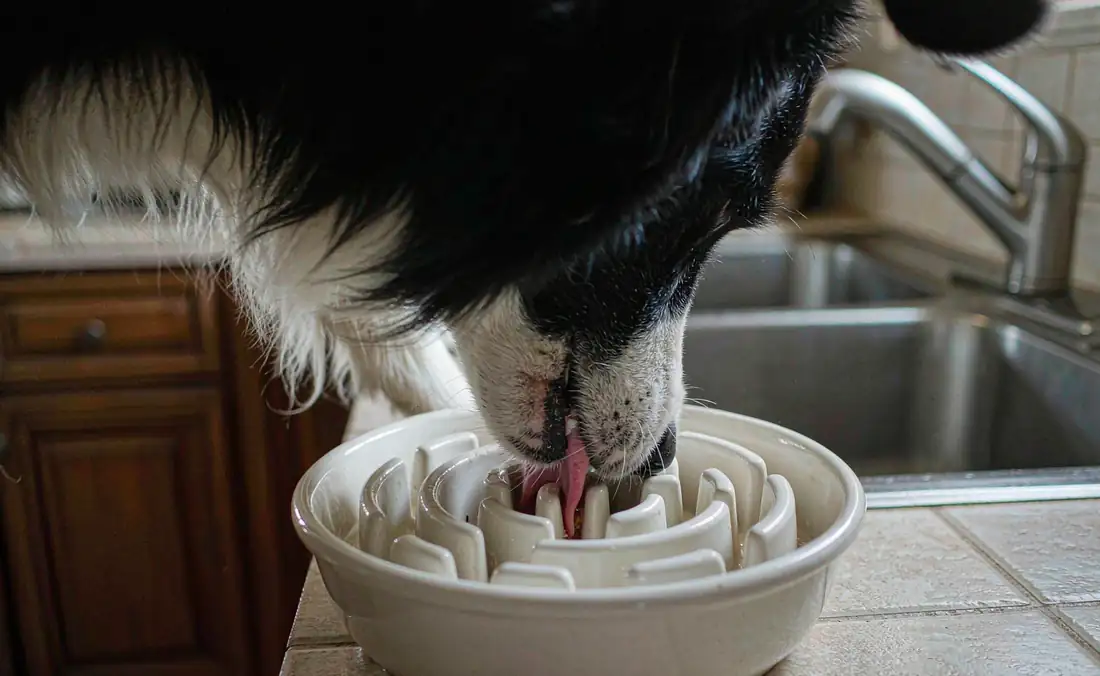
Owners and testers consistently measure the change with a kitchen timer: meals that took well under a minute stretch to five or ten minutes depending on channel depth and the pet’s determination. Manufacturers sometimes claim eating times up to ten times longer, and a study published through Veterinary Evidence — grown out of veterinary nurses recommending these devices in practice — supports the core mechanism: physical obstruction extends meal time.
The second change is less visible but matters more clinically: less swallowed air. Rapid eating drives aerophagia, the gulping of air along with food, and extended meal time reduces the volume of air swallowed per minute. That single detail connects the bowl to the most serious claim in the category, which the next section handles carefully.
The health problems fast eating actually causes
Fast eating sits behind a ladder of problems, from annoying to life-threatening, and a B2B buyer should know exactly which rungs the product addresses — because your retail copy will be asked.
Choking and gagging. Kibble swallowed in large unchewed clumps can catch in the throat. Smaller, paced mouthfuls make catching far less likely.
Regurgitation and aspiration. If a pet eats and then quietly brings the meal back up within minutes — a passive return of undigested food with no abdominal heaving — speed is one of the most common and most fixable causes in otherwise healthy dogs. Regurgitation is more than a carpet problem: returned food can be inhaled into the airway, and aspiration can lead to pneumonia. Pacing the meal keeps food moving in one direction. If regurgitation continues after the meal is slowed, the customer should see a veterinarian, because esophageal disease needs ruling out — a line worth printing on your packaging insert.
Bloat and GDV. The most serious concern is gastric dilatation and volvulus: the stomach distends with gas and twists on itself, and the condition is rapidly fatal without emergency surgery. VCA Animal Hospitals’ clinical summary lists rapid eating and being fed one large meal a day among the established risk factors, alongside family history and a thin body condition. Large, deep-chested breeds carry the highest risk — Great Danes, Saint Bernards, Weimaraners, Irish and Gordon Setters, Standard Poodles, Basset Hounds, Dobermans — and dogs weighing over 100 pounds have roughly a 20 percent lifetime risk of bloat.

Here is the honest boundary, and it belongs in your product copy: a slow feeder does not make a high-risk pet bloat-proof. There are no robust trials showing the bowls lower GDV incidence across populations, and the American College of Veterinary Surgeons frames diet speed as one reported factor among many. What the bowl does is directly address the gulping and air swallowing an owner can actually control — a defensible, low-cost intervention for a deep-chested pet who finishes a meal in under a minute. Copy that says “helps slow fast eating” is safe; copy that says “prevents bloat” is a liability.
How a slow feeder fits the broader prevention plan
Veterinary guidance for high-risk breeds is a plan, not a product, and positioning the bowl as one piece of that plan is both more accurate and more credible to informed buyers.
Alongside the bowl, the standard recommendations are: feed two or more smaller meals per day instead of one large meal; keep the bowl flat on the floor rather than elevated; feed pets separately in multi-pet homes so competition does not fuel gulping; avoid vigorous exercise right after meals; and discuss preventive gastropexy with a veterinarian for the highest-risk breeds — the surgical tack that stops the stomach from twisting. Cornell University’s canine health center treats GDV as a minutes-count emergency, which is why every serious brand also prints the warning signs: restlessness, unproductive retching, a swollen left-side abdomen, labored breathing, collapse.
For retail merchandising, that plan framing sells better than fear. A range card that says “one part of a feeding plan for fast eaters” reads as fluency; one that says “stops bloat” reads as someone who has never read a veterinary manual.
Design features that separate a good bowl from a returned one
The category looks uniform in wholesale catalogs and behaves very differently in customers’ kitchens. These are the features that drive satisfaction — and the ones whose absence drives returns.
- Channel depth matched to the pet. Deep, complex mazes slow determined large breeds and extend sessions; shallow, wide-open channels suit small pets, puppies and seniors. A giant breed with a shallow design finishes in seconds and leaves a one-star review; a Chihuahua with a deep maze gives up entirely. Both failures come from one SKU designed for “average.”
- Brachycephalic accommodation. Flat-faced breeds — French Bulldogs, Pugs, Boxers — need shallower obstacles and wider openings so breathing is never compromised mid-meal. A frustrated flat-faced customer abandons the bowl, and frustration is a documented reason the tool fails for anxious eaters.
- Capacity honest to the portion. Maze walls eat volume: a “large” bowl whose channels hold two cups does not serve a pet fed four cups. Print real capacity, not bowl diameter.
- Non-slip base. A sliding bowl turns a meal into a game of hockey across the floor — and the noise is the complaint, not just the movement. Weighted or rubberized bases solve it.
- Hygiene path. Maze crevices trap food particles, and a bowl that cannot be cleaned thoroughly grows bacteria between the ridges. Dishwasher-safe claims need to be true of the whole geometry, not just the rim.
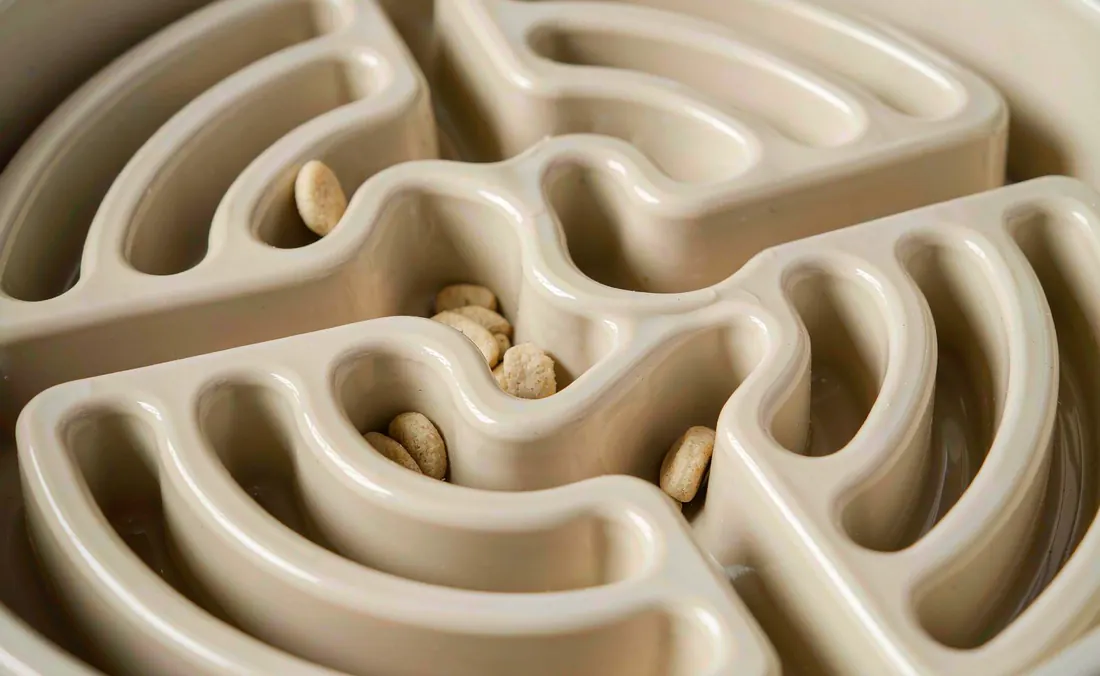
Feature choices also set price bands: a basic single-maze entry bowl, a multi-zone design for mixed breed households, and a stainless insert system can be three price points in one family — which is exactly how we quote the category for OEM and private label orders.
Materials: plastic, silicone and stainless
Material is where buyers quietly make their margin and their liability decisions.
Food-safe plastic dominates the category for good reasons: cheap to mold into complex mazes, light for shipping, endlessly colorable for brand palettes. The requirements that matter are food-contact certification (ask for LFGB or FDA documentation covering the batch), UV stability for outdoor use, and crack resistance — a ridge that snaps off becomes both a choking hazard and a review.
Food-grade silicone suits folding-travel designs and softer-channel variants for flat-faced breeds. It tolerates dishwasher and freezer cycles, resists odor, and folds flat — but complex rigid mazes mold better in plastic, so silicone tends to win the travel format rather than the flagship kitchen bowl.
Stainless steel inserts serve the premium and veterinary-adjacent segment: a perforated or ridged insert that drops into a standard steel bowl, giving hygiene-obsessed customers a dishwashable, non-porous option. Stainless carries a higher unit cost and limits maze complexity, which is why it usually ships as an insert rather than a molded bowl.
Whatever the compound, the sourcing rule is the same as the rest of the feeding category: name the material, name the food-contact standard, and hold the certificate. Feeding products get licked for an hour a day for years — “food-safe” without paperwork is a phrase, not a fact.
Slow feeder versus lick mat versus scatter feeding
Buyers will ask how the bowl relates to the other slow-feeding tools on the shelf, and the honest answer is that they solve overlapping but distinct problems — which is why ranges that stock them together sell through faster.
The bowl reshapes the mechanics of a meal: obstacles pace the intake of dry kibble. A lick mat reshapes a different food entirely — soft spreads, wet food and frozen portions on a flat textured surface, with a calming behavioral effect the bowl does not target.
Scatter feeding removes the container altogether: kibble tossed into grass or a snuffle mat turns the meal into foraging, which research links to genuine appetite and welfare benefits through the contrafreeloading effect — given the choice, many pets prefer to search for food rather than receive it free. But scatter feeding does not reliably slow intake; a motivated pet can vacuum scattered kibble nearly as fast as a bowl, and on hard flat surfaces it can even become a resource-guarding problem in food-anxious individuals.
For merchandising that means the three are complements, not substitutes: the bowl for daily dry kibble pacing, the mat for wet food and calming sessions, scatter feeding as the enrichment layer. Our own feeder range is merchandised on exactly that split.
Price bands, margins and the private label entry point
At retail, entry maze bowls typically sit in the ten-to-twenty-dollar band, multi-zone and branded designs reach the top of the range, and stainless inserts price above all plastic. Against those retail anchors, a food-certified molded bowl sourced from a qualified factory leaves room for healthy margins even at wholesale — and unlike apparel, the category has no sizing curve, no seasonal style risk and no return friction beyond the occasional material complaint.
Private label entry is equally forgiving. The specification sheet is short — geometry, compound, capacity, base, packaging — the sample iteration is fast, and the compliance surface is narrow compared with ingestibles. Brands that launch with a two-SKU bowl family (entry maze plus multi-zone) get a complete feeding story next to their existing accessories, and the same food-contact paperwork covers later additions. That is why our OEM-versus-ODM guide treats feeding hardware as a natural second project after a first starter SKU.
Sourcing checklist: 7 things to confirm before ordering
Everything above collapses into seven questions that separate a sellable range from a return magnet. Walk through them with any prospective supplier — a supplier who volunteers most of them unprompted is telling you something about their QC culture.
- Compound and certificate. What exactly is the material, and does a food-contact certificate (LFGB or FDA) cover this batch? Feeding surfaces need paperwork, not adjectives.
- Geometry matched to your customer. Channel depth for your breed mix, wider openings for brachycephalic lines, and real printed capacity — ask how the design behaves with a determined large breed and a timid small one.
- Base stability. Weighted or rubberized base, tested on tile and wood, with the noise complaint in mind.
- Cleanability. Dishwasher-safe as an entire geometry, verified by cycles, with no crevice that traps food after a rinse.
- Durability. Ridge crack resistance under daily dishwashing and outdoor UV exposure; ask for the aging test, not the promise.
- Packaging with education built in. The acclimation tips, the two-smaller-meals guidance and the “not bloat-proof” boundary printed on the card protect both the customer and your reviews.
- Quantity split and mixed batches. Colors and maze depths mixed across one order, low minimums per variant, stock items shipping in 3–7 days and custom colors at 7–30 days after sample approval. Our own terms are built around that split — send the variants and we will quote the mix.
A slow feeder looks like a simple product, and that simplicity is exactly why the specification details matter: with so little to the design, each of these seven points is doing visible work in the customer’s kitchen.
Introducing the bowl: the acclimation copy most brands skip
Even a well-built slow feeder fails its first review if the customer simply swaps it in cold. Some pets meet the maze with frustration — pawing at the barriers, barking, or giving up entirely — and frustration is a documented reason the tool fails for anxious eaters. The fix is a short acclimation routine that costs nothing to print on the packaging card: start the first meal with a small amount of a favorite food worked into the easier channels, keep the first few sessions brief and low-pressure, and mix kibble from the old bowl alongside the new one so the transition reads as a game rather than a wall.
If the pet paws or protests, spread food into the shallow entry channels for a few days before demanding full maze work. Most animals convert within a week; the handful that never settle often have a food-anxiety history worth mentioning to a vet, and packaging that says so positions the brand as fluent rather than defensive. This is the same logic that makes acclimation copy essential for boot acceptance — the training gap is the largest controllable cause of returns in both categories.
Frequently asked questions
Do slow feeder bowls actually work?
Yes — the mechanism is geometric and shows up at the first meal. Timed feeding trials and owner measurements consistently show meals stretching from under a minute to five or ten minutes, with smaller mouthfuls and less air swallowed. What they are not proven to do is prevent GDV; they address the gulping component of risk, not the whole condition.
Can a bowl prevent bloat in a Great Dane?
No single product can. Rapid eating and one-large-meal feeding are recognized risk factors, and slowing the meal addresses one of them — but breed anatomy and family history carry the rest of the risk. For high-risk breeds the plan is two or more smaller meals, a floor-level bowl, no exercise right after eating, and a veterinary conversation about preventive gastropexy.
Are slow feeder bowls suitable for flat-faced breeds?
Yes, with the right geometry: shallow channels and wide openings so breathing is never restricted mid-meal. Deep-maze designs frustrate brachycephalic pets and often fail — which is why a serious range carries a flat-face-friendly variant rather than one depth for everyone.
What is the difference between a slow feeder and a lick mat?
The bowl paces dry kibble through obstacles; the lick mat holds soft spreads, wet food and frozen portions on a flat textured surface and adds a calming behavioral benefit. They overlap on the “slow the intake” goal but differ on the food they carry — which is why ranges that stock both sell through faster than ranges that pick one.
What material is safest for a feeding bowl?
Whichever compound comes with food-contact paperwork: certified food-safe plastic for molded mazes, food-grade silicone for folding travel designs, stainless inserts for the hygiene-focused premium segment. The certificate matters more than the material family — an uncertified compound of any kind is the actual risk.
Should the bowl be elevated or on the floor?
Floor level. Elevated feeding has been associated with increased risk in large breeds in several studies, and the standard veterinary guidance for high-risk pets is a bowl kept flat on the ground. The non-slip base matters more than the height.

Related reading
the RFQ guide for pet products, OEM versus ODM, UPC barcodes and packaging marks and the wholesale pet supplies hub