
The Dachshund is the only breed where the standard body plan is itself the risk factor. Chondrodystrophy gives the Dachshund a long spine on short legs, and intervertebral disc disease follows from that shape rather than from anything an owner does.
Yet the three health tests the national breed club lists — published on the AKC breed page — cover the kneecap, the heart and the eyes. None of them screen the spine. For anyone specifying gear, the practical consequence is narrow but firm: the load path has to move off the neck and off the lumbar spine, and that is a pattern decision, not a fitting decision. This article sets out what the standard fixes, what the prevalence figures really measure, and five specifications that do the work.
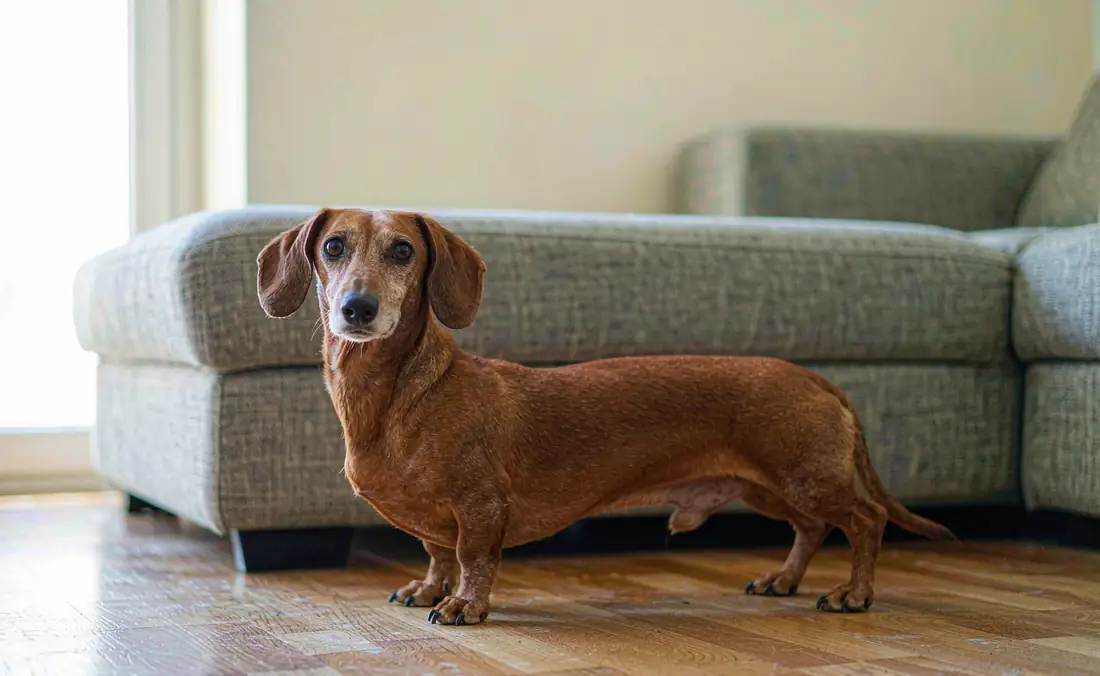
What the Dachshund standard actually fixes
| Measurement | Standard | Miniature |
|---|---|---|
| Height at the withers | 8–9 in (20–23 cm) | 5–6 in (13–15 cm) |
| Weight | 16–32 lb (7.3–14.5 kg) | 11 lb (5 kg) and under |
| Life expectancy | 12–16 years | 12–16 years |
| AKC group | Hound | Hound |
| AKC recognition | 1885 | 1885 |
Two numbers in that table do more work than the rest. The weight band for the standard size runs from 16 to 32 pounds, which is a two-fold spread inside a single size class. Most breeds do not vary that much across their entire range, let alone inside one division. Any chart that maps “standard Dachshund” to one harness size is therefore wrong before it starts.
The second number is height. At 8 to 9 inches at the withers, a standard Dachshund is lower than the shoulder height of most medium breeds, and that changes where a harness strap sits relative to the ground, to the front legs, and to the sternum.
The American Kennel Club lists the Dachshund in the Hound Group, recognises it from 1885, and describes three coat varieties — smooth, wirehaired and longhaired — within each size. Those varieties matter more than most buyers assume, and the reason is in the next section.
The test the breed club does not list
The AKC page for the Dachshund carries a recommended health testing list from the national breed club. It has three entries: patella evaluation, cardiac exam, and ophthalmologist evaluation.
None of them is a spinal screen.
That is not an oversight in the usual sense. Intervertebral disc disease in the Dachshund is conformational — it follows from the body the standard asks for — and there is no widely adopted screening test that a breeder can run on an asymptomatic young dog and get a clean answer. Radiographic disc calcification scoring exists and is used in some breeding programmes, but it is not on the standard recommended list alongside the patella and the eye exam.
For a buyer or a product developer, the useful reading is this: you cannot source your way around the risk by buying from “tested” lines, because the thing that matters is not on the test list. What you can do is control the mechanical load the animal meets every day, which is a product question.
What the IVDD numbers measure, and what they do not
| Figure | Value | What it actually measures |
|---|---|---|
| Relative risk vs other breeds | 10–12 times | Comparison across breeds, not within the Dachshund |
| Lifetime clinical signs, cited range | 19–24% | Estimate of dogs showing signs at some point in life |
| Survey prevalence, all varieties | 15.7% (95% CI 14.1–17.3) | Point prevalence in the DachsLife 2015 survey |
| Standard Smooth-Haired | 24.4% (95% CI 22.5–26.3) | Highest of the six varieties surveyed |
| Standard Wire-Haired | 7.1% (95% CI 6.0–8.2) | Lowest of the six varieties surveyed |
That table is routinely compressed into one sentence — “a quarter of Dachshunds get IVDD” — and the compression loses three things.
The 15.7% and the 19–24% are not the same measurement. The first is point prevalence in one owner-reported survey of 2,031 dogs, of which 310 were veterinary-diagnosed cases. The second is a lifetime estimate quoted in the background of the same paper. Quoting one as if it were the other is the most common error in this category.
The range inside the Dachshund is wider than the gap between the Dachshund and everything else. Standard Smooth-Haired dogs were diagnosed at 24.4% and Standard Wire-Haired at 7.1% in the same survey — a factor of roughly 3.4 between two varieties of the same breed. A buyer who treats “Dachshund” as one risk level is working with a number that hides more than it reveals.
One of the study’s lifestyle findings is probably backwards. The survey found increased odds of IVDD among dogs that were not allowed to jump on and off furniture. The paper itself treats this as hypothesis-generating rather than causal, and the plausible reading is reverse causation: owners restrict jumping in dogs that already show stiffness or that they have been warned about. Read the other way, it would say that preventing jumps causes disc disease, which the study does not establish and which contradicts the mechanical model. This is exactly the kind of figure that gets repeated without its qualifier.
The survey also found lower odds among dogs exercised more than an hour a day. Same caution applies.
Why the numbers move the specification, not the packaging
A prevalence figure tells a buyer how much of the market cares. It does not tell a developer what to change. What changes the product is the mechanism: load applied where the spine cannot take it.
Why “long back” is the wrong shorthand
“Long back” is the phrase every product page uses, and it is imprecise in a way that leads to wrong specifications.
The underlying condition is chondrodystrophy — a form of skeletal development in which the long bones stay short while the spine keeps its length. In the Dachshund it traces to an expressed FGF4 retrogene on chromosome 12, which is also what produces the short legs. The spine is not stretched; the legs are shortened, and the proportions follow.
The disc disease that results is classified as Hansen Type I: the inner material of the disc degenerates and calcifies early in life, then extrudes through the outer ring. This is different from Hansen Type II, seen more often in non-chondrodystrophic breeds, where the outer ring weakens and bulges gradually. The distinction matters commercially for one reason — Type I is an acute, load-sensitive event in a young to middle-aged animal, not a slow degenerative one. Sudden forces are the problem, not accumulated wear.
So the shorthand fails in both directions. “Long” implies the spine is fragile along its whole length, when the clinical issue is disc extrusion at specific sites. And “back” implies the force arrives at the back, when in most walking situations it does not.
Where load actually goes on a Dachshund
Three points take the force when a Dachshund pulls, and only one of them is safe on the Dachshund.
- The cervical spine. A collar puts the full pull load on the neck. On a chondrodystrophic dog this compresses the front of the spine exactly where cervical disc extrusion occurs, and it is the worst of the three options.
- The sternum and ribcage. A correctly cut harness spreads load across the chest. This is the safe path, provided the panel actually sits on the sternum rather than riding up onto the throat or back onto the soft abdomen.
- The lumbar spine. Load reaches here when a harness has no rear anchorage and rotates under tension, or when a Dachshund is lifted by the middle of the body. It is the point most products accidentally load.
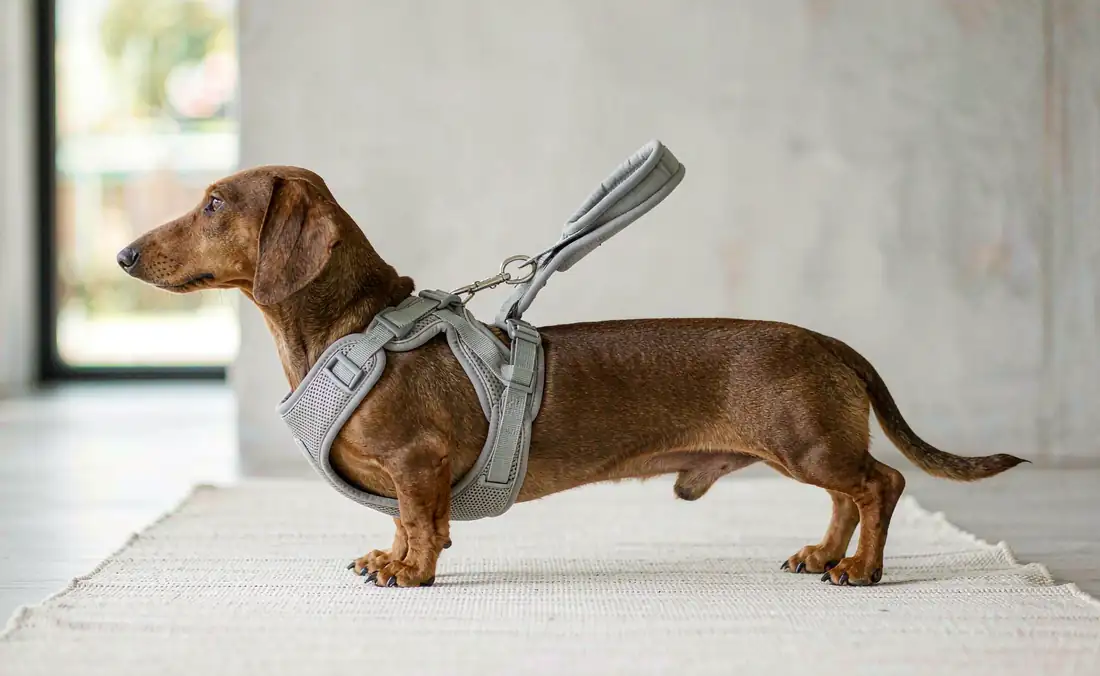
The common failure is a harness that is graded on chest girth alone. On a low, long Dachshund that produces a panel that is too short front-to-back, so the rear strap moves behind the ribcage onto the lumbar spine — point three. The dog is wearing a harness and is still being loaded where the harness was supposed to protect.
That is why our dog harness patterns carry a back-length column alongside girth rather than a single measurement.
Five harness specifications that matter here
These are the five that change outcomes on a Dachshund. None of them is a marketing claim, and all of them can be verified on a sample.
- Y-front rather than T-front. A T-shaped front crosses the shoulder and restricts the joint. A Y-shaped front leaves the shoulder free and puts the strap on the sternum. On a Dachshund with this shoulder-to-ground height, the difference is visible in the gait.
- A padded sternum panel, not a padded strap. Padding distributed along a narrow strap does nothing for the breastbone, which is prominent in the Dachshund and is the part that takes the load. The padding has to be a panel that is wider than the strap.
- Independent adjustment at neck and chest. Two adjustment points let the fit be set for the girth and the neck separately. One shared strap cannot accommodate a long body with a narrow neck opening.
- Graded on back length as well as girth. Back length — withers to the point where the rear strap crosses the ribs — is the dimension that stops the panel rotating onto the lumbar spine. A chart with only a girth column cannot prevent it.
- A lift handle placed over the centre of mass. Not for lifting the dog routinely, but because the alternative in an emergency is grabbing the middle of the body. On the Dachshund that is the one thing to avoid.
What to leave off
Two features look helpful and are not. A semi-rigid support panel running the length of the back restricts the spinal movement the animal uses to turn and to rise, and a no-pull design that tightens across the chest under load converts a pull into a compressive event. Both are sold into the Dachshund specifically.
Measuring a low, long dog
Three dimensions, in this order.
- Chest girth, taken at the widest point behind the front legs, with the tape pressed to the body rather than resting on the coat. This is the number most charts are built on and it is still the right starting point.
- Back length, from the withers to the base of the tail along the top line. This is the number that decides whether the panel stays on the ribcage.
- Neck circumference, taken where the collar would sit, low rather than high.
Record girth and back length together. A Dachshund that is long for its girth and a dog that is short for its girth need different patterns even when the girth number is identical, and on the Dachshund that combination is common.
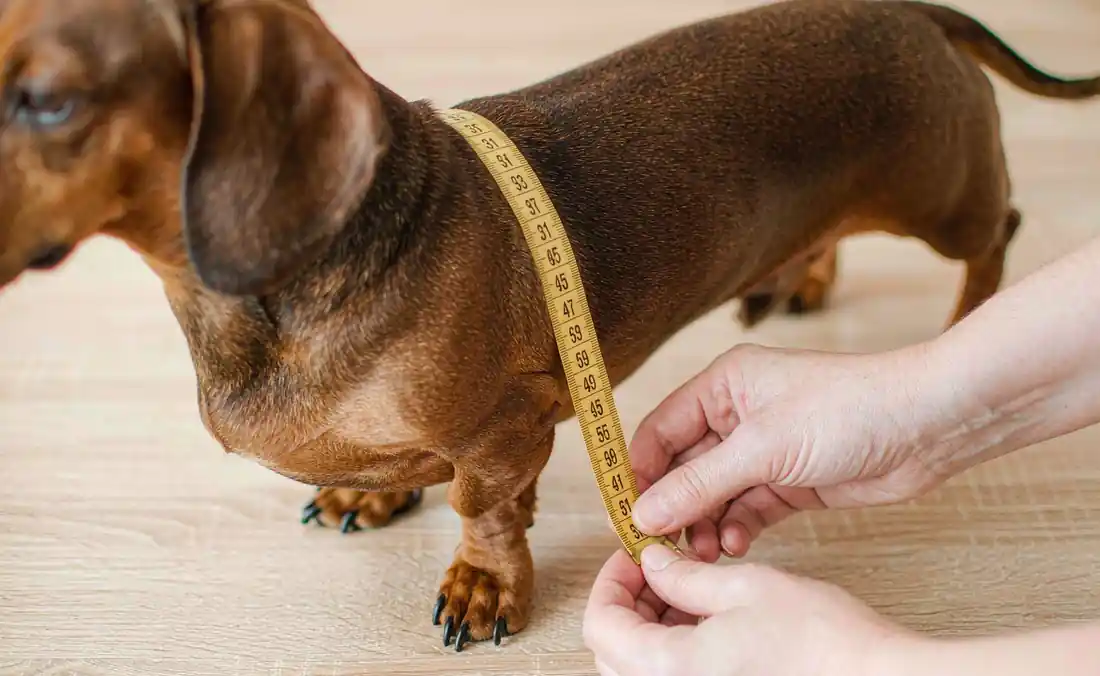
No registry publishes a girth figure for this or any other breed. Where a size band appears in a trade chart, it has been built from measurements taken by whoever drew the chart. Treat published bands as a working range to validate against your own pattern, not as a standard.
The size curve and what to stock
The two-fold weight spread inside the standard Dachshund size is the thing that breaks most assortments. A range built for “standard Dachshund” that carries one or two sizes will fit the middle of the distribution and miss both ends.
| Size | Weight | Notes for the assortment |
|---|---|---|
| Miniature Dachshund | Up to 11 lb (5 kg) | Overlaps the small-dog range; usually the fastest mover |
| Standard, lower half | 16–24 lb (7.3–11 kg) | Highest volume inside the standard band |
| Standard, upper half | 24–32 lb (11–14.5 kg) | Frequently omitted; the gap that generates returns |
Three sizes covering miniature plus both halves of the standard band will serve more of the distribution than four sizes that all cluster around the middle. Where shelf space limits the range to two, the defensible split is miniature and upper-standard, because the middle is the part most competitor ranges already cover.
The same logic applies across the dog products range: the sizes that are missing from competitor assortments are worth more than the sizes everyone carries.
Coat variety is not a sizing variable
Smooth, wirehaired and longhaired dogs differ in girth reading because the tape sits on different amounts of coat, but the underlying body is the same. Compress the tape and the difference largely disappears. Measuring over the coat produces readings up to a full size step apart, and it is the most common cause of a harness that fits in winter and hangs loose in summer.
Leads, stairs and the vertical problem
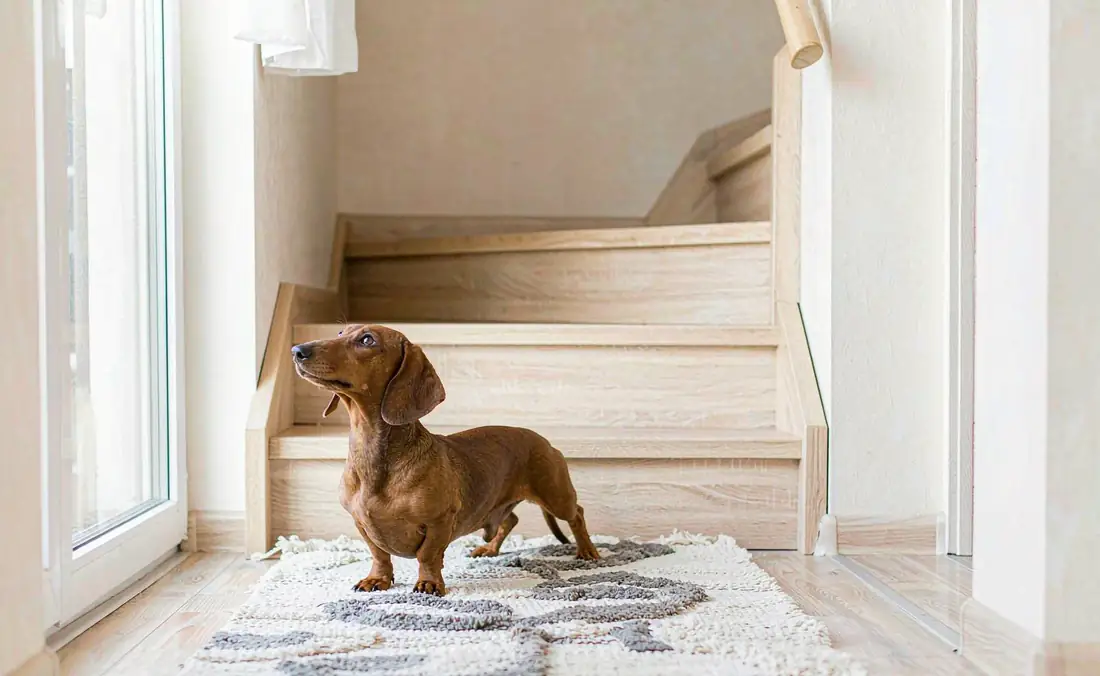
Vertical movement is the part of the Dachshund’s profile that products rarely address, and the AKC’s own guidance is explicit: do not let the dog run up and down stairs, and do not let it jump on and off furniture.
Two product consequences follow.
Retractable leads are the wrong choice. A retractable lead allows a run to build and then stops it, which is precisely the acute loading pattern that Hansen Type I extrusion is sensitive to. A fixed-length lead does not.
Anything that reduces a jump is worth more than anything that cushions one. A ramp matters more than a padded bed. Where a range includes dog beds, the entry height matters more than the fill: a bed the dog has to step up into reproduces the movement the guidance says to avoid.
Carrying a Dachshund
The correct way to lift a Dachshund supports the chest and the hindquarters separately, keeping the spine level. That is a handling instruction, but it has a product corollary: a harness with a handle placed over the centre of mass makes the correct lift possible, and one with a handle over the shoulders does not.
Collars still have a job
None of the above means a collar has no place. A collar is still the right place for identification tags, and it is what most owners leave on the dog indoors. The distinction is about which item takes the walking load.
| Use | Collar | Harness |
|---|---|---|
| Identification tags | Correct choice | Works, but slower to read |
| Lead attachment on walks | Wrong on the Dachshund | Correct choice |
| Indoor wear | Acceptable if flat and light | Not needed |
| Car support or lift | No | Correct choice, with handle |
For the collar itself, the specification that matters is width relative to the neck: a wide, flat collar distributes what contact load there is, and a narrow one concentrates it. Hardware weight matters too — a heavy tag assembly hanging from a light collar adds a constant downward pull at the front of the neck.
Our own range notes: for collars intended to carry a tag, we specify the D-ring as welded rather than bent, because a bent ring opens under a sustained pull and the Dachshund pulls.
Our terms versus common industry practice
| Question | Common practice | Our terms |
|---|---|---|
| Lead time, stocked items | Quoted as a flat number regardless of configuration | 3–7 days, confirmed per order |
| Lead time, custom | Quoted from order date | 7–30 days, counted after sample approval |
| Minimum quantity | Published as a single figure | Low and flexible; confirmed per configuration |
| Mixing categories | One MOQ per category | Mixed batches across categories supported |
| Samples | “Free samples” | Available; terms confirmed per request |
The distinction that matters most is the one on custom lead time. Counting from sample approval rather than from order date is the honest formulation, because the approval loop is the variable part and it sits with the buyer. A supplier who quotes from order date is quoting a number they do not control.
We do not publish a flat MOQ because the binding constraint is which parts of the line have to change for a given order, and that varies by configuration rather than by customer. The same applies across categories, which is why the wholesale pet supplies hub is organised by configuration rather than by customer type.
Five questions to ask any supplier
- Is the harness graded on back length, or on girth alone?
- Where does the rear strap sit on the longest size in the range — on the ribs or behind them?
- Is the front a Y or a T, viewed from the front with the dog standing?
- Is the D-ring welded or bent, and what is the webbing width at the sternum panel?
- Can one order cover miniature and upper-standard in the same colour, or does each size carry its own minimum?
The fifth question is the one that decides whether a three-size assortment is affordable. Suppliers that require a full minimum per size make the correct assortment more expensive than the incorrect one, which is worth knowing before the range is drawn up.
Whether those sizes come from an existing pattern or a new one is the decision covered in OEM versus ODM sourcing.
Frequently asked questions
Do Dachshunds need a special harness?
They need a harness with a different set of proportions, not necessarily a breed-labelled product. The requirement is a Y-front, a padded sternum panel, and grading on back length as well as girth. A harness that has all three works whether or not it is marketed for the Dachshund.
Is a collar safe for a Dachshund?
For identification, yes. For lead attachment, no — a collar puts the pull load on the cervical spine, which is where disc extrusion in the Dachshund commonly occurs. The usual arrangement is a flat collar for tags and a harness for walks.
How many Dachshunds get IVDD?
It depends on which figure and which variety. A survey of 2,031 dogs found 15.7% overall, ranging from 7.1% in Standard Wire-Haired to 24.4% in Standard Smooth-Haired. Lifetime estimates quoted in the same literature run 19–24%. A single number for the whole breed hides a 3.4-fold spread.
Does a harness prevent IVDD?
No. A harness changes where the walking load goes. It does not change the underlying conformation, and nothing in the product category prevents disc disease. What a correctly specified harness does is stop adding cervical compression to an animal that already carries conformational risk.
What size harness does a standard Dachshund need?
There is no single answer, because the standard weight band runs from 16 to 32 pounds. Measure chest girth and back length, and buy to both. A dog at the bottom of the band and one at the top are not the same size.
Why does the harness slide back onto the loins?
Because the panel is too short front-to-back for a Dachshund’s back length, which happens when a harness is graded on girth alone. Adding a size up in girth makes the neck opening worse without fixing the position of the rear strap. Grading on back length is the fix.
Are no-pull harnesses suitable?
Designs that tighten across the chest when a Dachshund pulls are not a good match. The tightening converts a pull into compression, and the acute-loading pattern is the one the Dachshund is sensitive to. A front-clip attachment that redirects without tightening is a different mechanism and is fine.
Should miniature and standard sizes come from the same pattern?
They can, provided the pattern is graded on both dimensions across the full range. Where a supplier uses one pattern for miniature and a different one for standard, check that the panel proportions and the sternum padding are consistent between them — this is a common place where the cheaper size loses the padding.
Do stairs actually matter, or is that an old wives’ tale?
The AKC’s own care guidance for the Dachshund says not to let the dog run up and down stairs and not to let it jump on and off furniture. That is the national kennel club’s position, not a forum claim. The mechanism is repeated vertical loading of a spine carried close to the ground.
What should I ask for in a sample before committing?
Ask for the longest and the shortest size in the range, not the middle one. Fit them on a Dachshund at each end of your target weight band with the lead attached, and check where the rear strap sits when the dog pulls. The middle size will fit almost anything on a table.
Where to start
Send us the Dachshund weight band you need to cover, the number of size steps, and whether you need the harness graded on back length. We will come back with a size curve, the specification sheet for the five points above, and a quote.
Related reading
Comparing body types across a range? The Maine Coon sizing guide covers the opposite proportion, a long rectangular torso on a heavy coat, and the French Bulldog guide covers a deep-chested compact body. The dog harness range and dog bed range carry the specifications described above. For range planning, OEM versus ODM sets out what has to change for a new pattern, and the wholesale pet supplies hub is the entry point across categories.
Written by the Cuteeye product team, Huizhou, Guangdong. Cuteeye manufactures silicone, nylon and webbing pet accessories for pet shops, e-commerce sellers, distributors and private-label brands. Health information in this article summarises published veterinary literature and the AKC breed standard and is not veterinary advice; fit decisions should be checked against the individual dog.