
Buckle fatigue is the failure mode that tensile testing alone will never catch on a pet collar or harness. A webbing sample can break at a heroic number of newtons in a static pull test and still fail in the field, because the side-release buckle on the same product opens and closes hundreds of times a month and wears like any mechanical part. This guide explains what a tensile test actually measures, why one static number is not enough, which four numbers separate a durable pet product from a showroom sample, and how to read a supplier test report without being misled.
Why there is no mandatory pass/fail standard for pet gear
Buyers often open hardware conversations expecting a safety standard and find a gap. Unlike child car seats or climbing equipment, pet collars and harnesses have no single mandatory international standard that defines a minimum break strength, a fatigue cycle count or a required test method. Voluntary test methods exist, industry bodies publish guidance, and individual retailers set their own entry requirements — but the legal floor is low, which means the range of quality on the market is enormous.
The absence of a standard has two consequences for a wholesale buyer. First, claims are unregulated: “heavy-duty” on a collar card can mean anything from a marketing adjective to a documented 2,000 N pull test, and nothing forces the first meaning to become the second. Second, the burden of specifying moves to the buyer: the test data that matters has to be requested explicitly, because no regulation forces it onto the datasheet.
This is also why the terminology gets confused. Human-product standards (climbing UIAA numbers, for example) get quoted on pet listings as if they transferred directly. They do not — the load paths, the durations and the failure consequences differ — and a listing that borrows a climbing number is borrowing credibility, not data. The fix is to ask for pet-specific numbers measured with named methods, which is what the rest of this guide sets up.
Tensile testing 101: what the machine actually measures
A tensile test is the most fundamental measurement in materials engineering: a sample is gripped and pulled under controlled tension until it fails. The machine is a universal testing machine (UTM) — two crossheads, one driven, with a load cell measuring force and, typically, an extensometer measuring stretch. The output is a force–extension or stress–strain curve, and from it come the numbers that matter:
- Break strength (or breaking strength): the force at which the sample actually separates, read directly from the curve. For pet webbing and assemblies this is the headline number.
- Ultimate tensile strength: the peak force the sample withstood, which for most webbing assemblies is the same event as the break.
- Elongation at break: how far the sample stretched before failing, expressed as a percentage. High elongation in webbing means a harness that absorbs a lunging dog’s energy; low elongation in a plastic buckle shell means it snaps rather than deforms.
- Yield behavior: where the material stops returning to shape. For plastics this predicts permanent deformation after a hard pull.
Standardized methods make those numbers comparable between labs. For plastics — which is what most buckle bodies are — the working methods are ASTM D638 (tensile properties of plastics) and, for the rubbers and elastomers in padded components, ISO 37. For assembled products, the meaningful test is not the raw material coupon but the finished assembly — webbing, stitching, buckle and ring together — pulled to failure, because the assembly’s weakest link is almost never the webbing itself.
One unit note, because datasheets mix them: force is quoted in newtons (N), kilogram-force (kgf) or pounds-force (lbf). 1 kgf ≈ 9.81 N ≈ 2.2 lbf. A “500 kg” collar claim is either 500 kgf (about 4,900 N) or a translation error; ask which.
Static load versus cyclic load: why one number is not enough
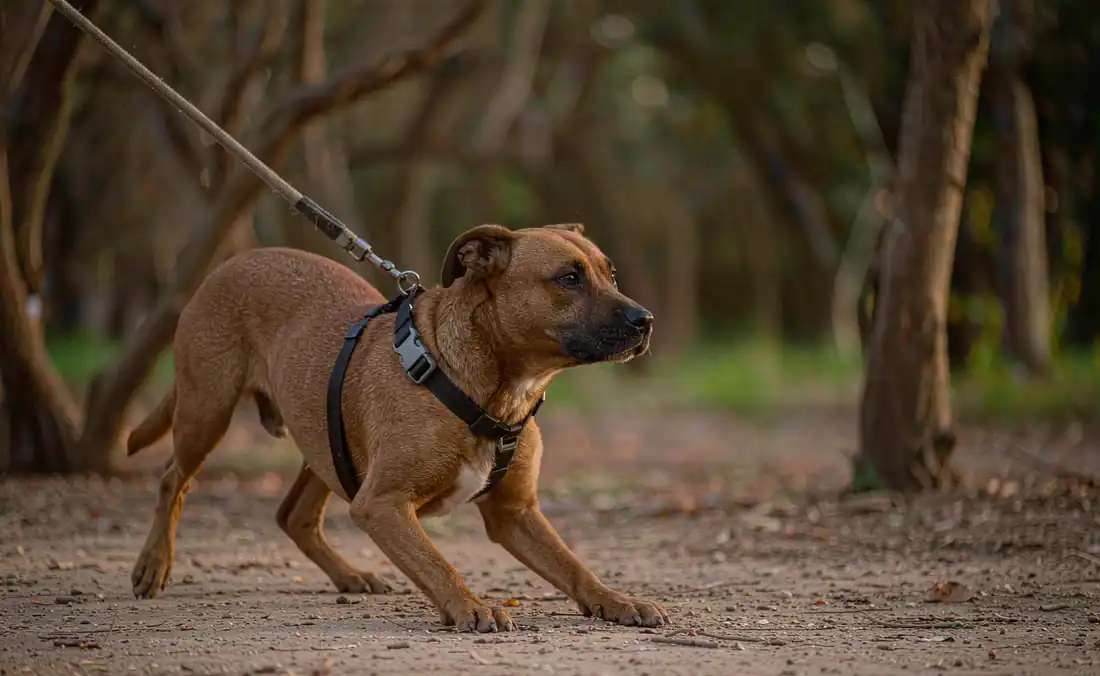
The static break strength answers one question: how hard does the product have to be pulled, once, to destroy it? Field failure rarely looks like that. A collar or harness in service experiences thousands of smaller load events — a lunge at the leash, a jerk on a tie-out, a dog scratching at the buckle — and between them the hardware sits under low steady load. Those repeated sub-maximal loads are cyclic loading, and their damage accumulates in a way a single pull test cannot show.
Materials science separates the two regimes cleanly. Static testing maps the stress–strain curve to failure. Fatigue testing applies a repeated load — typically some fraction of the static strength — for thousands or millions of cycles, and measures when the part cracks or stops functioning. The fatigue strength of a part is usually a small fraction of its static strength, which is the entire reason the two numbers must both be collected. A related long-term effect is creep: under constant stress over extended time, a plastic part slowly deforms.
A buckle arm held permanently loaded by a taut strap, or a webbing loop under a stored load, creeps — and a shell that seemed fine on delivery deforms enough over months to change how the release button engages. Warm environments accelerate creep noticeably, which is why a collar stored on a radiator shelf or a harness left in a hot car ages its hardware faster than the same product in daily rotation.
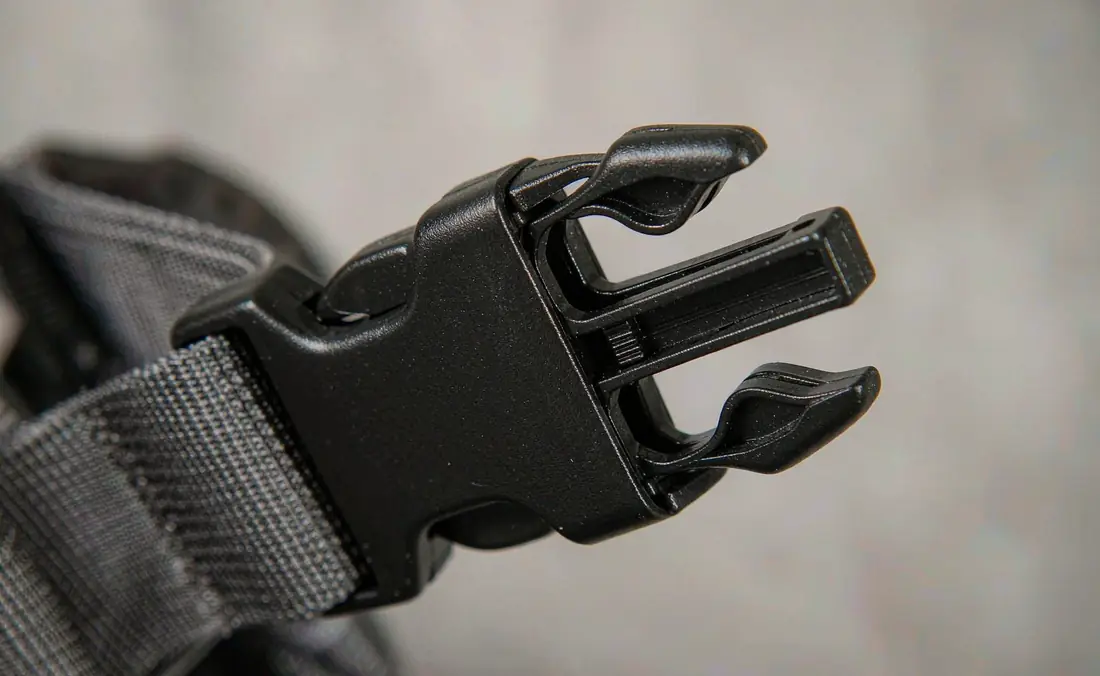
For pet hardware the practical consequence shows up in the buckle. Side-release buckles fail in the field through the mechanism, not the shell, in three recognizable ways:
- Spring-arm wear. The flexible arms that snap over the male pin lose engagement force after repeated insertions, so the buckle starts releasing under light load.
- Pin or slot distortion. A hard pull that deforms the pin without breaking anything leaves the latch seating imperfectly — the buckle that “works but feels loose”.
- Webbing slippage. The strap walks out of the buckle’s slot a few millimeters per load event, which is why the adjustment on an old harness no longer holds.
A supplier who tests only static break strength has measured the failure mode that happens last and least often.
Buckle fatigue: what cycling actually breaks, and what to ask for
Cyclic testing for a side-release buckle is straightforward to specify even without a dedicated standard: mount the buckle assembly, cycle it open-closed with a defined force, and set a pass criterion — no release under a defined pull load at the end of the test. Reasonable specifications run from a few thousand cycles for a light cat collar to tens of thousands for a working-dog harness buckle, and the pass criteria are stated in force: “after 10,000 cycles, the assembly must still withstand X N of straight pull without releasing.”
The four numbers a buyer should ask for on any collar, harness or leash program:
- Assembly break strength in newtons — the whole assembly (webbing, stitches, buckle, ring) pulled to failure, not the webbing coupon alone. Ask for the test speed too, since results vary with rate.
- Buckle cycle count with pass load — how many open-close cycles, and what pull force the assembly must still hold afterward. This is the number that separates a durable buckle from a smooth new one.
- Materials and process, webbing and hardware alike — which webbing (nylon stretches and absorbs shock, polyester stretches less and resists UV better, polypropylene floats and costs least but ages fastest in sunlight), and for the metal: solid steel versus zinc alloy die-casting, welded versus cast, with the plating specified. Cast zinc at a thin section is the classic hidden weak point; it passes a gentle check and fails a shock load.
- Stitch specification — thread type and the stitch pattern at load points (box-and-X is the common answer), because the stitches are usually the actual break point before the webbing is.
Each number is cheap to request and expensive to discover. A program that documents all four produces a datasheet a retailer’s QA team can sign; a program without them produces a conversation after the first field return.
Metal hardware failure modes
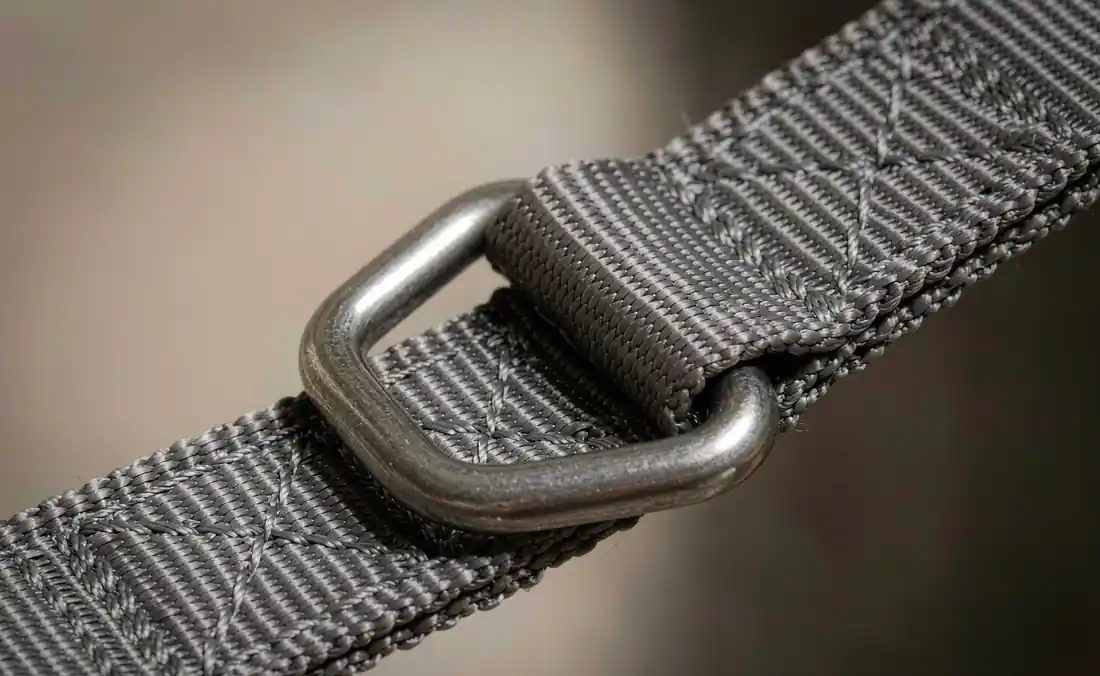
Metal components fail differently from plastic, and the differences matter when reading a supplier’s claims. Welded steel D-rings on quality webbing assemblies typically outlast the webbing; the failure arrives as stitch abrasion, not ring fracture. Die-cast zinc alloy rings are cheaper and can be perfectly adequate for light-duty cat collars, but they are cast with internal porosity, and a ring with a void near a thin section breaks at a fraction of its nominal rating. The visual cue on a failed cast ring is a grainy, crystalline fracture face; steel fails with a stretched, fibrous face.
Plating is the second metal question. Nickel plating over a base alloy protects against corrosion from rain and saliva, but thin or poorly adhered plating flakes, and the exposed base corrodes fast — the “rust” on a bargain D-ring after one wet winter. Ask what the plating is and its thickness rather than whether the part “won’t rust”; salt-spray hours are a legitimate specification for hardware destined for coastal or winter-salt markets.
None of this argues against plastic buckles. A well-made acetal side-release buckle on a medium dog harness is lighter, quieter and corrosion-proof by nature; the argument is only for matching the hardware class to the load class and asking for the numbers that prove the match. The same logic runs down to the lightest products in a range: a cat collar lives with far lower loads, but the mechanism behind buckle fatigue is identical, and a program that documents cycles and pass load for its harnesses can specify a scaled-down version for the cat line in the same datasheet format.

How to read a test report (and spot a weak one)
Suppliers’ test reports range from lab-grade documents to marketing PDFs. Four checks separate them:
- What was tested? The report must name the assembly — “25 mm collar with side-release buckle and welded D-ring” — not just the material. A webbing coupon report tells you nothing about the buckle that joins it.
- What method? Named standards (ASTM D638, ISO 37 for materials; a defined procedure for assembly pulls and cycle tests) make numbers comparable. An unmethoded number is a claim.
- How many samples? One sample is an anecdote. Credible assembly tests average several specimens; ask how many, and what the spread was. A spread that runs wide — one sample breaking at twice the force of another — is itself a finding: it usually means inconsistent stitching tension or mixed hardware batches rather than a measurement problem.
- What failed? A good report says where the sample broke — buckle body, stitches, webbing — because that tells you the next weakest link after you strengthen the first. Reports that show only an average force with no failure location hide exactly the information a redesign needs.
A report that answers all four is usable data. A report that answers none of them is a brochure with numbers on it, and it should be treated as a reason to request testing, not as evidence of it.
Our terms versus industry practice
Industry practice is that break strength claims are voluntary, assembly-level and fatigue testing are uncommon on datasheets, and retailers decide case by case what documentation they require. Our own terms at Cuteye are stricter: on custom collar, harness and leash programs we document assembly break strength in newtons, the buckle cycle specification and pass load, hardware material and plating, and the stitch pattern at load points — and we supply the reports with the pre-production sample, so the numbers you approve are the numbers that ship. Where a customer’s market demands a specific test method, we test to that method rather than to our house method, and the difference is stated on the report.
That specification discipline is the same one behind our sizing work — a product that is strong but badly graded fails in a different way. For the fit side, the breed-specific guides cover how body shape changes the load path: the Dachshund harness sizing guide explains why a long back moves load onto the chest panel, and the Maine Coon sizing guide covers a heavy coat on a long torso. The dog harness range carries the hardware and webbing specifications discussed here.
Frequently asked questions
What break strength should a dog collar have?
There is no legal minimum, so the number has to be set by the program: light cat collars are designed to release under load, while working-dog gear is commonly specified in the thousands of newtons at the assembly level. The right question is not “what is the standard” but “what load class is this product for”, followed by an assembly-level pull test on the actual build.
Is a higher break strength always better?
No. Extremely high static strength often comes with stiff webbing and heavy hardware, which hurts comfort and, on cat collars, can defeat the safety release the product is supposed to have. Match the spec to the load class; beyond it, strength is cost and discomfort without benefit.
How many cycles should a side-release buckle survive?
It depends on the product class: thousands of cycles with a defined pass load is a reasonable floor for a daily-wear harness buckle, and working-dog specifications go much higher. The important part is that the criterion pairs the cycle count with a force the assembly must still hold afterward — a cycle count alone does not say whether the worn buckle still locks.
Do metal D-rings ever fail before the webbing?
Yes, when the ring is thin-section die-cast zinc with internal porosity, or when the plating has corroded through. Welded steel rings on properly stitched webbing usually outlast the fabric. Ask for the alloy, the process and the plating spec, and pull-test the assembly rather than the ring alone.
Can I get test reports before ordering?
You can and should. Ask for reports with the pre-production sample, confirm which method was used and how many specimens were tested, and if the market you sell into requires a specific method, put it in the specification so the factory tests to it rather than to a house default.
Related reading
size curve planning, the Dachshund harness sizing guide, the Maine Coon sizing guide and the dog harness range
Four numbers, one datasheet
Static break strength, buckle cycle count with pass load, hardware alloy and process, and stitch specification: four numbers turn “heavy-duty” from an adjective into a specification, and none of them costs more than a line in the RFQ. A supplier who produces them quickly has tested before; a supplier who stalls has not.
For any collar, harness or leash program — stock build or full custom — send the load class you are selling into and we will return the assembly datasheet with the sample, so the hardware decision is made on numbers rather than on how the buckle feels on the first day.