
An escape-proof harness is a cat harness engineered so a cat cannot back out of it when it startles — the single most common way cats shed gear in the open. Fit, not brand, does most of the work: the right style, two snug contact points, and an adjustment range that matches the cat in front of you. Veterinary guidance is blunt on the baseline, too — cats should always be walked on a harness, because collars slip off far too easily. This guide walks through the escape-proof harness designs that hold, the measurements that decide fit, the indoor training that makes any design work, and the seven checks worth running before a wholesale order.
Why cats escape harnesses — and why a collar never substitutes
Cats do not pull forward out of gear the way dogs do; they reverse. A startled cat drops its weight and backs up in one motion, and anything that only wraps the neck — a collar, a loose figure-eight — slides straight over the shoulders. That is why VCA’s leash-walking guidance tells owners to purchase a harness sized so the cat cannot wiggle out of it, and to skip collar-and-leash walking entirely.
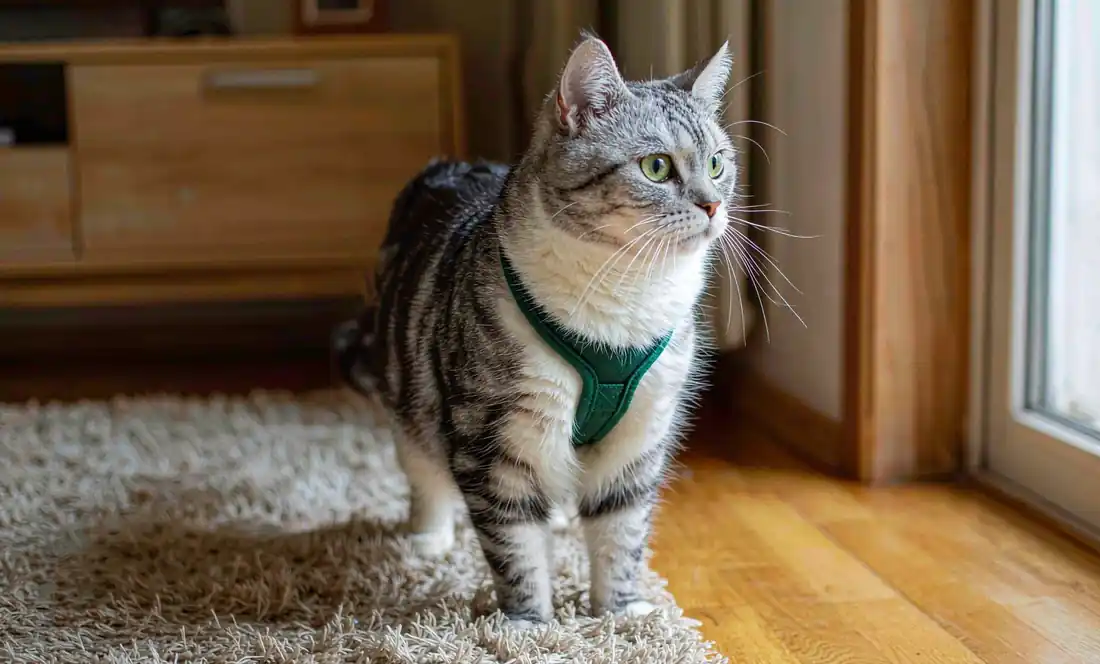
Backward escape has two accomplices worth naming, because both are design failures rather than cat failures. The first is a gap between the neck strap and the chest strap — any slack at the shoulder blades becomes an exit hole. The second is a single contact point: gear that attaches at the neck only rotates and slips when the cat twists. A harness that closes both contact points snugly and keeps its leash ring between the shoulder blades removes both escape routes at once.
Escape-proof harness designs: H-style, vest and jacket
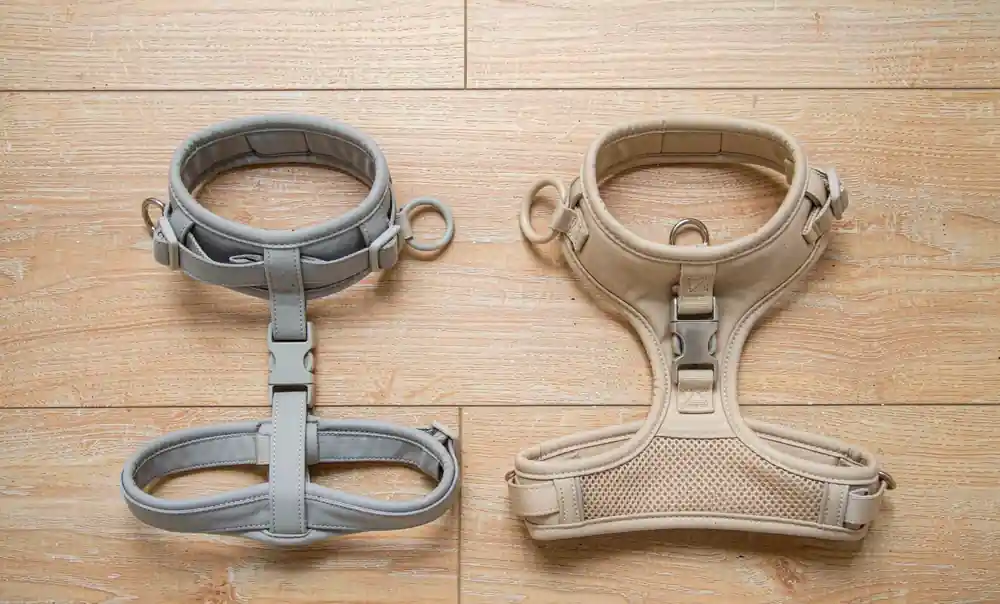
Three families dominate the shelf, and each solves the backing-out problem differently. Knowing which one you are quoting matters more than which one you personally prefer — they serve different cats and different price points.
| Style | How it holds | Adjustment points | Best suited to |
|---|---|---|---|
| H-style | Two straps connected over the shoulders and under the belly | Neck plus girth, usually 3–4 sliders | Everyday walks, warm climates, low-cost ranges |
| Vest | Wraps chest and torso in one soft panel | Neck plus girth with wide contact surfaces | Startled easily or slender, escape-driven cats |
| Jacket | Full torso coverage with buckled closure | Multiple buckles plus strap sliders | Outdoor adventures, cool weather, premium lines |
The H-style is the entry point: light, breathable, quick to put on, and easy to grade across sizes for production. Its weakness is that a poorly adjusted H-style leaves the classic shoulder gap, so quality control matters more than usual. Vest designs close that gap with fabric instead of straps — the wide, soft contact surfaces spread pressure and give a backing cat nothing to slide against, which is why behavior-focused retailers push them for nervous cats. Jacket styles add coverage and buckles, trading fiddliness for maximum containment, and they price accordingly.
None of the three is escape-proof by design alone. What makes an escape-proof harness real is the combination: a style that closes both contact points, an adjustment range that reaches snug on the cat actually wearing it, and an owner who runs the fit checks below before every outing.
Escape-proof harness specs: the details that decide performance
Two harness designs can look identical in a listing photo and behave completely differently on a cat. The difference lives in a handful of specifications, and each one can be written into a purchase order as a requirement rather than a hope.
The leash ring position. A ring between the shoulder blades pulls pressure along the contact points where the harness holds best; a ring on the neck strap pulls the whole design forward and rotates under load, opening the shoulder gap. Ask where the ring sits on every style you quote.
Closure hardware. A side-release buckle with positive engagement holds adjustment through a startle; a friction-only slider drifts. Metal or reinforced polymer hardware at the girth point is the load path that matters most — a backing cat pushes there first, and a harness that gives way there has failed before the leash comes into play.
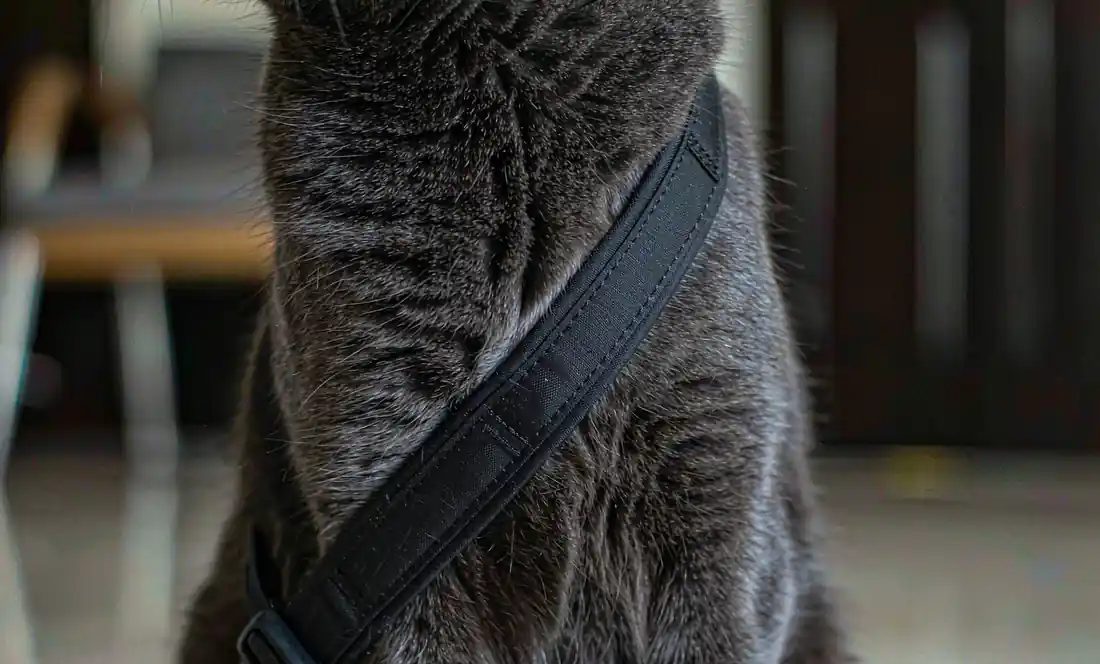
Strap geometry. Wide, softly edged straps distribute pressure across the neck and chest; narrow straps with raw edges cut in and teach the cat that the harness hurts, which surfaces later as behavior a buyer will blame on the product. Padded edges on the chest panel are worth the unit cost on vest and jacket styles.
Breathability and weight. Mesh panels on vest designs keep a walking cat cool, and a total weight under about one hundred grams keeps the gear from changing a cat’s gait. A cat that walks differently is a cat working out how to leave the harness behind.
Visibility. Reflective stitching or trim turns an evening walk into a visible one, and it costs a fraction of what a reflective add-on sells for. For a range built around outdoor use, it is a spec worth standardizing rather than offering as an upsell.
Each of these is verifiable on a sample in minutes, which is the standard to hold: a supplier who can demonstrate ring position, buckle engagement and strap width on request is a supplier whose escape-proof claim means something.
Fit comes first: the two-finger rule and three measurements
Fit is measurable, which is exactly why it belongs in your product copy and your quality checks. Three numbers define it, and all three should appear on the packaging in a size table.
- Neck circumference — measured at the base of the neck where the collar would sit, not halfway up. The neck strap should close with a two-finger allowance: two fingers slide under the strap with light resistance, and a third cannot.
- Chest girth — the widest point behind the front legs. This is the measurement that decides escape resistance, because it is the contact point a backing cat pushes against. Same two-finger rule applies.
- Weight band — useful as a starting bracket only. Two cats of identical weight can differ by centimeters of girth, so packaging should present weight as a hint and the two measurements as the rule.
Webbing width is the fourth spec that rarely makes listings but decides comfort. Cat-rated webbing sits in the ten-to-fifteen-millimeter band: narrow enough to flex with a small body, wide enough not to cut under load. Hardware scales with it — a buckled closure with a metal or reinforced slider holds adjustment far better than a friction-only slider that drifts loose over weeks of wear, and a harness that drifts loose is an escape in slow motion.
The escape test every buyer should run
A claim is only as good as the test behind it, and the test takes ninety seconds. Retail buyers can run it on any sample; brands can standardize it as an inbound QC step.
The backward pull. With the harness fitted indoors, apply firm but gentle steady pressure backward at the leash ring — the same direction a startled cat escapes. The neck and chest straps should tighten into the contact points and hold. Any visible gap opening at the shoulder blades is a fail.
The two-finger check at both contact points. Two fingers under the neck strap, two under the chest strap, both with light resistance. If only the neck is snug and the chest is loose, the cat has an exit and does not yet know it. Adjust and repeat.
The rotation check. Grip the harness at the shoulders and try to rotate it around the cat’s body. Slight drift is normal; a harness that swings to the side has too much slack somewhere, and the slack will find the cat’s shoulders during the first startle.
Run all three after any adjustment, because the failure mode is almost always interaction between the sliders — tightening one loosens the other.
Indoor acclimation: the behavioral half of escape prevention
Hardware is half the equation; the other half is a cat that tolerates the harness at all. A panicked cat tests every millimeter of slack, so the training plan belongs in your packaging copy next to the size table — it is a selling asset, not filler.
VCA’s training sequence breaks into five steps, and the first three happen entirely indoors: let the cat investigate the harness, offer treats while wearing it — a calming pheromone spritz helps nervous cats form the association — then attach the leash indoors and follow the cat around the house so it learns the weight. Only after that comes gentle leading, never dragging, and a first outdoor session kept to the yard. VCA’s enrichment guidance adds the boundary most buyers miss: do not take a cat outdoors on the harness until it is completely comfortable walking indoors on leash first.
Treats are not the only currency. Short wand-toy bursts between harness sessions keep the association positive, and International Cat Care’s play guidance makes the case for one-to-two-minute bursts over long sessions — cats are sprinters, and a tired, satisfied cat tolerates handling far better than a bored one. VCA’s own exercise guidance lists harness walking among the indoor-to-outdoor activities worth training gradually for exactly this reason: the gear is the tool, and daily short play is what makes the cat willing to wear it.
Leash choice matters more than most listings admit. A lightweight leash in the four-to-six-foot band is the veterinary recommendation, and retractable or long lines are explicitly discouraged — a cat on a long line can reach a tree or a fence before an owner reacts, and a length of line converts a startle into a fall. This is the kind of guidance worth printing on an insert card, because it protects the customer’s first experience with your product.
Outdoor rules that keep the fit honest
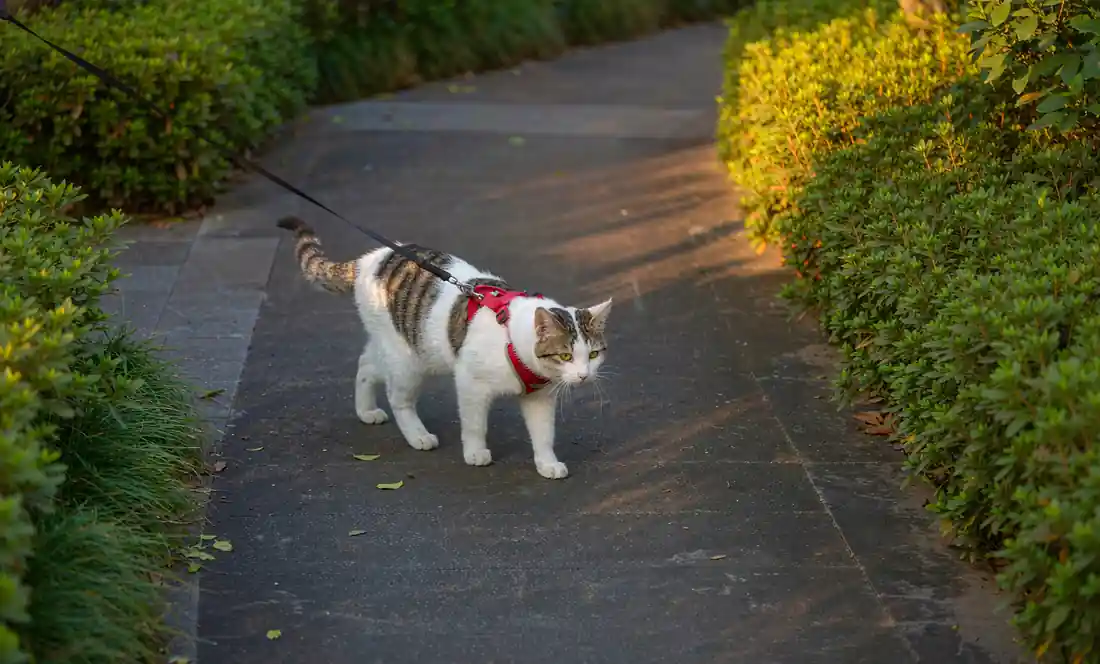
A snug fit on the doorstep can still fail outdoors if the outing itself is run badly, so the safety rules deserve the same shelf presence as the fit instructions.
Identification comes first. VCA recommends ID and microchip status be current before any outdoor walk, and parasite prevention and vaccination updated alongside — outdoor time measurably raises flea, tick and parasite exposure. At home, a breakaway collar carries the ID while the walking gear stays on its hook; the two products complement rather than replace each other, which is exactly how we merchandise our cat collar range against our walking gear.
Supervision is the second rule. Off-leash dogs end walks: the standard guidance is to pick the cat up immediately and change route. A session that turns fearful ends early — carrying the cat home is always cheaper than a lost-cat poster. None of this overpromises: even a correctly fitted harness does not make a cat outdoor-safe on its own, and copy that says so will out-convert copy that implies it.
Where the SKU sits in a cat accessories range
A cat harness earns its slot by pairing, and the pairing logic is worth explaining to retail buyers because it lifts the whole category rather than one SKU.
The natural basket is a walking kit: one harness, a lightweight leash, and a home ID collar from the breakaway guide we published earlier. Retailers who merchandise the three together convert better than retailers who list the harness cold, because the buyer’s first question — “is this safe for my cat?” — is answered by the education printed next to the product. Stock items in core colors ship in three to seven days from our warehouse floor; custom colors and logo runs at seven to thirty days after sample approval, which matches the seasonal restock rhythm of the category.
Sizing is where cat walking gear differs most from the dog equivalent. Cat size curves run tighter, and the top of the range still ends well below medium-dog territory — which is why our Maine Coon sizing guide treats the breed as the ceiling case for cat gear and still grades it within a cat curve. A range that copies a small-dog curve will overbuild the large sizes and underbuild the adjustability the small ones need.
Sourcing checklist: 7 things to confirm before ordering
Everything above collapses into seven questions, and a supplier who volunteers most of them unprompted is telling you something about their QC culture.
- Closure and hardware. Buckled closures with positive locks, sliders that hold adjustment under load, and a leash ring positioned between the shoulder blades — not on the neck strap.
- Adjustment range per size. Ask for the actual neck and girth span each size covers, not the weight bracket. The spans, stacked, should leave no gap a kitten or a chunky adult falls into.
- Webbing and stitching spec. Cat-rated width in the ten-to-fifteen-millimeter band, bar-tacked load points, and hardware that survives a backward pull without deforming.
- Escape test evidence. The backward-pull and two-finger checks run on the production harness, documented. “Escape-proof” as a bare claim is marketing; the same claim with a test record is a specification.
- Materials and contact safety. Breathable mesh or padded panels for vest and jacket styles, dyes specified for skin contact, and a material declaration in writing.
- Size curve and mixed batches. Kitten through large-adult coverage with mixed sizes in one order — our minimums flex per variant, and stock configurations ship in three to seven days while custom builds run seven to thirty days after sample approval. Industry practice often forces full-carton-per-size ordering; our own terms are built around the mixed split instead.
- Packaging that carries the education. Size table with the two measurements first, weight as a hint, the five-step indoor plan and the supervision rules printed on an insert. Packaging that teaches fit sells the next unit of the range, not just this one.
A cat that walks on gear is a customer who buys a leash, an ID tag, and a second color within a year. The walking kit is a retention product as much as an accessory — which is why the fit education belongs in the packaging and not just on the listing page.
Frequently asked questions
What actually makes a harness escape-proof for a cat?
Two snug contact points at the neck and chest with no gap at the shoulder blades, verified by a backward-pull test indoors. Style contributes — vest and jacket designs resist backing out better than a loose H-style — but fit does the decisive work, and the two-finger rule at both contact points is the check that matters.
Can I walk my cat on a collar and leash instead?
No. Collars sit on the thinnest part of the anatomy and slip over the head the moment a cat backs up, which is why veterinary guidance recommends a harness specifically sized so the cat cannot wiggle out. Keep the collar for ID at home and use walking gear for outings.
Which style should a first-time range stock?
An H-style in a three-size curve is the volume anchor: cheapest to produce, easiest to grade, and the simplest to explain on packaging. Add a vest for the nervous-cat segment once the H-style sells through. A jacket style is a premium seasonal addition, not a starting point.
How do I know the fit is right before going outside?
Run three checks indoors: two fingers under the neck strap with light resistance, two under the chest strap, and a firm gentle backward pull at the leash ring that opens no gap. Only when the cat walks comfortably indoors on leash should the first outing happen — and keep it to the yard.
Are retractable leashes suitable for cats?
They are not recommended. A cat on a long or retractable line can reach a tree, a fence or a road before an owner can react, and the line’s length converts a startle into a fall. A lightweight four-to-six-foot leash is the guidance printed by veterinary behavior resources, and it is what our own inserts say.
What safety items belong with a walking gear purchase?
Current ID and microchip registration, up-to-date parasite prevention and vaccinations, and a plan for off-leash dogs — pick the cat up and change route. A breakaway collar at home carrying the ID tag completes the setup; walking gear and the home collar do different jobs.
At what age can a kitten start harness training?
There is no minimum age in the veterinary guidance — the constraint is patience, not weeks. Start a kitten with short, treat-heavy indoor sessions, and expect a young cat to accept the harness faster than most adults because the introduction is its first impression rather than a habit to break. Keep the sessions short, end them before the kitten objects, and let the fit checks mature with the growth: a kitten-sized adjustment range gets outgrown quickly, and a harness that fits at four months will be loose by six.
How long does harness training take before the first walk?
Most cats move through the five indoor steps in one to three weeks of daily short sessions, but the honest answer is a range, not a promise: a confident young cat may accept the gear in days, while a reserved adult may need a month of treats before the leash clips on. The milestone that matters is indoor comfort, not the calendar — the first outdoor session waits until the cat walks on leash indoors without freezing, dragging or refusing.
Related reading
the cat harness range, the cat products hub, the RFQ guide for pet products and the 12-week private label launch guide