
Kitten teething is the two-to-three-month window when a young cat replaces 26 baby teeth with 30 permanent ones — roughly from ten weeks of age to six or seven months. Almost every kitten in that window wants to chew, the chewables on offer range from genuinely safe to tooth-breaking, and the difference is measurable with one fingernail. This guide lays out the six stages on the timeline, the signs that are normal versus the ones that need a vet, the toy materials that survive scrutiny, and the seven specification checks worth running before stocking a chew range.
How many teeth a kitten has — and why the count matters
The whole category hangs on two numbers: 26 and 30. VCA Animal Hospitals’ dental overview counts 26 deciduous teeth in a young cat — the “milk teeth” — and 30 permanent teeth in the adult set. The baby teeth erupt starting around three weeks of age and finish by six to eight weeks, which means the full baby set is already in place before most kittens leave their mother.
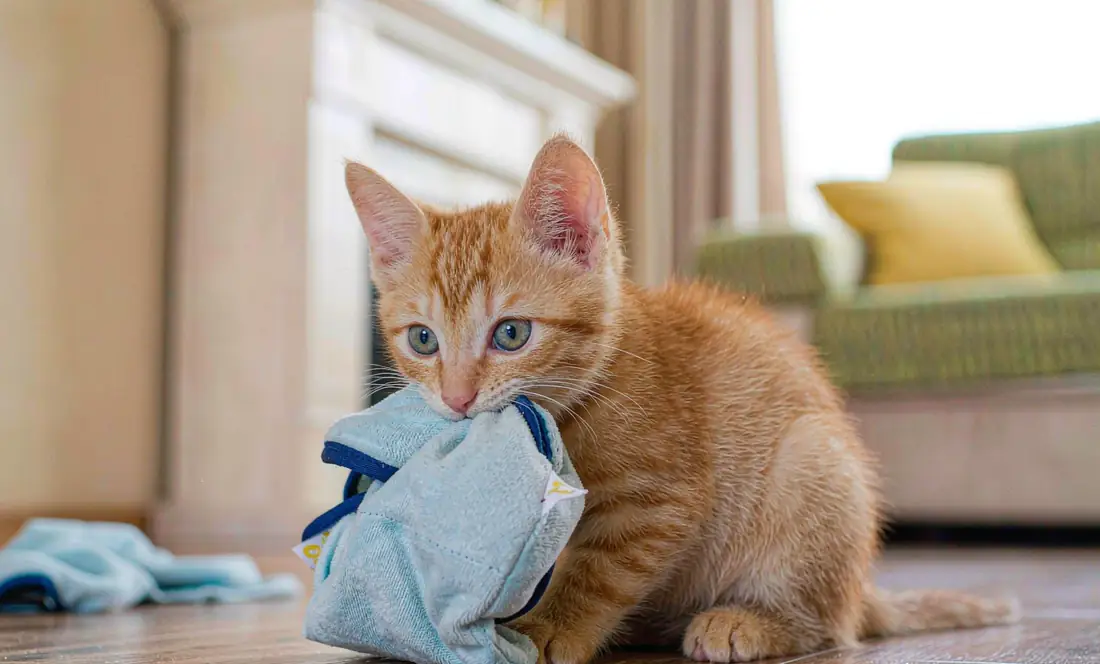
The adult count splits unevenly across the jaw: 16 teeth up top and 14 below, per VCA’s tooth-count page — the adult set adds four molars the baby set never had. The four types do different jobs, and the jobs explain the chewing behavior buyers see. Incisors groom and nip, canines grasp, premolars crunch and shear, molars grind at the very back. A chewing kitten is exercising all four, which is why a safe chew range needs to offer more than one texture.
The count is also the category’s early-warning system. When a kitten’s two teeth share one socket, the baby tooth never fell out — the retained tooth that vets extract early. That failure mode starts a chain from crowding to tartar to gum disease, and it is the reason packaging should point owners at weekly mouth checks, not just at toys.
The kitten teething timeline, stage by stage
Six stages cover the whole process, and they compress into a remarkably short window — VCA describes two to three months of active teething between roughly ten weeks and six months of age. The stage table below is the version worth reprinting on packaging and buyer-facing pages, with every number sourced and every boundary stated as a range.
| Stage | Age band | What happens |
|---|---|---|
| 1 | Birth to ~3 weeks | Toothless gums; nothing has erupted yet |
| 2 | ~3 to 6 weeks | Baby incisors and canines come through |
| 3 | ~5 to 8 weeks | Baby premolars finish the set of 26 |
| 4 | ~10 to 14 weeks | First adult incisors replace baby incisors |
| 5 | ~4 to 6 months | Adult canines, premolars and molars erupt; peak chewing |
| 6 | ~6 to 7 months | All 30 permanent teeth in place; teething over |
Two practical readings fall out of that table. Stage 5 is where teething discomfort peaks and where demand for safe chewables peaks with it, so the chew range should be fully merchandised by the time a buyer’s litters reach four months — a chew product launched in month six misses most of the window it exists for. And stage 6 sets the end of the age-grading story: chewing that persists well past seven months is habit, not teething, and packaging should say so rather than implying the product serves adult dental needs it does not have.
Breed size barely moves the timeline — the stages hold across small and large breeds within the stated bands, unlike skeletal growth, which varies enormously. That makes a single age-graded label defensible in a way a size-graded label for apparel is not. A kitten that drops kibble for a day or two mid-window is also normal teething, not a food complaint worth a return.
Normal teething signs versus vet flags
Signs sorting is where this category earns trust, because owners seeing blood for the first time tend to blame the toy instead of the timeline. Sorting the two lists clearly — on packaging, on listings, in a buyer’s FAQ — turns a worried return into a loyal customer.
Normal during the window. Drooling beyond the everyday amount, mild “kitten breath” odor that lasts exactly as long as teething does, a speck of red on a chew toy where a tooth let go, slightly slower or messier eating, and short spells of irritability with a tender mouth. Swallowed baby teeth sound alarming and are not: kittens swallow shed teeth constantly and harmlessly, and most owners never find a single one on the floor.
Vet flags. A double tooth in one socket — the retained baby tooth VCA documents most often on the upper canines — needs extraction early, and VCA explicitly advises against waiting for the spay or neuter appointment, because an early extraction lets the adult tooth settle into place. Bleeding that keeps recurring, refusal to eat, a visibly broken tooth, or foul breath that outlasts the window all warrant an examination. The packaging line that covers both lists is one sentence: weekly mouth checks until about seven to eight months, two teeth in one spot means a vet visit now.
Safe chew choices: the fingernail test and the freezer
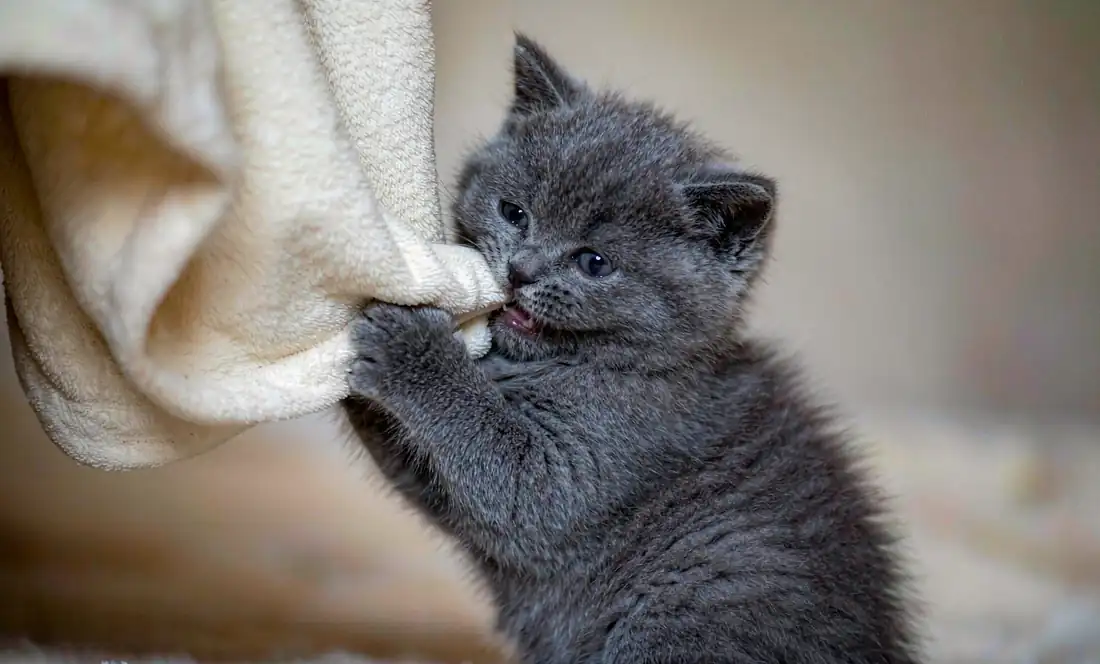
Chew safety has one governing principle, stated plainly by VCA’s pediatric team: avoid anything extremely hard, because a young tooth under full bite force on a rigid surface can fracture. VCA’s teething page turns that into a test any buyer or owner can run — press a fingernail into the surface, and if it will not indent at all, it is too hard for a teething mouth. Nylon bones fail that test; soft, mouse-shaped toys pass it.
The freezer is the other half of the answer, borrowed from human baby care: chilled toys and treats reduce the inflammation and soreness that drive the chewing in the first place. A damp washcloth soaked in broth and frozen, a chilled silicone chew, a frozen treat mat — all serve the same purpose, and all convert a destructive chewer into a settled one. The redirection rule belongs in the same paragraph: when a kitten chews something off-limits, swap in an acceptable chew and reward the swap, and never allow hands or feet as chew targets, however cute the habit looks at twelve weeks.
Three product-side rules complete the safety picture, all of them checkable before an order leaves the factory:
- No small detachable parts. Toys small enough to swallow cause intestinal blockages — the risk veterinary enrichment guidance flags for any play object, and doubly serious for a mouthing kitten.
- String and wand play is supervised play only. Wand toys go out of reach after the session, per International Cat Care’s play guidance; ingested string is a surgical emergency, not a wardrobe malfunction.
- Inspect and retire. Any chew that starts breaking apart, loses pieces or frays gets discarded. Supervised chewing is part of the product, not fine print.
Design specifics: what a teething-safe chew looks like
Materials are the first filter, but shape and construction decide whether a chew survives contact with an actual kitten. Four construction details separate a teething-safe design from a generic toy with a kitten label slapped on it, and every one of them can be verified on a sample.
Texture without ridges that snag. A teething chew should offer gentle ribs or nubs that massage sore gums — texture is the point — but ridges deep enough to catch a baby canine put shear load on a tooth that is mid-eruption. Shallow, rounded patterning gives the gum relief without the snag.
Size graded to the mouth. The whole chew must be larger than the mouth can close around — the blockage rule — while light enough for a four-month-old to carry. That combination, at kitten scale, is exactly why a scaled-down dog chew fails the brief: it is either too dense or too heavy.
One-piece construction. Molded one-piece silicone chews have no seam to gnaw open; sewn fabric chews need double stitching, an internal fill that is safe if a seam does open, and no glued eyes or noses. A construction audit belongs in the sample review, not on the spec sheet alone.
A shape that works chilled. The freezer half of the routine needs geometry: a chew that holds cold through a session, that a damp paw can push across a floor, and that dries fast after thawing. Thin profiles chill fast and warm fast; a denser core holds the cold longer through the ten-to-fifteen minutes a sore-mouthed kitten stays engaged.
Put together, the four details read as one packaging sentence worth printing: designed for erupting teeth — soft enough to indent, big enough to be swallow-proof, built in one piece, and ready for the freezer. A chew that satisfies all four is a chew a retailer can sell beside the stage table without a single caveat.
What goes into a wholesale kitten chew range
The chew range is a merchandising story more than a single SKU, and the strongest ranges are built around the three formats above rather than five variants of one shape.
A starter set covers three jobs: a soft silicone chew that passes the fingernail test and survives the freezer, a fabric or plush chew for carrying and comfort, and a frozen-format piece — a chilled mat or a broth-ready toy — for the sore-gums peak of stage 5. Together they cover the timeline from stage 2 through stage 6, which is the age-grading pitch a buyer hears in one sentence: the range serves the whole window, not a week of it. Our own kitten chew assortment is built exactly on that three-job split, and it merchandises naturally beside the broader cat toy range rather than duplicating it.
Crossover sales are the quiet upside. A chilled chew format is the same mechanic as the frozen lick-mat session we covered in our lick mat guide — texture plus cold plus food motivation, at cat scale — so a retailer already selling frozen feeding accessories adds the chew range with no new customer education. Tooling overlaps too: food-contact silicone, soft fabrics and no small parts means the chew range borrows the same compliance file as the rest of a silicone line, which keeps the sampling cycle short.
Margin behaves the way accessory margins should: light to ship, no sizing returns, and a repeat purchase clock set by wear rather than by season. The one structural risk is safety copy — a range that skips the supervision and inspection warnings is buying a return rate and worse, so the warnings are printed on our packaging by default.
Display completes the range. A bin of loose chews reads as commodity; a pegged card that shows the stage table, the fingernail test and the freezer trick reads as education, and education sells the second format to a customer who came for the first. Our own retail cards carry the six-stage table on one side and the safety lines on the other — the same insert our packaging ships with — because a buyer who understands the teething timeline restocks for the peak rather than the season.
Sourcing checklist: 7 things to confirm before ordering
Seven checks separate a sellable chew range from a liability, and the same supplier conversation covers all of them.
- Material and hardness. Food-contact silicone or soft TPR that passes the fingernail-indent test on the production sample — not just the prototype. Hardness drift between batches is real.
- Certificate against the batch. LFGB or FDA food-contact paperwork covering the actual run. “Food-grade” without the document is a phrase, and kitten mouths make it a consequential one.
- Small-parts audit. Eyes, whiskers, squeakers and fillings photographed and pull-tested against detachment. The blockage risk applies to parts, not just whole toys.
- Freezer and cleaning behavior. Material that flexes at freezer temperatures and cleans under warm water without swelling or odor retention — chilled formats live in both environments weekly.
- Age grading and the six stages. Packaging that maps the product onto the stage table, with the stage 5 peak called out and the seven-month endpoint stated honestly.
- Warnings printed, not omitted. Supervision, inspection and retirement copy, the no-hands rule and the two-teeth vet line on an insert card. Packaging that teaches protects every retailer downstream.
- Quantity split and mixed batches. Three formats, core colors, mixed in one order with low per-variant minimums — stock configurations ship in three to seven days and custom colors in seven to thirty days after sample approval. That mixed split is our own term; full-carton-per-SKU ordering remains common industry practice and quietly kills small-brand assortments.
Kitten chewables look like the simplest products in the cat aisle, and that simplicity is why the seven checks all carry weight: with so little to the product, each failure surfaces directly in a customer’s hands or a kitten’s mouth.
Frequently asked questions
When does kitten teething start and end?
The active window runs from about ten weeks of age, when adult incisors begin replacing baby ones, to six or seven months, when all 30 permanent teeth are in place — VCA describes two to three months of active teething inside that span. The baby set of 26 is fully erupted by six to eight weeks, before most kittens leave their mother.
Is it dangerous if a kitten swallows a baby tooth?
No. Kittens swallow shed teeth constantly, usually while eating, and it is harmless — most owners never find a single tooth on the floor. A speck of blood on a chew toy where a tooth let go is equally unremarkable; recurring bleeding is not, and that distinction belongs on packaging.
What chew toys are actually safe during teething?
Soft materials that pass the fingernail-indent test — food-contact silicone, soft rubber, plush fabric — and nothing extremely hard, because rigid surfaces like nylon can fracture young teeth. Freezer-chilled versions reduce the soreness that drives chewing. Every chew gets supervision and retirement when it frays or loses parts.
Why are two teeth in one socket an emergency?
It means the baby tooth never fell out — a retained tooth — and it is most common on the upper canines. The crowding forces the adult tooth in at an angle, traps debris and sets up tartar and gum disease. Early extraction lets the adult tooth settle correctly, which is why the advice is a prompt vet visit rather than waiting for the next routine appointment.
Do teething kittens need different products from adult cats?
Yes, on hardness above all. An adult can handle firmer materials; a mouth carrying erupting teeth cannot, which is why the fingernail test defines the chew range rather than durability ratings. Age grading on packaging should end honestly at about seven months — chewing after that is habit, and pretending otherwise oversells the product.
How does a chew range fit a store that already stocks cat toys?
As a completes-the-basket SKU rather than a duplicate. Soft chews, plush carries and frozen formats serve a developmental window adult toys do not, and the frozen format reuses the same mechanic and customer education as chilled feeding mats — so the range merchandises beside the existing assortment with no new shelf story to write.
What can go inside a frozen chew?
Plain, unsalted broth, tuna juice diluted with water, or a spoon of wet food frozen into the toy — portions small enough to finish in one supervised session. Skip seasoned or salty broths and anything with onion or garlic in the ingredients list, and treat frozen formats as a session, not a snack bar: once the toy thaws past the chilled stage, the teething relief is gone and the chew goes back in the wash.

Related reading
the cat products hub, the RFQ guide for pet products, OEM versus ODM and the slow feeder bowl guide